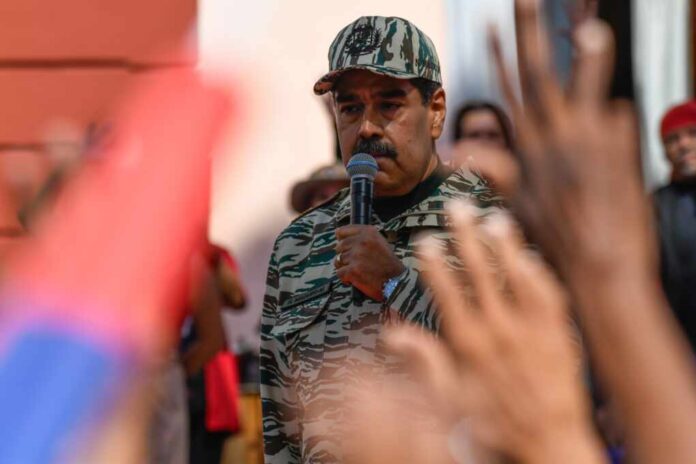
The unsealing of an indictment against Venezuelan President Nicolás Maduro and his wife following a U.S. military strike raises significant constitutional and international law questions.
Story Overview
- The Trump administration conducted a military strike on Caracas, leading to the capture of Nicolás Maduro and his wife.
- The indictment issued by Attorney General Pam Bondi charges Maduro with narco-terrorism and drug trafficking.
- This legal action raises questions about executive power due to the lack of congressional authorization.
- The indictment adds Maduro’s wife, Cilia Flores, as a defendant for the first time.
Military Strike and Indictment Unveiling
On January 3, 2026, the Trump administration announced a military strike on Caracas, resulting in the reported capture of Venezuelan President Nicolás Maduro and his wife, Cilia Flores. Attorney General Pam Bondi immediately unsealed an indictment charging them with narco-terrorism and drug trafficking conspiracies. This move aims to hold Venezuelan leadership accountable for their alleged role in importing tons of cocaine into the United States over a 25-year span.
The indictment, which was coordinated across multiple U.S. jurisdictions, adds Maduro’s wife as a defendant, marking a significant escalation from the initial charges filed in 2020. This action has been framed by U.S. officials as a necessary step in combating international drug trafficking that uses narcotics as a weapon against the United States.
Early this morning, the Trump administration carried out military strikes in Venezuela and captured dictator Nicolás Maduro and his wife. @IamGermania explains why Venezuelans around the world are celebrating and what must come next. pic.twitter.com/JQ9pmqp9up
— The Free Press (@TheFP) January 3, 2026
Legal and Constitutional Implications
The military strike in Venezuela has sparked debate over executive power, as it was conducted without congressional authorization. Such unilateral action raises constitutional concerns, especially regarding the separation of powers and the precedent it sets for future military interventions. The Trump administration justifies the operation on the basis of the legal indictments, though this rationale has yet to undergo judicial scrutiny or legislative review.
In terms of legal proceedings, Maduro and Flores are expected to face trial in the Southern District of New York. The outcome could lead to significant disruptions in Venezuelan cocaine trafficking networks, potentially impacting drug supply chains to the United States and altering regional geopolitical dynamics.
International and Regional Impact
The capture of Maduro and Flores creates a potential power vacuum in Venezuela, raising questions about the country’s political future and the stability of its government. The international community is closely watching the situation, as the U.S. military action without international consensus could influence norms around sovereignty and intervention.
This development also underscores the U.S. focus on Venezuelan drug trafficking networks, particularly following the designation of the Cartel de los Soles as a foreign terrorist organization in November 2025. This designation and subsequent actions are likely to affect international cooperation on narcotics enforcement and financial sanctions regimes.
https://youtu.be/xREv1PVdtJo?si=-7pJs0uBxYrXURib
Sources:
Politico: Maduro Drug Trafficking Charges
LAist/NPR: Charges Against Nicolás Maduro
CBS News: Venezuela U.S. Military Strikes
VPM/NPR: Nicolás Maduro Charges