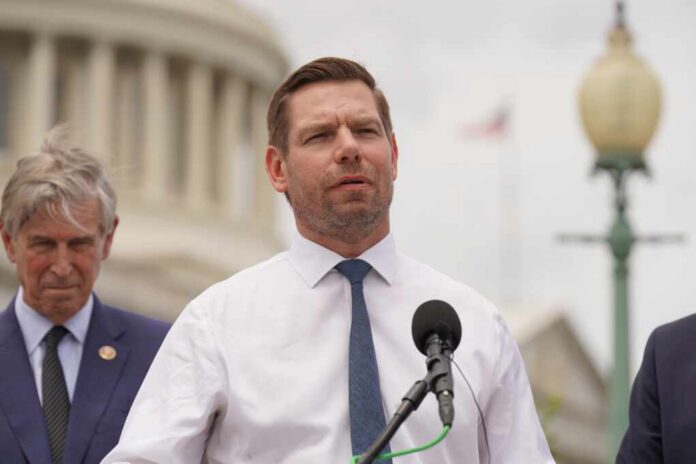
California’s governor race just took a darker turn: Rep. Eric Swalwell says he’d use “emergency powers” to blacklist former ICE agents from state jobs—turning political vendettas into government hiring policy.
Story Snapshot
- Eric Swalwell says that, if elected California governor, he would make former ICE agents “un-hirable” for any California state government positions using emergency powers.
- The pledge lands amid renewed federal-state friction over immigration enforcement with President Trump back in office and California Democrats signaling resistance.
- Swalwell’s stance clashes with his June 2025 vote backing a House resolution thanking ICE, which rivals cite as evidence of political flip-flopping.
- California’s Police Chiefs Association endorsed both Swalwell and Republican candidate Chad Bianco, highlighting how public safety politics are cutting across party lines.
Swalwell’s “Un-Hirable” Pledge Targets Federal Immigration Enforcement
U.S. Rep. Eric Swalwell, now running in the 2026 open race for California governor, says he would bar former Immigration and Customs Enforcement agents from being hired into any California state government roles. Reporting on his campaign comments describes the plan as an “emergency powers” move aimed at opposing federal immigration enforcement. The announcement fits a larger Democratic pattern in California: signaling resistance to Washington whenever immigration enforcement ramps up.
Swalwell’s proposal matters beyond symbolism because it reframes a policy dispute into employment blacklisting. State hiring typically hinges on qualifications, background checks, and job fit—not which federal agency someone previously served. The available reporting does not detail how Swalwell would define “former ICE agent,” what due-process protections would apply, or how broad the ban would be across departments. Those unanswered questions are central for voters weighing constitutional norms and basic fairness.
https://www.youtube.com/watch?v=U5157QMAOec
A Familiar California Playbook: Sanctuary Politics Meets Trump-Era Enforcement
The backdrop is California’s long-running conflict with federal immigration enforcement, intensified by sanctuary-state policies such as SB 54, which limited state cooperation with ICE. That tension never really disappeared; it hardened into a political identity issue inside Democratic primaries. A KQED report from the last major wave of anti-ICE campaigning shows candidates denouncing ICE at public forums and framing resistance as a moral cause, setting the tone for today’s rhetoric.
Immigration politics in California also surged after high-profile enforcement operations. In June 2025, ICE raids in Southern California became a flashpoint, with reports describing chaotic outcomes and political backlash. The same period saw federal force deployments that fueled further anger and distrust. Against that history, Swalwell’s pledge functions as a signal to the party’s activist base: it’s not just about limiting cooperation with ICE, but punishing association with ICE through state employment policy.
The Political Contradiction Rivals Are Seizing: Swalwell’s ICE “Gratitude” Vote
Swalwell’s opponents have a clear opening because his record includes a notable moment that cuts the other way. During the June 2025 enforcement controversy, Swalwell voted for a House resolution “expressing gratitude to ICE for protecting the homeland.” That vote aligned him with Republicans on the measure and against many prominent Democrats. Former Los Angeles Mayor Antonio Villaraigosa has used that contrast to attack Swalwell’s credibility as the governor’s race heats up.
The contradiction is not a minor footnote because it touches the core question: is this a governing plan or a campaign tactic? Supporters can argue a politician can praise lawful enforcement while opposing tactics or leadership decisions; critics can argue that moving from “gratitude” to “un-hirable” is a sharp pivot driven by primary politics. The sources do not provide a detailed explanation from Swalwell reconciling those positions, so voters are left evaluating intent from timing and messaging.
Law Enforcement Endorsements Complicate the Narrative
Adding to the complexity, the California Police Chiefs Association endorsed Swalwell and Republican Chad Bianco, emphasizing public safety experience rather than party loyalty. Association leadership tied the endorsement to qualifications, with Swalwell highlighting his prosecutor background and presenting himself as focused on protecting Californians. That endorsement stands in tension with his promise to blacklist former ICE personnel—people who also worked in law enforcement roles—raising practical questions about recruitment, morale, and consistency.
Swalwell’s campaign message tries to occupy two lanes at once: tough-on-crime credibility paired with a hard anti-ICE posture. That balance may play well in a Democratic primary where “resisting Trump” remains a rallying cry. Yet, for many Californians worried about crime and disorder, punishing federal agents through state hiring could read as ideological overreach rather than governance. The reporting also does not clarify whether the police chiefs weighed in on the ICE-hiring-ban concept specifically.
What This Signals for Federalism, Equal Treatment, and the 2026 Race
The long-term stakes extend beyond one campaign soundbite. If a state can blacklist former federal agents by category, the precedent invites tit-for-tat politics across agencies and across states, converting public employment into a partisan loyalty test. The reporting does not address the legal feasibility of using “emergency powers” for such a ban, and that gap matters. Emergency authorities are typically justified for immediate crises, not broad employment prohibitions.
For conservative readers watching constitutional guardrails, the key issue is process: the government should not punish people for having served in a lawful federal role absent specific, proven misconduct. California voters will ultimately decide whether this is “resistance” they want in Sacramento or a step too far toward politicized governance. Meanwhile, the dual endorsement of Swalwell and Bianco underscores that public safety remains a top issue—one that may not fit neatly into the state’s usual partisan script.
Sources:
California governor candidates denounce ICE at San Francisco forum
California Police Chiefs Back Swalwell and Bianco for Governor