

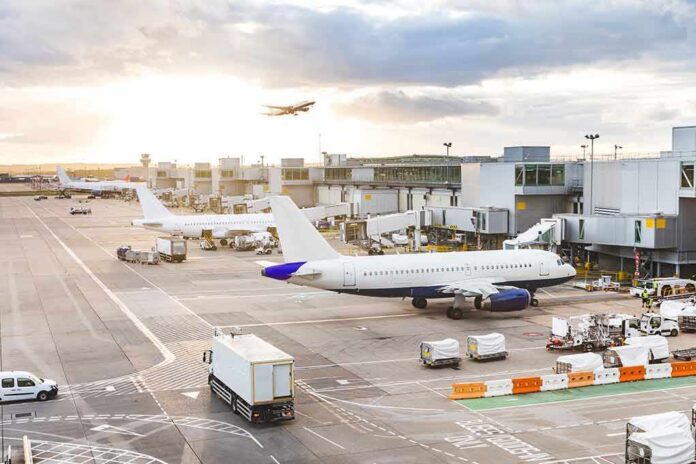
For four tense hours, the nation’s airports went silent as the Federal Aviation Administration halted all departures to fix a communications breakdown across key air traffic control centers.
Story Snapshot
- The Federal Aviation Administration lifted a nationwide ground stop about four hours after it began.
- Officials cited a communications issue affecting Air Route Traffic Control Centers as the cause.
- The order paused all departing flights and managed inbound international flights case by case.
- The action was described as “for reasons of safety” and is a rare national measure.
What Prompted The Stop And How It Ended
On November 13, the Federal Aviation Administration ordered every airport in the United States to hold departures. The agency said a communications issue hit Air Route Traffic Control Centers, which guide planes between cities at higher altitudes. Transportation Secretary Sean Duffy said technicians were investigating, and the agency framed the move as necessary for safety. The Federal Aviation Administration later lifted the order about four hours after it began and allowed departures to resume.
The Federal Aviation Administration’s command center advisory told airports to keep all departures on the ground until further notice, with inbound international flights handled case by case. Networks and local outlets reported widespread delays and the risk of rolling cancellations into the evening. Officials did not cite a specific failed device or line. They said the exact technical cause was still being reviewed at the time of the lift order. Safety remained the stated reason for the nationwide scope.
Why This Move Was So Unusual
A nationwide ground stop is rare. The Government Accountability Office has noted that the last time the nation saw a similar halt was January 11, 2023, when the Notice to Air Missions system failed and departures paused for under two hours. That 2023 event was the first nationwide stop since September 11, 2001, making this latest action part of a very short list. That low frequency shows the threshold the Federal Aviation Administration uses when basic systems become unreliable.
In 2023, the Federal Aviation Administration later said contractors unintentionally deleted files while working on a database sync, leading to the Notice to Air Missions outage. After that, the Government Accountability Office pressed the agency to update aging systems and improve planning for modernization. Lawmakers and watchdogs have warned that old systems, complex vendor networks, and tight budgets raise risk. Friday’s order fits the pattern: stop traffic first, then verify that communications are stable before resuming.
How The Outage Ripples Through Daily Life
A four-hour nationwide pause does not end when planes start moving. Airlines must reassign crews, reset maintenance windows, and juggle gate space. Passengers often face missed connections and next-day rollovers. The advisory’s language signaled a scaled restart to prevent midair confusion while communications were checked. Airports in major hubs saw the biggest lines. Smaller airports also felt the hit as planes and crews ended up out of place, creating a second wave of delays after the stop lifted.
Both conservatives and liberals can read the same lesson here. The country depends on complex, aging systems that fail rarely but hit millions when they do. People want safe skies and honest answers. The Federal Aviation Administration said this was a communications problem and took the safest path by stopping departures. The specific failure was not named when the order lifted, which is common in the first hours of recovery. A clear, public root-cause report will matter next.
What To Watch Next
Watch for a formal incident report that lists which centers had issues, what equipment or links failed, and how redundancy performed. The Government Accountability Office has urged the Federal Aviation Administration to modernize air traffic systems and improve cost and schedule planning to cut risk. Congress may seek timelines and funding details. Airlines will publish recovery schedules, but some delays and cancellations can linger for a day or more after a nationwide stop.
Sources:
pjmedia.com, cnbc.com, 6abc.com, nbcnewyork.com, cbsnews.com, houstonpublicmedia.org, nbc26.com, gao.gov, files.gao.gov