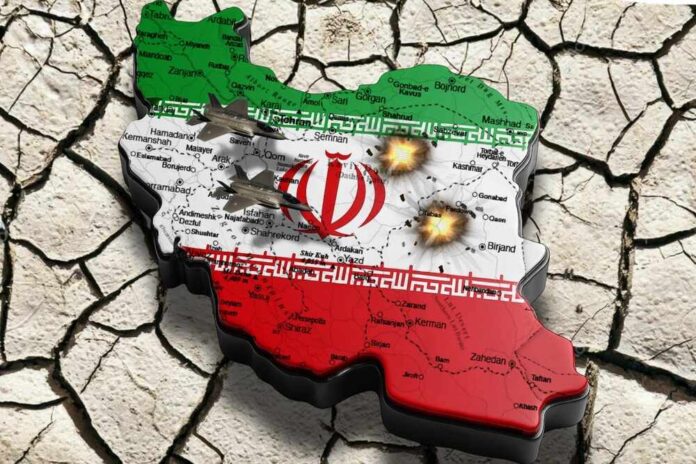
Iran’s military infrastructure just suffered a devastating blow as combined US-Israeli forces penetrated deep into Tehran’s heartland, systematically dismantling the regime’s retaliatory capabilities in unprecedented direct airstrikes that mark a dramatic escalation in Middle Eastern conflict.
Story Snapshot
- Combined US-Israeli forces destroyed approximately 50% of Iran’s missile launchers and struck critical military targets across Tehran, Najafabad, Yazd, and Khorgu
- Israeli Defense Minister announced first-ever direct IAF strikes over Tehran using advanced munitions, marking a historic shift from standoff bombing to over-target operations
- Three senior Iranian Intelligence Ministry officials were eliminated in targeted strikes, severely degrading Iran’s internal security apparatus
- Disputed satellite imagery shows damage to Natanz Nuclear Facility buildings, though IAEA reports no confirmed nuclear infrastructure damage
- Iran retaliated with missile waves and reportedly struck UAE’s Jebel Ali power station, disrupting 2,060 MW of energy capacity
Historic Strike Deep Into Iranian Territory
Israeli Defense Minister Israel Katz announced that IAF aircraft conducted direct bombing runs over Tehran for the first time in history, deploying “stand-in” munitions against high-value military targets. The combined US-Israeli operation represents a fundamental tactical shift from previous standoff strikes to penetrating Iranian airspace directly. Satellite imagery confirmed extensive damage to the missile base near Najafabad in Esfahan Province, while Yazd Missile Base and Khorgu Missile Base also sustained significant hits. This escalation follows the June 2025 Israel-Iran War, when IDF forces initially targeted Iranian ballistic missile capabilities with more limited engagement.
Iranian Command Structure Crippled by Leadership Losses
The strikes eliminated three critical Iranian Intelligence Ministry officials: Deputy for Israel Affairs Yahya Hamidi, Espionage head Jalal Pour Hossein, and Internal Security Deputy Seyyed Yahya Hosseini Panjaki. These targeted killings severely compromise Iran’s ability to coordinate intelligence operations and internal security responses. Additionally, approximately half of Iran’s missile launcher fleet was destroyed during the initial Iranian missile wave on March 1, with analysts noting that security personnel appeared to abandon launchers immediately after firing. This pattern suggests Iran’s retaliatory infrastructure has been fundamentally compromised, limiting the regime’s ability to sustain prolonged military operations against Israeli or American interests.
Nuclear Facility Damage Remains Disputed Territory
Satellite imagery captured between March 1-2 shows visible damage to buildings within Iran’s Natanz Nuclear Facility complex, sparking immediate controversy over whether nuclear infrastructure was compromised. Iran’s UN ambassador Reza Najafi and Atomic Energy Organization head Mohammad Eslami both claimed the facility was hit by US-Israeli forces, calling the strikes criminal acts. However, IAEA Director General Rafael Grossi firmly stated on March 2 that his organization detected no indication of nuclear damage. The Institute for Science and International Security corroborated the IAEA assessment, noting that while building damage occurred, no functional nuclear equipment appears compromised. This represents a critical distinction for international observers concerned about nuclear proliferation and contamination risks.
Regional Escalation Threatens Broader Stability
Iran’s retaliatory strike on UAE’s Jebel Ali power and desalination station demonstrates the regime’s willingness to target civilian infrastructure in allied nations, potentially widening the conflict beyond direct combatants. The attack knocked out 2,060 megawatts of power capacity, affecting hundreds of thousands of UAE residents. Over 50 Iranian drones were intercepted targeting Israeli territory, while two separate missile waves on March 1 attempted to overwhelm Israeli defenses. The systematic degradation of Iran’s naval capabilities, air defenses, and command centers by the combined force aims to prevent further escalation by eliminating Tehran’s ability to project power regionally. This approach reflects the Trump administration’s commitment to decisive military action against threats to American allies, contrasting sharply with previous diplomatic approaches that allowed Iran to develop advanced missile capabilities threatening regional stability.
The ongoing operations reveal Iran’s weakened strategic position following years of failed nuclear negotiations and unchecked military buildup. The combined force’s air superiority and precision targeting capabilities have exposed fundamental vulnerabilities in Iran’s defensive posture. Intelligence analysts report that Iranian forces are systematically abandoning missile launcher positions after firing, suggesting collapse of operational discipline. The strikes near Basij paramilitary sites in Tehran civilian areas underscore the challenge of distinguishing military targets embedded within population centers, though Israeli forces maintain they target only legitimate military objectives. As the Trump administration continues supporting Israel’s defensive operations, the regime in Tehran faces mounting pressure with degraded capabilities to threaten American interests or regional allies.
Sources:
Iran Update Morning Special Report: March 2, 2026 – Critical Threats Project
Iran Update Evening Special Report: March 2, 2026 – Institute for the Study of War
2026 Iran–United States crisis – Wikipedia