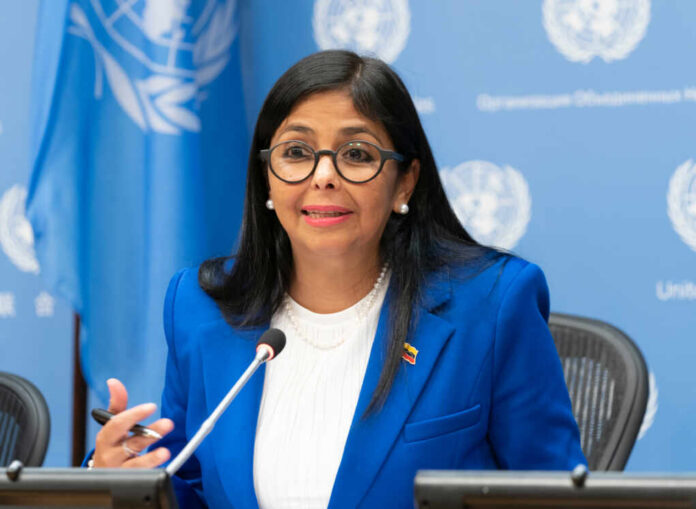
A new chapter in Venezuela’s political saga unfolds as Delcy Rodríguez assumes the presidency following Nicolás Maduro’s dramatic capture by the U.S.
Story Highlights
- Delcy Rodríguez was appointed acting president of Venezuela after the U.S. captured Nicolás Maduro.
- The Supreme Tribunal of Justice swiftly confirms Rodríguez’s presidency to ensure continuity.
- Rodríguez’s appointment marks a pivotal moment in U.S.-Venezuela relations under Trump.
- Potential diplomatic negotiations loom as Venezuela faces internal and external pressures.
Rodríguez’s Rapid Ascent to Power
On January 3, 2026, the U.S. captured Venezuelan President Nicolás Maduro, creating a sudden power vacuum. In response, the Supreme Tribunal of Justice appointed Delcy Rodríguez as the acting president. This swift decision underscores the judiciary’s alignment with Chavismo, ensuring administrative continuity amid external intervention. As a long-time ally of Maduro, Rodríguez is uniquely positioned to maintain stability while navigating the complexities of this abrupt transition.
The appointment of Rodríguez highlights her critical role within the regime, having served as vice president and head of the Bolivarian Intelligence Service (SEBIN). Her leadership is seen as a strategic move to uphold Chavismo’s legacy and counter U.S. pressure. The judiciary’s decision emphasizes the need for a loyalist figure to lead during this tumultuous period, reflecting the deep-rooted political dynamics in Venezuela.
Venezuela's SC named Delcy Rodríguez acting President after US airstrikes killed 40. Nicolás Maduro and Cilia Flores were captured by US forces for narcoterrorism charges.
So in short nothing changes!
Only the face of leader has changed!
Nicolas Maduro's party still holds the… pic.twitter.com/Sl5CxSDg7N— Major Sammer Pal Toorr (Infantry Combat Veteran) (@samartoor3086) January 4, 2026
The Broader Implications for Venezuela
Rodríguez’s ascension occurs against a backdrop of economic turmoil and international isolation. Her tenure as acting president will be closely watched by the international community, particularly the United States. The Trump administration’s direct intervention in capturing Maduro signals a firm stance against socialism and could lead to potential negotiations with Rodríguez. This development raises questions about the future of U.S.-Venezuela relations and the possibility of easing tensions or escalating conflicts.
Internally, Rodríguez faces significant challenges as Venezuela grapples with hyperinflation and social unrest. Her previous roles in finance and petroleum sectors may guide her efforts to stabilize the economy, yet the specter of sanctions looms large. The Chavismo base may rally around her leadership, but opposition groups could exploit vulnerabilities, leading to possible unrest or migration spikes.
Navigating a Complex Political Landscape
As acting president, Rodríguez must balance the demands of internal security and diplomatic relations. Her position as SEBIN head and intelligence oversight equips her with the tools to manage potential threats from opposition forces. However, the U.S.’s involvement presents a diplomatic tightrope, requiring careful negotiation to navigate the geopolitical landscape effectively.
The future of Rodríguez’s presidency will significantly impact Venezuela’s trajectory. If she successfully consolidates power and addresses economic challenges, it could prolong the Chavismo era. Conversely, sustained international pressure and domestic instability might accelerate a transition towards a new political order. The coming months will be crucial in determining the country’s path forward.
https://youtu.be/NLwZMUvgrZ4?si=hRP3ttXhf4SDA2mj
Sources:
Delcy Rodríguez – Wikipedia
Delcy Rodríguez Named Acting President
Who Is Delcy Rodríguez, Maduro’s Potential Successor?
Delcy Rodríguez’s Interim Status