

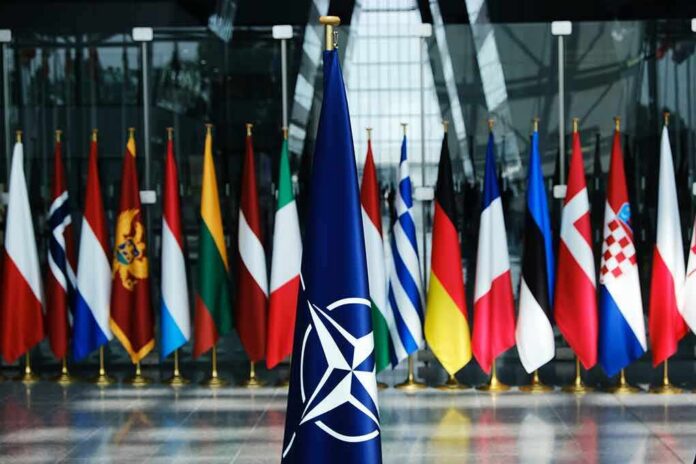
NATO just tied nuclear weapons, missile defense, space, and cyber into one “tailored” playbook to face Russia, while the United Kingdom and France backed it with new coordination and a first-ever joint exercise.
Story Highlights
- NATO affirmed an adaptable mix of nuclear and non-nuclear tools to deter aggression.
- NATO’s Nuclear Planning Group pledged modernization to keep a safe and credible nuclear posture.
- The United Kingdom and France formed a Nuclear Steering Group and conducted a joint exercise.
- Russia’s 2024 doctrine raised concern about wider triggers for nuclear use.
NATO Details a “Tailored” Deterrence Model Across All Domains
NATO said it will deter threats with a flexible mix of nuclear, conventional, missile defense, space, and cyber tools. The Alliance stated it will keep freedom of action and adjust responses to the full range of challenges. Leaders framed this as necessary because Europe faces complex risks that can move fast across domains. NATO also highlighted that nuclear forces remain part of deterrence “as long as nuclear weapons exist,” even after deep cuts since the Cold War.
NATO’s 2026 Nuclear Planning Group reinforced that message by committing to modernize allied nuclear capabilities. Ministers said they will improve nuclear planning, sustain readiness, and maintain a posture that is safe, secure, effective, and credible. The statement links these steps to preserving peace and stopping coercion. It signals that allied leaders want options that scale from conventional responses up to nuclear deterrence if needed, without locking in a one-size-fits-all plan.
United Kingdom–France Coordination Moves From Pledges to Practice
The United Kingdom and France formed a Nuclear Steering Group under the Northwood Declaration to coordinate work on policy, capability, and operations. Officials said the group first met in Paris on 10 December 2025. Both governments describe their nuclear forces as independent but able to coordinate for shared security needs. They also said any extreme threat to Europe would draw a response from both nations, signaling unity while preserving national control.
The two countries then ran Exercise “Rummy” in October 2026 over the Mediterranean. The United Kingdom reported that British and French forces trained together to improve rapid joint response under the Northwood framework. The government said no nuclear weapons were involved, and the exercise focused on interoperability and coordination. That detail matters because it shows European nuclear powers are testing the pipes of cooperation without taking steps that would signal imminent nuclear use.
Russia’s Declaratory Policy Raises Threshold Questions for Europe
Russia revised its nuclear policy in November 2024 in ways that worry European planners. A United States Congressional Research Service brief says Moscow now treats aggression by a non-nuclear state with support from a nuclear state as a joint attack against Russia. The same brief notes that Russia links nuclear forces to “escalation management” and ending wars on terms it accepts. That wording adds pressure to Europe’s crisis planning and messaging.
These shifts feed a bigger pattern across Europe. The European Parliament’s research service describes today’s changes in nuclear deterrence as the most significant since the Cold War. Repeated Russian nuclear signaling, the war in Ukraine, and debate over long-term American commitments have pushed allies to re-check plans. As that debate grows, European nuclear powers are taking visible steps to show they can coordinate and respond if needed.
Why This Matters for Americans Who Feel Washington Is Failing
Allied leaders say this overhaul aims to prevent war, not start one. But the stakes are high for the United States taxpayer and the American military. If allies deter threats better, the burden on United States forces and budgets may be lower. If deterrence fails, costs rise fast. Clear plans, honest risk tradeoffs, and real competence matter more than speeches. Citizens on the right and left who see elites dodge hard choices will watch whether these moves deliver results, not slogans.
Two concerns loom. First, public papers do not reveal detailed thresholds, force levels, or alert timelines. NATO says this ambiguity is part of deterrence. Still, it limits outside testing of claims about credibility. Second, drills like Exercise Rummy can be mislabeled as nuclear strike rehearsals. The United Kingdom said no nuclear weapons were involved. Clear language helps prevent panic while keeping pressure on leaders to match words with serious, sober planning.
What to Watch Next
Watch for allied steps that turn policy into muscle. Signs include more joint planning events, shared command-and-control drills, and investments in secure communications. Look for follow-up meetings of the United Kingdom–France Steering Group and any new exercises that test speed and coordination without stoking alarm. Track Russian rhetoric and deployments for signs that allied moves are shaping its choices. These concrete items will show whether “tailored deterrence” is a headline or a working shield.
Sources:
realcleardefense.com, gov.uk, questions-statements.parliament.uk, nato.int, eng.chinamil.com.cn