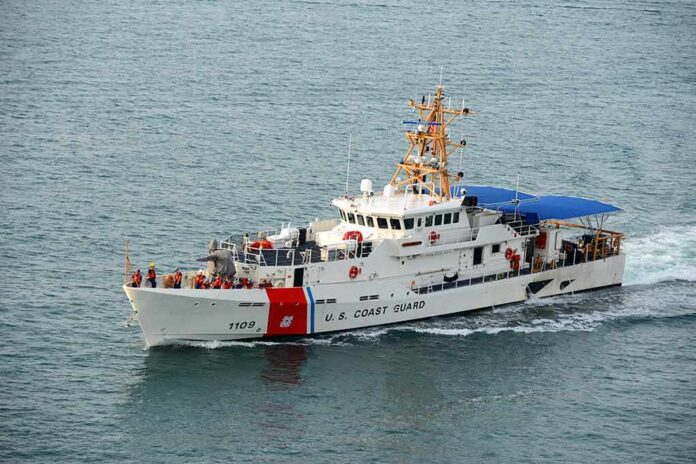
U.S. Coast Guard crews are searching off Nantucket after air traffic officials lost contact with a Boston-bound Gulfstream carrying six people early Saturday.
Story Snapshot
- Coast Guard launched air and surface crews off Nantucket to find a missing jet.
- The aircraft is a Gulfstream G100 flying from Bermuda to Boston with six aboard.
- The Federal Aviation Administration reported losing contact early Saturday.
- Officials have not released identities, ownership, or confirmed any outcome yet.
Confirmed Search Details From Authorities
U.S. Coast Guard units began a search off the coast of Nantucket after the Federal Aviation Administration reported it lost contact with a business jet early Saturday morning. Reporters cited the Coast Guard’s Northeast update saying air and surface crews were deployed to the area. The aircraft was identified as a Gulfstream G100 traveling from Bermuda to Boston. The Coast Guard said six people were on board the aircraft when contact was lost, and the search remained active as of publication.
Local and national outlets reported the search zone near Nantucket, a common waypoint for flights entering New England from the Atlantic. Coverage on Saturday aligned on the core facts: contact was lost, six people were aboard, and crews were scanning the ocean surface. Officials did not announce a cause, and no recovery had been confirmed. Outlets also reported that media had reached out to the Federal Aviation Administration for more details but had not received a formal statement yet.
What We Know About The Aircraft And Route
Reports described the airplane as a Gulfstream G100, a small twin-engine jet used by private operators and medical transport firms. The flight path was listed as Bermuda to Boston, a route that crosses long stretches of open water before reaching Massachusetts. That track places any emergency squarely in the Coast Guard’s maritime zone, which is why Coast Guard aircraft and cutters take the lead in the search, while the Federal Aviation Administration handles alerts and coordination tasks.
Newsrooms noted that some outlets referred to the flight as a medical transport. However, officials have not published a passenger manifest, the operator’s name, or the tail number in available reports. Without those details, it is not possible to verify the ownership or mission beyond what reporters relayed from the initial Coast Guard update. The key confirmed points are the aircraft type, the route from Bermuda to Boston, the lost contact report, and the count of six aboard.
How Search And Rescue Works Over Water
Federal Aviation Administration guidance explains that when an aircraft is missing or overdue, controllers issue an alert notice and coordinate with the rescue centers that lead on searches. The U.S. Coast Guard is responsible for maritime search and rescue, and it dispatches planes, helicopters, and surface vessels to grid the likely area. That system often creates a short window when the only public facts are “lost contact” and “search underway,” while responders work to find debris, beacons, or survivors.
The top U.S. stories from the past few hours:
🔸 The Coast Guard searched off Massachusetts for a medical transport plane with six aboard flying from Bermuda to Boston.
🔸 Tennessee's corrections commissioner resigned after two failed lethal injection executions.
🔸 President… pic.twitter.com/h3yiScw3Th
— US News Recap (@USNewsRecap) October 3, 2026
Aviation alerts also tap support from radar and tracking analysts once a probable last-known position is set. The Federal Aviation Administration describes how alert notices help local and federal teams mobilize, while later steps can include radar forensics and satellite-based tracking reviews. Those tools can narrow the search box and guide ships and aircraft to specific coordinates. That process takes time, which explains why early updates focus on the launch of search crews rather than confirmed outcomes.
Sources:
facebook.com, wcvb.com, nbcboston.com, pinkpillbox.com, faa.gov