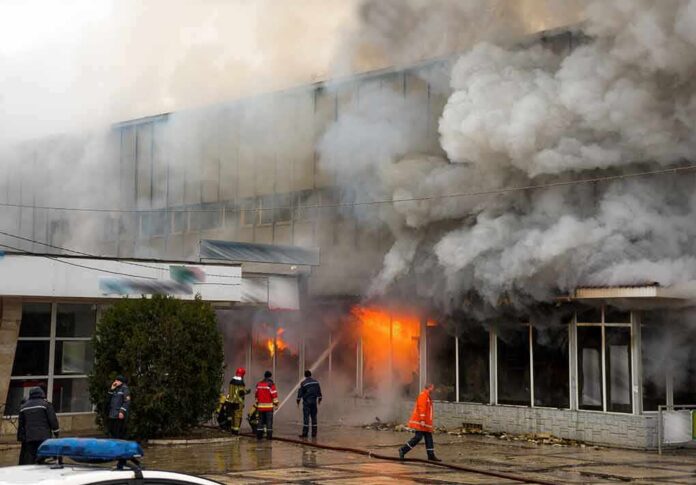
A Russian attack drone slammed into Ukraine’s National Academy of Sciences in central Kyiv, setting the landmark ablaze and forcing people to flee through windows.
Story Snapshot
- A Russian drone hit the National Academy of Sciences building in Kyiv, sparking a fire.
- Kyiv’s mayor reported a strike on a non-residential site in the same central district.
- The hit follows weeks of near-daily attacks damaging schools, hospitals, and homes.
- Repeated strikes on civic sites deepen public anger at a war that keeps targeting daily life.
What Happened in Central Kyiv
Local media and emergency updates said a Russian unmanned aerial vehicle struck the National Academy of Sciences of Ukraine in the Shevchenkivskyi district. The impact caused a large fire and forced people inside to escape, with some seen climbing out of windows to reach safety. Kyiv Mayor Vitali Klitschko described a drone strike on a non-residential building in the same area as crews rushed in to fight flames and help the injured. Officials have not released final casualty figures.
Witness clips and daytime images showed heavy smoke rising above central streets as firefighters worked to contain the blaze. The Academy complex sits near offices, shops, and transit lines, so debris and shockwaves disrupted traffic and local business. First responders closed blocks around the site while they checked for structural risks and gas leaks. City services asked residents to avoid the area, clear routes for ambulances, and follow shelter alerts during any follow-on waves.
A Pattern of Strikes on Civic Life
The strike fits a steady pattern of Russian drone and missile attacks that have pounded Kyiv for weeks. Reporters have described “nearly round-the-clock” waves that damaged homes, schools, and university buildings. Daytime hits have injured commuters and forced families to take shelter on short notice. A recent series killed and wounded civilians across the capital and nearby regions, with fires spreading in multiple districts during the heaviest barrages. These repeated hits have turned normal routines into daily risk calculations.
Past strikes in September damaged an education facility and injured more than a dozen people, including children, according to city and national updates. Other waves hit retailers, warehouses, and transport hubs, showing that the air campaign reaches deep into the city’s basic services and work sites. When schools, clinics, markets, and offices face the same threat profile, the line between front and rear fades. Each new blast adds pressure on emergency systems already stretched by constant alerts and repairs.
Why This Target Matters
Hitting the National Academy of Sciences carries extra weight because it is a symbol of research, culture, and national identity. Science buildings, like schools and hospitals, stand for the future a country is trying to protect. When strikes land on these places, fear spreads beyond the blast zone. People ask how to send kids to class, how to get care, and how to work when sirens and debris are now part of city life. That is the real cost of repeated waves on civic sites.
During a Russian drone strike on the Ukrainian capital, Kyiv, on September 28, a direct hit was recorded on the building of the National Academy of Sciences (NAS) of Ukraine, Report informs.
The strikes were carried out at approximately 14:15 local time.
Casualties and… pic.twitter.com/fx0ZvNxM48
— Report News Agency (@reportaznews) September 28, 2026
Emergency crews now face the hard work of search, rescue, and cleanup inside a historic structure with fire and water damage. Engineers must test walls, ceilings, and beams before staff can return. City planners must also weigh how to shield public buildings that were never designed for modern drone warfare. For residents, the guidance stays the same: keep alerts on, know the nearest shelter, and move fast when warnings sound.
What to Watch Next
Residents should expect rolling air defense activity, transport delays, and short-term power disruptions in affected blocks. Officials will update injury counts, damage assessments, and any changes to transit or school schedules. Ukraine’s partners will track whether strikes on civic and cultural sites increase as the weather shifts and daylight attack patterns evolve. For Kyiv, the goal is clear but hard: repair faster than drones and missiles can undo the work, and keep daily life moving under fire.
Sources:
insiderpaper.com, en.apa.az, reuters.com