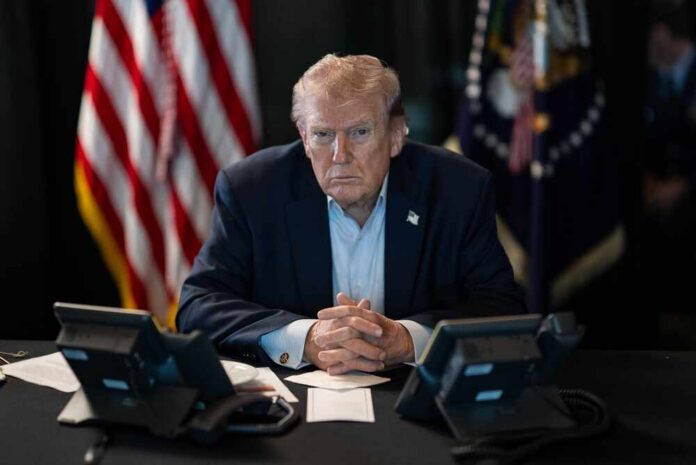
President Trump’s warning that America may target Iran’s bridges and electric grid next is turning a fast-moving war into a loyalty test at home for a movement that voted to end forever wars.
Quick Take
- President Trump publicly threatened strikes on Iranian bridges and electric power plants unless Tehran agrees to a peace deal “FAST.”
- A U.S.-Israeli double strike destroyed Iran’s tallest B1 Bridge near Karaj, with Iranian officials reporting eight killed and 95 wounded.
- Iran’s foreign minister rejected the pressure campaign, saying attacks on civilians will not force surrender, while retaliation risks remain high.
- Reports indicate back-channel diplomacy and a list of U.S. demands, but key details—like Iran’s claimed F-35 shootdown—remain unverified.
Trump’s escalation shifts from military targets to civilian infrastructure
President Donald Trump posted on Truth Social on April 3, 2026, that the U.S. military “hasn’t even started destroying what’s left in Iran,” and then named bridges and “Electric Power Plants” as what could be hit next unless Iran’s leadership reaches a peace agreement quickly. The post followed a major strike on the B1 Bridge near Karaj and came after Trump’s televised pledge to bomb Iran heavily over a short timeline.
U.S. and Israeli forces reportedly hit the B1 Bridge in a two-part attack: an initial strike and a second strike that hit the area as responders arrived. Iranian provincial authorities said the bridge attack killed eight people and wounded 95, placing civilians at the center of the story and immediately raising questions about proportionality and limits. Video circulated online showing the collapse, with Trump amplifying destruction footage as leverage for negotiations.
What happened at B1 Bridge—and why it matters operationally
The B1 Bridge was described as a strategic, roughly one-kilometer structure near Tehran, and its destruction signals a campaign designed to disrupt movement, logistics, and economic activity—not just degrade military hardware. When bridges and power systems enter the target list, the war stops looking like a discrete strike campaign and starts resembling coercion through societal pressure. That shift also increases the odds of blowback across the region, including attacks on energy routes.
Iran’s Foreign Minister Abbas Araghchi rejected the threat-based approach, arguing that targeting civilians will not compel Iran to surrender. That response matters because it implies Tehran may absorb infrastructure losses rather than concede under public humiliation, which can harden positions and extend conflict duration. Separately, Iran claimed it downed another U.S. F-35, but available reporting describes that claim as unverified, leaving uncertainty about the air war’s real balance.
Negotiations, demands, and the “deal FAST” pressure campaign
Reporting indicates diplomacy may be occurring alongside the air campaign, with discussion of U.S. demands that include halting missile activity, ending proxy funding, and eliminating uranium enrichment. At the same time, Iran has signaled any agreement must include stopping offensive operations. Those positions are far apart, and Trump’s public messaging suggests a preference for rapid capitulation rather than a slow, face-saving process—an approach that can produce quick outcomes or trigger longer resistance.
A Council on Foreign Relations analysis has warned that strikes on energy infrastructure can inflict sweeping harm on civilians and carry serious legal and moral risk, with critics using the “war crime” label in that context. That warning does not settle the question by itself, but it underscores the stakes for an administration now fully responsible for the federal government’s wartime decisions. If U.S. operations cross into broad civilian hardship, support at home can fracture quickly—even among loyal voters.
MAGA’s split: backing strength abroad vs. rejecting another endless war
Trump’s base is not monolithic on Iran, especially after years of frustration over regime-change wars, high energy prices, and a feeling that Washington never learns. Some supporters see maximum pressure as the quickest way to end the war and deter future attacks; others hear “bridges and power plants” and recognize the familiar slope into open-ended escalation. The movement is also wrestling with how far U.S. interests align with Israel’s operational tempo, and what “America First” means when costs rise.
For conservative voters who prioritized border security, inflation control, energy independence, and constitutional limits, the political risk is not abstract: a widening war can drive fuel prices, expand executive power, and normalize emergency-style governance. The available facts show an administration publicly contemplating strikes that would predictably affect civilian life, while Iran openly refuses to be coerced by that method. If Washington wants a durable outcome, clarity on objectives, limits, and end-state matters as much as raw firepower.
Sources:
Trump threatens to destroy Iranian infrastructure
Israel under fire as Trump warns of destroying Iranian …
Iran War Live Updates: Trump Speech Rattles Markets