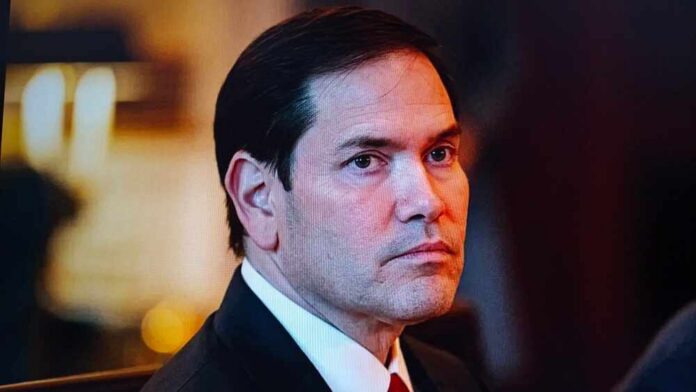
Secretary of State Marco Rubio just admitted what many Americans suspected: we’re protecting sea lanes that our allies depend on far more than we do, raising hard questions about why American troops should risk their lives for Europe and Asia’s energy security.
Story Snapshot
- Rubio states U.S. receives “very little” energy through the Strait of Hormuz while allies depend heavily on it
- Iran threatens to establish tolling system charging ships $2 million to transit international waters
- Asian and European allies pressured to “step up” and take responsibility for securing their own energy supplies
- Administration signals U.S. willing to participate but not lead security efforts in the region
America First Energy Independence Changes the Equation
Marco Rubio delivered a stark message to global allies: the Strait of Hormuz crisis is primarily their problem, not ours. Speaking on ABC’s Good Morning America, Rubio emphasized that while approximately 20% of global energy supplies transit through this critical waterway, the United States receives very little of its energy through the strait. This represents a fundamental shift in how America views its obligations in the Persian Gulf, reflecting energy independence achieved through domestic production. Rubio warned Iran that establishing permanent control over international waters “will never be allowed to happen,” but made clear that nations with greater stakes should lead the response.
Iran’s Brazen Tolling Scheme Threatens Global Commerce
Iranian Vice President Mohamed Reza Aref declared that “the Hormuz Strait regime will no longer be as it was in the past,” signaling Tehran’s intent to fundamentally alter freedom of navigation through international waters. Iran has reportedly begun charging ship operators $2 million to transit the strait, with some vessels paying these extortion fees discreetly to avoid disruptions. Iranian parliament member Alaeddin Boroujerdi defended these charges as demonstrating “the power and the right that the Islamic Republic of Iran has.” This represents a direct challenge to established international law governing free passage through critical waterways, setting a dangerous precedent if allowed to stand unchallenged by the international community.
Allies Hesitate While Their Own Energy Security Hangs in Balance
The burden-sharing message hits particularly hard for Asian nations, with India receiving over 50% of its oil through the Strait of Hormuz. China and other Asian economies face similar vulnerabilities to Iranian disruptions. Yet European G7 allies have declined some of Trump’s requests for support, citing lack of consultation on Iran conflict decisions. Rubio pointedly noted that “for all these countries that care about international law, they should be doing something about it.” The administration submitted a 15-point plan to Iran addressing nuclear programs, ballistic missiles, and maritime security, but Iran rejected it and countered with five conditions including recognition of sovereignty over the Strait and reparations for war damages.
Post-Conflict Planning Reveals New American Strategy
Rubio described ensuring the Strait remains open as an “immediate challenge” after military operations conclude, but added a crucial qualifier: “We don’t have to lead that plan, but we’re happy to be a part of it.” This represents a fundamental departure from decades of American assumption of primary responsibility for Persian Gulf security. The Secretary of State reported progress through indirect communications with Iran via intermediary countries, noting “a growing amount of energy” flowing through the Strait, though “not as much as should be flowing.” Rubio stated the waterway “can be open tomorrow if Iran stops threatening global shipping,” placing responsibility squarely on Tehran while signaling reduced American willingness to shoulder the security burden alone.
The strategic implications are clear: American energy independence fundamentally changes the calculus of Middle Eastern engagement. While maintaining international law and freedom of navigation remains important, the question of who should bear the costs and risks deserves honest examination. Nations that depend on Persian Gulf energy have both the capability and responsibility to protect their own vital interests rather than expecting American taxpayers and military families to carry the burden indefinitely. This approach tests whether allies genuinely value the international order they frequently invoke, or whether their commitment extends only as far as American willingness to do the heavy lifting at our own expense.
Sources:
Secretary of State Marco Rubio Remarks to Press – U.S. Department of State
US’ Rubio says ‘growing amount of energy’ flowing through Strait of Hormuz – Anadolu Agency