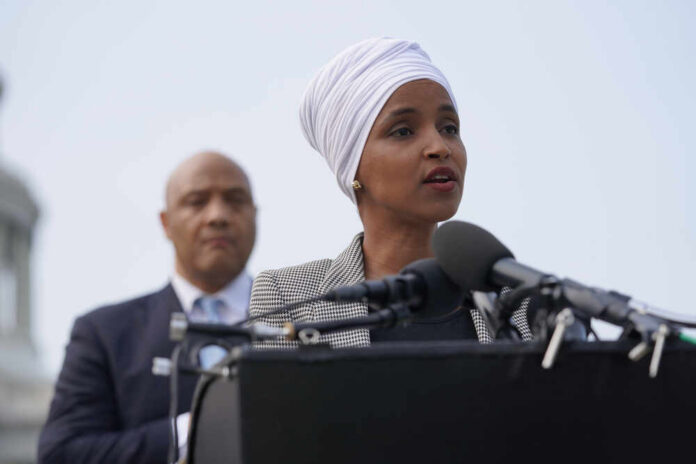
A rare House ethics probe is now chasing paper trails across Kenya, Dubai, and Somalia after Rep. Ilhan Omar’s family finances raised fresh questions about disclosure and a sudden jump in wealth.
Story Snapshot
- A federal ethics complaint alleges Omar underreported or mischaracterized assets and income tied to husband Tim Mynett’s failed wine and marijuana ventures.
- House investigators have taken the unusual step of scrutinizing a member’s spouse, a move described as rare in modern practice.
- Rep. James Comer is seeking documents tied to Mynett’s reported rise from roughly $51,000 in assets to an estimated $30 million within about a year.
- Public reporting links the scrutiny to investor lawsuits, disputed valuations, and questions about how disclosures captured liabilities and ownership stakes.
From Local Business Disputes to a Federal Ethics Complaint
Rep. Ilhan Omar’s latest scrutiny began with a straightforward question that often drives Washington scandals: did a lawmaker accurately disclose family finances? A complaint filed with the Office of Congressional Ethics alleges Omar’s disclosures in 2021 and 2022 did not properly reflect assets, transactions, or liabilities connected to her husband Tim Mynett’s business ventures. The underlying activity involved a wine project and a marijuana-related venture that later drew investor lawsuits alleging fraud and breach of contract.
The complaint’s specifics, as reported, focus on valuation and disclosure categories rather than criminal charges. One example highlighted in coverage is a reported $300,000 investment in the wine business and the question of how that squares with disclosure ranges that listed smaller stake values. Those kinds of discrepancies matter because congressional disclosure rules are designed to flag conflicts of interest before they turn into policy problems, not after headlines hit.
Why the Spousal Angle Matters to Voters Across the Spectrum
Most Americans do not follow the fine print of congressional financial forms, but they understand the principle: elected officials should not profit in the shadows. That is why spousal business scrutiny—especially when described as rare—lands harder than routine partisan sparring. Conservatives see another example of a political class that expects rules for everyone else. Many liberals, especially those frustrated with inequality, see the same underlying concern: powerful families accumulating wealth while ordinary households face inflation, housing costs, and rising interest burdens.
Coverage also notes Omar’s defense that she did not personally work for the gains attributed to her husband’s ventures. That claim, even if accepted, does not resolve the central compliance question investigators appear to be pressing: whether the required reporting categories captured the true value of holdings and liabilities at the time disclosures were filed. In ethics enforcement, intent can matter, but accuracy matters first because the disclosure regime collapses if “close enough” becomes the standard.
Comer’s Document Push and the “Going Global” Expansion
Recent reporting frames the probe as expanding beyond the original U.S.-based ventures. House Oversight Chair James Comer has sought information tied to business dealings in Kenya, Dubai in the United Arab Emirates, and Somalia. The stated focus is a dramatic increase in reported wealth, with coverage describing Mynett’s assets rising from roughly $51,000 in 2023 to an estimated $30 million in 2024. Comer’s public concern centers on how businesses grew so quickly in value soon after reporting limited assets.
This is where the story intersects with broader distrust of institutions. When investigators ask foreign jurisdictions for records connected to a lawmaker’s household, Americans hear “complex deals” and “limited transparency” in the same sentence—and they assume the system is tilted toward insiders. That reaction is not inherently partisan. It reflects years of public frustration that agencies move slowly on elite misconduct while moving quickly on ordinary taxpayers, small businesses, and families dealing with paperwork mistakes.
What Is Known, What Is Not, and What to Watch Next
Based on the available reporting, the current posture remains investigative: a complaint exists, oversight letters have been reported, and the matter is moving through congressional and ethics channels with no final resolution described. The biggest factual gaps are also the most important: the precise structure of the overseas deals, the documentation requested, and the breakdown of the $30 million figure. Without primary documents released publicly, outside observers cannot verify the full pathway from disclosure questions to overseas business links.
Ilhan Omar Probe Expands Into Hubby's $30M Of Shady Biz Deals In Kenya, Dubai And Somalia https://t.co/ASundzYAYe
— zerohedge (@zerohedge) April 27, 2026
For voters, the practical takeaway is less about personalities and more about accountability mechanics. If disclosures can be filed with major valuation disputes, and if enforcement only accelerates when the opposing party holds gavels, then trust in government keeps eroding—exactly the bipartisan frustration Americans voice when they say “the system is rigged.” The next meaningful milestone will be any public release of records, a formal finding, or a referral that clarifies whether this is a paperwork fight or a deeper ethics breach.
Sources:
Ilhan Omar Says She Isn’t a Multimillionaire, Blames …
Ilhan Omar, Tim Mynett’s talent for making money appear …