President Trump’s pending decision on Taiwan weapons sales represents a critical test of American resolve against Chinese intimidation.
Story Snapshot
- Trump to decide “pretty soon” on additional Taiwan arms sales following February 4 warning call from Xi Jinping
- China claims Taiwan arms sales are “most important issue” in bilateral relations, conducting blockade drills after December’s $11 billion U.S. package
- Decision comes ahead of April Beijing summit, with analysts suggesting Trump may delay to preserve diplomatic momentum
- Taiwan’s $40 billion domestic defense plan blocked 10 times by opposition parliament despite U.S. lawmaker pressure
Trump Weighs Strategic Commitment Against Beijing Pressure
President Donald Trump announced aboard Air Force One on February 16, 2026, that he would decide “pretty soon” on sending additional weapons to Taiwan. The decision follows a February 4 phone call with Chinese President Xi Jinping, who urged caution on arms sales, describing Taiwan as the most critical issue in U.S.-China relations. Trump emphasized maintaining a “good relationship” with Xi while acknowledging ongoing discussions about the weapons package. The announcement comes as Trump prepares for an April summit in Beijing, where Taiwan and trade disputes are expected to dominate discussions.
Watch;
https://youtu.be/goJ39osy2A4?si=eyn-BtOrfWRC6ONb
China Escalates Warnings as Taiwan Remains Vulnerable
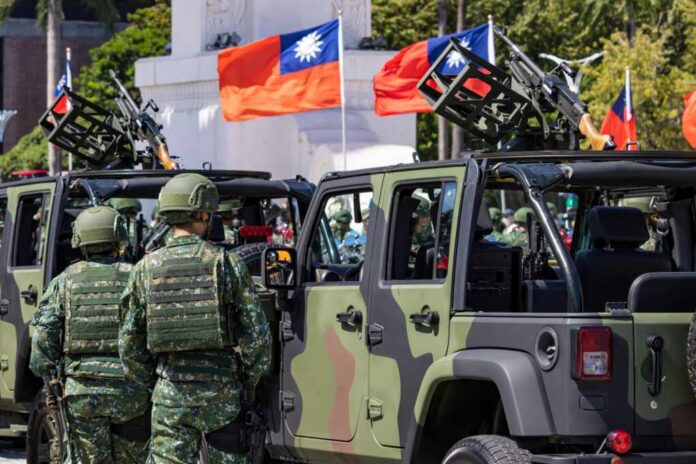
Chinese Foreign Minister Wang Yi issued stark warnings at the Munich Security Conference on February 14, stating the U.S. must stop “plotting” on Taiwan or face “confrontation.” Beijing responded to the December 2025 $11 billion U.S. arms approval with live-fire military drills simulating a Taiwan blockade, demonstrating the regime’s willingness to use force. Despite never having governed Taiwan, China claims the democratic island as its territory and views reunification—by force if necessary—as a core national interest. This represents exactly the kind of authoritarian overreach that threatens regional stability and challenges America’s commitment to defending freedom-loving allies.
Domestic Defense Budget Remains Stalled Despite U.S. Pressure
Taiwan President Lai Ching-te’s ambitious $40 billion eight-year defense spending plan has faced repeated rejection, blocked 10 times by opposition forces in Taiwan’s parliament since early December 2025. U.S. lawmakers urged Taiwan’s opposition on February 12 to pass the critical funding package, emphasizing that American support cannot substitute for Taiwan’s own defense investments. Lai expressed confidence in eventually securing passage, but the delays highlight political divisions that undermine deterrence against Chinese aggression. Taiwan’s defense minister noted the U.S. has accelerated deliveries of previously approved weapons systems, providing some interim capability improvements while budget battles continue.
Strategic Ambiguity Faces Critical Moment
The United States maintains “strategic ambiguity” regarding Taiwan, acting as its primary military backer under the Taiwan Relations Act while not formally recognizing the island’s independence. Trump’s softer public tone on Taiwan in his second term contrasts with his first administration’s more assertive stance, raising questions about America’s commitment to defending the island’s 23 million people. Delaying necessary defensive weapons to appease an aggressive communist regime risks emboldening further Chinese military adventurism and signals weakness that could invite miscalculation. The decision will significantly shape U.S.-China relations amid ongoing trade disputes and strategic competition over semiconductors and regional influence.
US President Donald Trump said Monday he would decide soon on whether to send more weapons to Taiwan, after Chinese President Xi Jinping warned him not to do so.https://t.co/rc7LXiosAU
— Channels Television (@channelstv) February 17, 2026
Trump’s upcoming decision represents more than arms sales—it tests whether America will stand firm on constitutional principles of supporting allies against authoritarian threats or sacrifice strategic commitments for short-term diplomatic gains. China’s red lines demanding U.S. acquiescence on Taiwan fundamentally challenge American sovereignty in making independent defense policy decisions. As the April summit approaches, conservatives will watch closely to ensure Trump prioritizes strength and American interests over appeasing a regime that views compromise as weakness and seeks to reshape the Indo-Pacific region according to communist dictates.
Sources:
Trump to decide ‘soon’ on sending weapons to Taiwan – The Straits Times
Trump says decision on Taiwan weapons coming soon – Economic Times
Trump confirms Taiwan arms sales talks with Xi Jinping, decision imminent – Caliber.az
Trump to decide on Taiwan weapons sales ‘soon’ after Xi talks – The Japan Times
Trump Says He’s Talking to Xi About Weapons Sales to Taiwan – Bloomberg Government