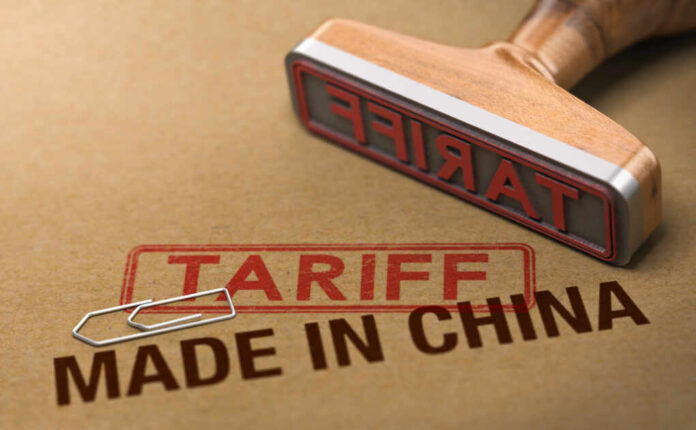
Amid tensions with China, new tariffs on semiconductors are set to begin, raising concerns about economic impact and strategic security.
Story Highlights
- The Trump administration announces tariffs on Chinese semiconductors to begin in 2027.
- These tariffs are in response to China’s dominance and non-market practices.
- Concerns arise over potential inflation and supply chain disruptions.
- No credible evidence supports claims of illegal shortages created by these tariffs.
Trump’s New Tariff Announcement
On December 23, 2025, the Trump administration announced a series of tariffs targeting Chinese-made semiconductors, with enforcement delayed until June 23, 2027. The decision follows a thorough Section 301 investigation initiated during the Biden administration, aimed at addressing China’s control over the semiconductor market through state subsidies and coercive practices. These tariffs will start at a rate of 0% and are expected to rise as implementation nears, with details to be announced 30 days prior to the effective date.
Trump announces that tariffs on Chinese semiconductors will be 0% until 2027. pic.twitter.com/q6vxIaOxtb
— Zhao DaShuai 东北进修🇨🇳 (@zhao_dashuai) December 24, 2025
Background in the U.S.-China Semiconductor Tensions
The semiconductor tensions between the U.S. and China are deeply rooted in China’s strategic industrial policies, notably the Made in China 2025 initiative. This approach has allowed China to dominate the global supply chain through state-backed subsidies, effectively reducing prices and squeezing out competition. This dominance poses a significant threat to U.S. national security, with 66% of U.S. products relying on Chinese semiconductors. The COVID-19 pandemic further highlighted the risks of such reliance, prompting U.S. policymakers to take action.
Historically, the U.S. has faced substantial trade deficits, exacerbated by non-reciprocal practices like value-added taxes (VAT) imposed by China. These practices have contributed to the hollowing out of American manufacturing, resulting in the loss of 3.7 million jobs between 2001 and 2018. In response, the Trump administration has invoked the International Emergency Economic Powers Act (IEEPA) to declare a national emergency, aiming to rectify trade imbalances and bolster domestic manufacturing capabilities.
Potential Impacts and Stakeholder Reactions
The newly announced tariffs are designed to reduce reliance on Chinese semiconductors, yet they raise concerns about potential inflation and supply chain disruptions. In the short term, the delayed implementation provides a window for negotiation, but U.S. firms may face increased costs once tariffs kick in. Medical device manufacturers and other industries depending on these components are particularly vulnerable to disruptions.
In the long term, the tariffs aim to spur domestic semiconductor production, supported by initiatives like the CHIPS Act. However, U.S. manufacturers must contend with higher local production costs compared to China’s subsidized prices. The layered tariffs (Biden’s existing 50% plus new duties) could lead to higher consumer prices and potential shortages if not managed carefully.
https://youtu.be/EVhvurc6oaI?si=jTuJ07a3WqNpBFAL
Sources:
Trump administration announces new tariffs on Chinese chips and electronic components but fresh sanctions won’t take effect until 2027 and rates remain unknown
Trump administration delays new China chip tariffs until June 2027
Guide to Trump’s Section 232 Tariffs in Nine Maps
Fact Sheet: President Donald J. Trump Declares National Emergency to Increase Our Competitive Edge, Protect Our Sovereignty, and Strengthen Our National and Economic Security