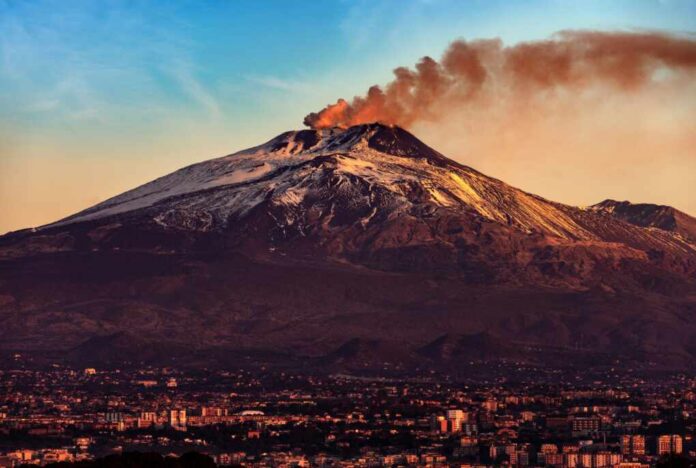
Mount Etna’s recent explosive eruptions, which sent ash clouds soaring 38,000 feet into commercial flight paths and triggered maximum aviation warnings, failed to shut down Sicily’s airports. Unlike previous volcanic disruptions that caused widespread closures, sophisticated monitoring systems and coordinated protocols allowed Catania Airport to remain operational. This modern aviation management demonstrates how real-time response maintains safety while avoiding the travel disruption that has historically followed major volcanic events.
Story Highlights
- Mount Etna erupted December 26-27, 2025, shooting volcanic ash to cruising altitude and triggering red aviation warnings.
- Advanced monitoring systems and coordinated protocols kept Catania Airport operational despite significant volcanic activity.
- January 1, 2026 lateral eruption created spectacular lava flows but poses no threat to nearby villages.
- Modern aviation management demonstrates how real-time response maintains safety while avoiding travel disruption.
Explosive Episodes Trigger Maximum Aviation Alerts
Mount Etna delivered two major explosive episodes on December 27, 2025, at 08:30 UTC and 14:30 UTC, launching volcanic ash columns to flight level 380—approximately 38,000 feet where commercial aircraft cruise. The Toulouse Volcanic Ash Advisory Center immediately raised the aviation color code to red, signaling maximum warning levels for European airspace. These ash clouds drifted west and northwest before dissipating within 6-12 hours, demonstrating the volcano’s capacity to directly impact critical flight corridors.
Italy’s National Institute of Geophysics and Volcanology characterized the eruptions as “highly energetic but brief,” with lava fountains and dense ash columns easily detected through satellite imagery and webcam networks. The explosive activity followed renewed strombolian eruptions detected December 26, continuing a pattern of volcanic unrest that has periodically challenged regional aviation since July 2024.
ANSA – Etna spews lava in spectacular but not dangerous eruption
https://t.co/D2S5ANiQvn pic.twitter.com/eFYC6SwdLK— AMAN (@AMAN_Alliance) January 3, 2026
Sophisticated Response Protocols Keep Airports Operational
Unlike previous volcanic disruptions that caused prolonged airport closures, Sicily’s aviation authorities deployed integrated monitoring systems combining real-time satellite imagery, ground observations, and numerical ash dispersion models. Airport management, air navigation providers, and volcanic ash analysts coordinated to keep closures targeted and brief while maintaining safety standards. Airlines activated refined contingency plans developed from previous Etna eruptions in July 2024 and February 2025.
The critical assessment factor for pilots and air traffic controllers involves modeled ash concentration spreads at different flight levels, not simply ash cloud height. Airlines work directly with advisory centers to determine whether airspace can be crossed safely or whether flights require altitude changes, horizontal rerouting, or temporary avoidance. This precision approach prevents the widespread travel disruption that characterized earlier volcanic events across Europe.
New Year’s Eruption Creates Dramatic Display Without Danger
A spectacular lateral eruption began January 1, 2026, near midnight when an eruptive fracture activated near Monte Simone cone, producing lava flows in the Valle del Bove. INGV volcanologist Boris Behncke described the eruption as “spectacular but not dangerous,” occurring in deserted areas on the volcano’s upper slopes. The lava flow front advanced from 2,100 meters to 1,580 meters altitude, remaining safely distant from nearby villages Fornazzo and Milo, located 5 and 5.5 kilometers away respectively.
At least two vents continue spattering, launching incandescent lava to heights of several dozen meters, though dense cloud cover initially obscured the dramatic display. The aviation color code remains elevated due to ongoing ash emissions, yet flight disruptions are not expected unless ashfall increases significantly. Catania Airport continues normal operations with protocols ready for temporary capacity adjustments if ash dispersal patterns change.
Watch the report: Mount Etna Erupts as 2026 Begins With Lava Flows
Sources:
- Mount Etna’s Winter Eruptions Send Ash Into Flight Paths, Causing Delays but Keeping Sicily Open to Travelers
- Etna spews lava in spectacular but not dangerous eruption