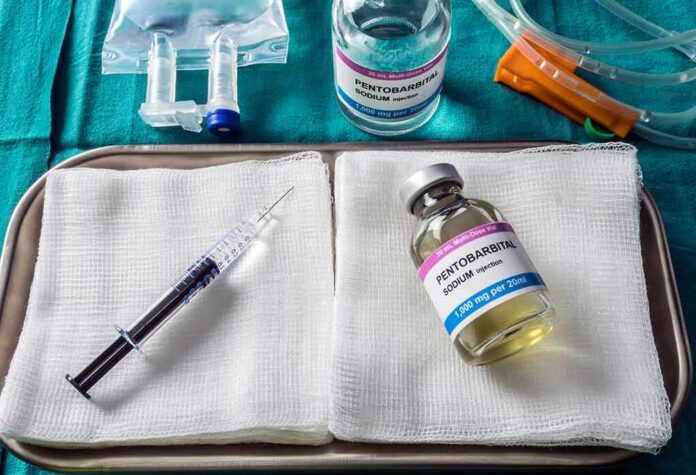
Tennessee’s promised “fail‑safe” execution system broke down in front of witnesses, forcing the state to call an ambulance after two doses of pentobarbital did not end Christa Pike’s life.
Story Snapshot
- Officials administered two syringes of pentobarbital, then halted the execution and sent Pike to a hospital.
- Governor Bill Lee ordered an outside review and paused all executions for the rest of the year.
- Witnesses reported Pike breathing and “snoring” after the drugs were given, raising protocol questions.
- Tennessee adopted single‑drug pentobarbital after past protocol failures, increasing scrutiny now.
What Officials Confirmed And Did Next
State lawyers told the Tennessee Supreme Court that Christa Pike was transported by ambulance for medical care after the execution team halted the procedure late Wednesday night. The Tennessee Department of Correction said the team followed each step of the state’s approved protocol. Governor Bill Lee directed a comprehensive, third‑party review and suspended further executions for the rest of the year to determine what went wrong and how to fix it. Those steps show the state views the breakdown as serious, not routine.
Media witnesses and Pike’s attorneys said two doses of pentobarbital were administered before the curtain closed and reopened, with Pike still breathing and making loud sounds. Reporters described a confused scene and repeated efforts to check her condition. An emergency court filing by the defense echoed those accounts. While an attempted execution is not a conviction or an acquittal, it is a legal act that must follow strict rules. On that, both sides now expect answers.
Why Pentobarbital Was Supposed To Prevent This
Tennessee switched to a single‑drug barbiturate, pentobarbital, after a multi‑year review prompted by earlier errors in drug testing and handling. Officials said the new process would be simpler and easier to control than the old three‑drug method. Other states have used pentobarbital, and courts have upheld its use when procedures are followed. Tennessee’s own materials present it as a reliable path that reduces risk. That claim faces new pressure after the Pike attempt.
Defenders of the protocol argue the problem may lie in how the drug was prepared, stored, or delivered through the intravenous line, not the drug itself. Critics respond that those are not small details. They are the entire system. If lines fail, if the solution degrades, or if training is thin, the outcome can be prolonged and painful. Prior Tennessee reviews already found lapses in drug testing and compliance. The public will look for whether those older gaps reappeared here.
Competing Claims And What We Actually Know
Pike’s lawyers said the state “failed to carry out a lawful execution,” citing difficult vein access, possible degraded pentobarbital, and a lack of on‑site medical care when things went wrong. State officials countered that staff followed the approved playbook and that the governor immediately ordered independent scrutiny. Both can be true in part: the team may have checked boxes while key steps still broke down in practice. The review’s job is to sort claim from fact.
Courts have allowed new execution attempts after past failures in other states, ruling that a breakdown does not, by itself, violate the Constitution or bar a future attempt. But judges also weigh evidence of pain, protocol flaws, and risk of repeat errors. The Pike case will likely move within that lane. The core question is practical: can Tennessee show it can carry out the sentence lawfully, safely, and the same way every time, not just on paper?
Why This Hits A National Nerve
Americans across politics see a familiar pattern: a closed, technical process that leaders say is under control until it is not. In 2022, Tennessee paused executions for protocol failures. In 2024, it finished a reform and said the single‑drug plan would fix things. In 2026, the first high‑profile test faltered in public view. That cycle fuels the belief that agencies protect themselves before they protect the public trust.
Christa Pike is still alive after Tennessee’s attempt to execute her by lethal injection.
The 50-year-old death-row inmate received two doses of pentobarbital but survived and was taken to a hospital for medical treatment. Her current condition has not been publicly disclosed.… pic.twitter.com/ij4y8tpw8Q
— Thoughts of Zoe ✝️💜🛐 (@bheavs17) October 1, 2026
People can disagree on the death penalty and still agree on this: if the state uses its power to take a life, it must run a process that is transparent, tested, and dependable. This event demands specific answers, not slogans. The independent review should release clear findings on drug quality, chain of custody, intravenous access, training, and real‑time medical support. If Tennessee cannot prove those basics, a pause is not politics. It is common sense.
Sources:
redstate.com, theguardian.com, usatoday.com, cnn.com, abcnews.com, bbc.com, tncourts.gov, yahoo.com, supremecourt.gov, abc7chicago.com, fox5atlanta.com