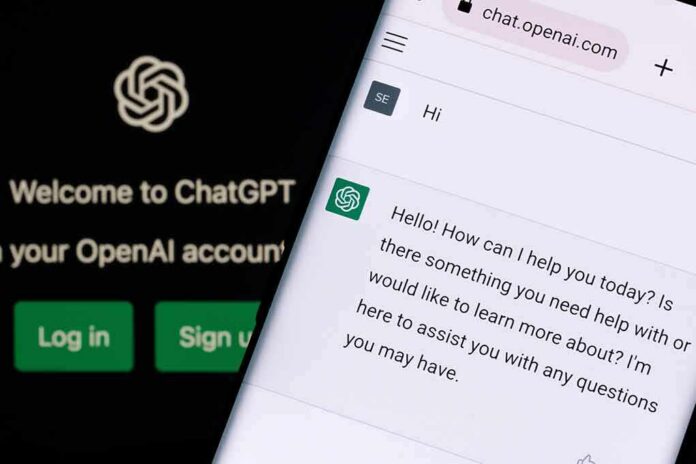
OpenAI now says its artificial intelligence models reach more than 1 billion active users, raising big questions about who really controls the digital tools that shape everyday life.
Story Snapshot
- OpenAI reports that its models now serve over 1 billion active users and 2 million businesses worldwide.
- Market research and news outlets say the ChatGPT app itself passed 1 billion monthly active users in May 2026, faster than any major consumer app on record.
- OpenAI’s own earlier numbers focused on 900 million weekly active ChatGPT users, showing huge scale but using a different metric.
- The claim highlights how a handful of tech and “AI elites” now mediate work, learning, and politics for ordinary citizens who feel Washington has stopped working for them.
OpenAI’s billion-user milestone
OpenAI announced that its artificial intelligence models now reach more than 1 billion active users and over 2 million businesses worldwide. The company says it crossed this milestone less than four years after launching ChatGPT, its popular chatbot, in late 2022. Leaders at OpenAI describe this growth as proof that people are finding real value in the tools and are using them more deeply as they gain confidence. This is not a government report; it is the company’s own statement to the public and investors.
This new figure builds on earlier numbers that already showed explosive growth. In February 2026, OpenAI said ChatGPT had more than 900 million weekly active users, a 350 percent jump in only 18 months. That same update noted more than 50 million paying consumer subscribers, plus millions of business users. Weekly active users measure how many people use the service at least once in a week. Now, when OpenAI talks about “more than 1 billion active users,” it is referring to all its models, not just the main ChatGPT app.
Sensor Tower’s estimate for ChatGPT itself
Separate from OpenAI’s own statement, major outlets report that the ChatGPT app alone hit 1 billion monthly active users in May 2026. The Reuters report cites data from market research firm Sensor Tower, which tracks app usage to estimate how many unique people use a product each month. According to this estimate, ChatGPT reached the billion-user mark in about three years, faster than Google Maps, TikTok, Instagram, or YouTube did. That makes ChatGPT one of the quickest-growing consumer software products in modern history.
CNBC, Times of India, and other publications echo this same estimate and name Sensor Tower as the source. They say ChatGPT’s growth outpaced viral platforms like TikTok, which took about five years to reach a similar milestone, and Instagram, which needed nearly eight years. These stories stress that the 1 billion monthly active users figure is an estimate based on app data, not a detailed public audit from OpenAI itself. Still, the coverage has turned the number into a widely accepted benchmark for ChatGPT’s reach.
Weekly users, monthly users, and what “active” really means
The numbers sound clear, but the terms are not always simple. OpenAI’s February figure of 900 million weekly active ChatGPT users measures use over a seven-day period, while Sensor Tower’s 1 billion monthly active users estimate looks at use over an entire month. A person who opens ChatGPT once a month counts for the monthly figure but might not count as a weekly user every time. That difference makes direct comparisons tricky, especially when the methods are not fully explained.
There is also a gap between “ChatGPT users” and “OpenAI model users.” When the company says its models reach more than 1 billion active users, it includes people using ChatGPT, other apps that plug into OpenAI models through application programming interfaces, and likely enterprise tools built on its technology. In practical terms, this means the same company now powers software used in offices, schools, hospitals, and media companies around the world. Yet ordinary citizens have almost no say in how these systems are designed, measured, or governed.
Why this matters for a frustrated public
Many Americans on both the right and the left already feel that the federal government is failing them and that a small class of elites makes the real decisions. The OpenAI milestone shows that key life tools are shifting even more from public institutions to private platforms led by wealthy tech leaders. A single company now claims to shape how more than a billion people search for answers, write documents, and even get health or legal advice, without the kind of open oversight citizens expect from their government.
OpenAI says ChatGPT now has more than 1 billion active users.
It took Facebook six years to reach the same number.
AI chatbots are growing faster than any social network before them.
— Simple AI (@Simple_AI_00) July 31, 2026
Conservatives who are tired of global tech giants and “woke” corporate culture see another powerful firm collecting data and attention from workers, families, and small businesses. Liberals who worry about inequality and discrimination see that advanced tools, built by a narrow slice of society, may deepen the gap between people who can use them well and those who cannot. Both sides share a concern that the rules are written by unelected elites, whether in Washington agencies or Silicon Valley boardrooms, while citizens carry the risks when things go wrong.
Missing transparency and the risk of “official” numbers
The billion-user headline also shows how fast a number can become “official” without full proof. Sensor Tower’s estimate is widely repeated, but the public does not see its exact method, error margin, or how it handles duplicate accounts. OpenAI’s own blog post about more than 1 billion active users does not break down how many of those are on ChatGPT versus other tools, or how many are businesses, students, or government offices. As with many tech metrics, the story gets simplified for headlines long before voters, workers, or regulators can see the details.
This is the deeper issue behind the milestone. Artificial intelligence now sits at the center of work, education, and public debate, yet the core facts about who uses it and how are set by companies, not citizens. People who already feel locked out of the American Dream see tech platforms racing ahead while wages lag, costs rise, and government leaders focus on elections more than solutions. The growth of ChatGPT and OpenAI’s billion-user claim are not just tech news; they are another sign that power and influence are moving even further away from the everyday people both parties say they represent.
Sources:
insiderpaper.com, reuters.com, cnbc.com, timesofindia.indiatimes.com, 9to5mac.com, aibusinessweekly.net, finance.yahoo.com, forbes.com, reddit.com