
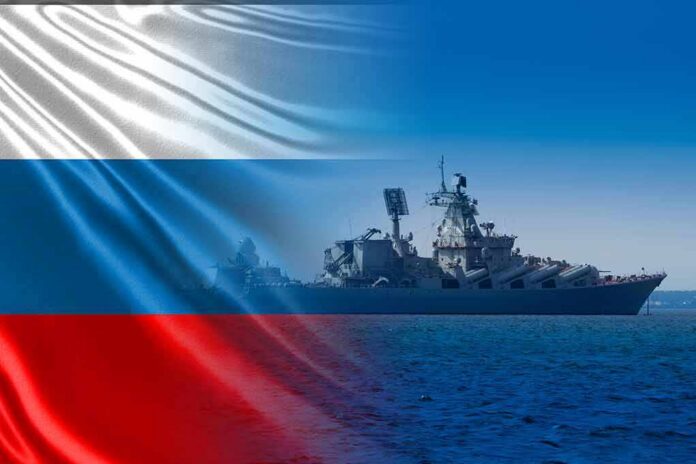
Ukraine says its naval drones sank a Russian warship docked thousands of miles from the war, in the Libyan port of Benghazi, a strike that shows Kyiv can now hit Moscow’s military assets far outside the Black Sea.
Quick Take
- President Volodymyr Zelenskyy says seven Ukrainian naval drones hit the Russian corvette Merkury at a naval base in Benghazi, Libya, and sank it.
- Libyan officials confirmed an explosion and fire severely damaged a Russian warship at the port, matching Ukraine’s account of the location and timing.
- Satellite images reviewed by The Independent reportedly show the vessel capsized, with only its bow still above water.
- Ukraine also claims it hit a second ship, MV Angara, which Zelenskyy says was moving weapons for Russia.
- The Kremlin has declined to comment, saying Russia’s Defense Ministry will respond “if deemed appropriate.”
Drones Strike Far From the Front Line
Zelenskyy said on Telegram that Ukrainian forces launched seven naval drones at the Merkury, a corvette commissioned by Russia in 2023. He said the ship sank at the Benghazi naval base in eastern Libya. Ukraine’s Security Service added that a Ka-27 helicopter on board was also destroyed in the strike.
Libya’s eastern-based government, which does not control the entire country, confirmed a blast hit a Russian ship docked at Benghazi’s naval base. Reuters and the Associated Press reported the explosion caused a fire and severe damage to the corvette, a description that lines up with Ukraine’s claim even before Kyiv’s own statement.
Satellite Images and Video Back Up the Claim
Commercial satellite images from the company Vantor, cited by The Independent, identified the damaged vessel as the Merkury. Images taken after the attack reportedly show most of the ship capsized and underwater, with only its bow sticking out. Zelenskyy’s office also released video that appears to show drones closing in on the ship just before a large explosion.
The footage, reported by CNN and CNBC, shows small boats skimming toward the warship moments before it blows up. Zelenskyy called the operation “exemplary” and said Ukrainian forces also struck a second vessel, the MV Angara, which he described as a Russian-linked cargo ship used to move weapons.
A Weapons Ship and an Unconfirmed Helicopter
Zelenskyy’s claim that the Angara was carrying weapons has not been backed up with shipping records, cargo manifests, or inspection reports in the public record so far. The same is true of the claimed Ka-27 helicopter loss, which comes only from Ukrainian statements and has not yet been matched to independent wreckage photos or Russian navy inventory records.
Russia’s government has stayed quiet on specifics. Kremlin spokesman Dmitry Peskov declined to comment when asked about the attack, saying Russia’s Defense Ministry would release information “if deemed to be appropriate”. That silence leaves Ukraine’s version as the only detailed public account of what exactly happened to the ship and its crew.
Part of a Bigger Pattern at Sea
Benghazi fits a pattern Ukraine has built for years. Ukrainian missiles and sea drones have already damaged or destroyed roughly a dozen Russian warships in the Black Sea, forcing Russia’s fleet to move its main base from Sevastopol to Novorossiysk, far from Ukrainian shores. Naval analysts have called those earlier attacks a turning point in how smaller countries can fight bigger navies on a budget.
Russia has leaned on Libya’s eastern faction, led by commander Khalifa Haftar, as a logistics hub for military shipments across the Mediterranean and into Africa. By hitting a ship there, Ukraine is signaling it can reach Russian supply lines well beyond its own coastline, raising the stakes in a war that keeps spreading past its original borders.
No group has claimed responsibility publicly beyond Ukraine’s own government, and Russian and Libyan authorities have reportedly opened a joint investigation into the blast. For now, the most solid facts are the explosion itself, the damaged ship, and Ukraine’s public claim of credit — with some specific details, like the helicopter and the Angara’s cargo, still resting on Kyiv’s word alone.
Sources:
youtube.com, afp.com, abc.net.au, cnbc.com, bbc.com, latimes.com