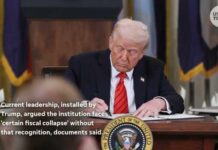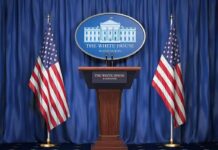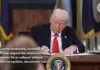

President Trump promised “really, really big news” about voting machines and election fraud in a primetime White House address — but the intelligence his team reviewed reportedly did not show that any foreign country actually changed votes.
Story Snapshot
- Trump delivered a primetime address from the White House on election integrity, promising to reveal newly declassified intelligence on foreign interference and voting machine vulnerabilities.
- The Federal Bureau of Investigation (FBI) opened an investigation into 2020 election results in Fulton County, Georgia, seizing ballots and records in January 2026 — though a judge later blocked a key subpoena in the case.
- Reuters sources said the declassified intelligence on China did not show that Beijing manipulated or changed any votes.
- Multiple courts, audits, and Trump’s own first-term Justice Department and Homeland Security officials previously found no evidence of widespread fraud or voting machine tampering.
What Trump Said — and What He Promised to Show
The White House announced the speech would cover newly declassified intelligence on election investigations and voting machine vulnerabilities. Trump teased the address for days, telling supporters to expect “really, really big news.” He planned to speak from the White House East Room at 9:00 PM Eastern Time. A task force led by John Solomon reviewed intelligence documents on foreign election interference ahead of the speech.
Trump has made election integrity a centerpiece of his second term. At his 2026 State of the Union, he declared, “That cheating is rampant in our elections. It’s rampant.” He formally proposed the Save America Act, which would require voter ID, proof of citizenship, and tighter limits on mail-in ballots. The speech fit a pattern Trump has followed since 2016 — raising fraud alarms before and after major elections.
What the Intelligence Actually Shows
Here is where the story gets complicated. Reuters sources confirmed that the declassified intelligence on China did not show Beijing manipulated or changed votes in 2020. A 2021 assessment from the Office of the Director of National Intelligence — signed off by the Central Intelligence Agency, FBI, Department of Homeland Security, and National Security Agency — found “no indications that any foreign actor attempted or succeeded in altering any technical aspect of the 2020 presidential election vote.”
The Department of Justice and Department of Homeland Security jointly concluded that Russia and Iran did compromise some election-related networks, but did not affect voter data, vote counts, or the transmission of results. The FBI investigation in Fulton County, Georgia, is real — ballots and records were seized in January 2026. But a Trump-appointed judge blocked a grand jury subpoena for election worker records in July 2026, limiting what investigators can access.
Why Both Sides Should Pay Attention
This story touches a nerve across the political spectrum — and for good reason. Conservatives have long argued that election security is too important to ignore, and that questions about mail-in ballots, foreign hacking attempts, and voting machine software deserve serious answers. Those are fair concerns. At the same time, every major court challenge to the 2020 results failed. No judicial body validated the fraud claims. Trump’s own Justice Department officials said the same.
🚨 Karoline Leavitt Drops MAJOR Trump Announcement Ahead of Tonight’s Primetime Address
JUST IN: A major primetime address is coming tonight.
President Trump will speak to the nation at 9 PM ET, focusing on what the White House says is a major push to protect election… pic.twitter.com/LXctgkTaqb
— ᶠᵃⁿ Karoline Leavitt (@KLeavitNews) July 16, 2026
What frustrates many Americans on both sides is that trust in elections keeps eroding — and neither party seems focused on fixing that in a way that unites rather than divides. Research shows that exposure to unsubstantiated fraud claims reduces public confidence in elections, regardless of whether the claims are true. A Gallup poll found that only 57 percent of Americans said they were confident votes would be accurately counted. That gap in public trust is real, even if the fraud claims driving it are not. The country deserves straight answers — not a primetime tease.
Sources:
insiderpaper.com, youtube.com, ajc.com, whitehouse.gov, intel.gov, justice.gov, govinfo.gov, reuters.com