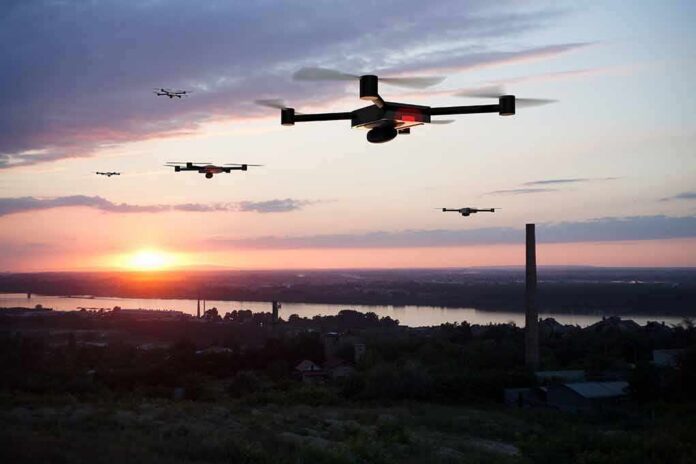
Beijing outlawed owning, storing, or bringing drones into the city, turning the entire capital into controlled airspace effective November 15, 2026.
Story Highlights
- Beijing’s legislature enacted a citywide drone ban covering ownership, storage, flights, and transport into the capital.
- Officials moved from sales limits in May to full possession limits in November, with confiscation and fines allowed.
- A June aircraft crash near the city’s tallest tower preceded the rules, though it was not tied to a drone in reports.
- Residents were told to remove drones from Beijing by the effective date using air, rail, or road options.
Citywide Prohibition and Effective Date
Beijing’s Municipal People’s Congress Standing Committee adopted revised rules that ban owning, storing, flying, or carrying drones and core parts anywhere in the city from November 15, 2026. The measure designates all of Beijing as controlled airspace, meaning private drones are not allowed within the city’s limits at all. The National People’s Congress site states the prohibition applies “across the city,” including urban and rural areas. The change reflects a formal regulation rather than only an executive notice.
Authorities also barred people and companies from bringing drones or core components into the capital by any means of transport. The rules direct current owners to remove drones from Beijing before the effective date by using civil aviation, rail, or roads. This approach sets a clear compliance clock and a removal path for existing owners. The municipal legislature’s summary frames the move as strengthening capital security with a single, clear standard for the whole city.
Escalating Controls and Penalties
Officials used a staged approach. They first restricted sales in May 2026. They then expanded the limits to include possession and storage, closing gaps that would allow drones to remain in homes, offices, or warehouses. The Associated Press reports that enforcement tools include confiscation of noncompliant drones and fines on people or firms that break the rules. These steps move beyond warnings and rely on penalties designed to change behavior and reduce drone presence.
The new rules give police and other local agencies clear authority to act. Because the ban covers all neighborhoods, enforcement does not hinge on complex no-fly maps or technical geofences. The all-city scope reduces room for disputes over boundaries or exceptions at district edges. However, public excerpts do not detail any exemptions for government, emergency, industrial, or research use, nor do they explain an approval path for such operators in Beijing.
Triggering Incident and Stated Rationale
The policy followed a deadly late-June crash of a small aircraft near Beijing’s tallest skyscraper. Reports say the pilot died and thirteen people were hurt. Coverage places this crash just before the regulatory push, which ties the timing of the policy to a period of heightened safety concern. The reports that describe the crash and the penalties do not say a drone caused the accident, and they do not cite a public accident report linking drones to the event.
The official summaries stress security of the capital as the goal and present a controlled airspace as the tool to reach it. They do not publish threat data, incident totals, or a comparison showing why broad possession limits outperform options like registration or geofencing. The rule’s design chooses simplicity and control at city scale over a layered model with narrower prohibited zones or tiered access based on operator history and technology.
What the Ban Means Beyond Beijing
The sweeping scope sets Beijing apart from many cities that rely on targeted no-fly areas and operator tracking. China has promoted a “low-altitude economy” that includes delivery drones and other services, yet its airspace rules are still evolving. Analysts describe overlapping roles among military, civil aviation, and local bodies, and call for clearer, unified systems. Beijing’s move fits a global pattern where governments tighten control as drone use rises faster than safety systems mature.
Drone ownership ban comes into force in Beijing over security concerns https://t.co/wGkx7LUdNR
— Franz Gil (@athendoflight) November 15, 2026
The next test will be enforcement clarity and economic impact. Residents, travelers, and businesses face an all-or-nothing rule at airports, train stations, warehouses, and homes. Confiscations and fines are possible, but public records of inspections, appeals, or exemptions are not yet available. For many readers, this story will feel familiar: a government using broad powers to manage risk with little public data. That is a reminder to track how rules meant for safety can reshape daily life and industry as they expand.
Sources:
insiderpaper.com, nst.com.my, apnews.com, economictimes.indiatimes.com, rutlandherald.com