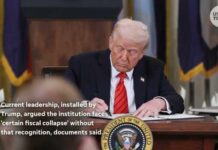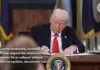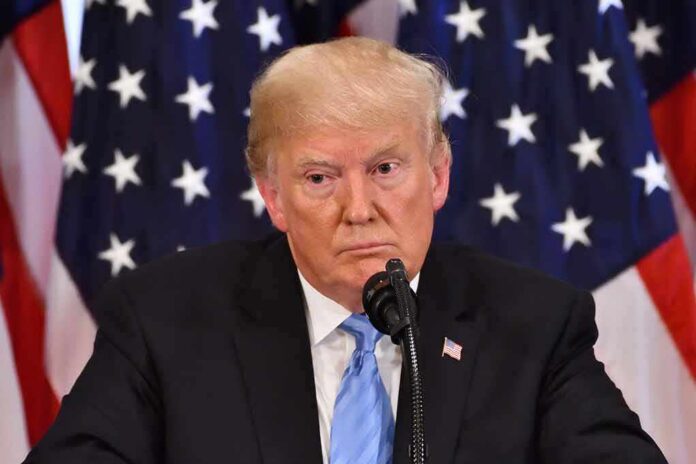
President Trump moved his Friday Cabinet meeting out of the White House and into Camp David, letting cameras roll for the entire public session as officials briefed him on Iran, the economy, and border security.
Quick Take
- President Trump held his July 31 Cabinet meeting at Camp David instead of the White House.
- Press Secretary Karoline Leavitt said letting media stay for the whole meeting shows the president’s commitment to transparency.
- Cabinet officials gave updates on their agencies during a session that can run up to three hours.
- The meeting happened as tensions with Iran and border security remained top issues for the administration.
- No official transcript has been released, so the full content of the discussion is not yet public record.
A Cabinet Meeting Moves to the Mountains
President Trump swapped the White House Cabinet Room for the rustic backdrop of Camp David on July 31, 2026. Live broadcasts from C-SPAN and several news outlets showed the president gathering senior officials at the Maryland retreat. The White House said the session covered Trump’s policy agenda, including domestic priorities and national security matters tied to ongoing tensions with Iran.
The move was not without precedent. Camp David has hosted formal Cabinet business before, including a similar meeting during Trump’s first term in September 2017. But the retreat’s use has been unpredictable this year. In May, Trump abruptly canceled a planned Camp David trip over bad weather, shifting the meeting back to the White House at the last minute.
Cameras Roll for the Full Session
Press Secretary Karoline Leavitt pointed to the extended camera access as proof of the president’s openness. She said allowing reporters to stay for the duration of the meeting, rather than just brief opening remarks, “proves his commitment to transparency”. Reporting confirms these sessions can stretch up to three hours, with Cabinet members updating Trump on their departments in front of the cameras.
That claim, however, rests mostly on the administration’s own description of the event. No independent transcript or full pool recording has surfaced publicly to verify exactly how much of the meeting stayed on camera or whether any portions were closed to reporters. That gap does not undercut what clearly did happen on screen, but it does limit outside verification of the administration’s broader transparency claim.
Substance Behind the Spectacle
Multiple outlets, including The Hill and C-SPAN, treated the event as a routine but real Cabinet meeting, not a staged photo opportunity. Still, past coverage of these sessions has noted a pattern: officials often use the televised time to heap praise on the president rather than dive deep into policy specifics. That dynamic can make viewers question how much real governance happens versus performance for the cameras.
Camp David’s secure, controlled setting adds another wrinkle. Unlike the White House press room, the retreat is not a normal media venue, so outside reporters and viewers depend almost entirely on official broadcasts to know what happened. That limits independent corroboration and leaves the administration largely in control of the narrative around its own openness.
Why This Matters Beyond One Meeting
This episode fits a familiar pattern in modern presidencies: high-visibility events blur the line between genuine governance and stage-managed messaging. When the venue is secure, the camera access is chosen by the White House, and the administration itself explains why the event matters, skeptics on both the left and right have reason to ask whether transparency claims hold up under scrutiny or simply serve a talking point.
None of this disproves that real business got done at Camp David. Officials did brief the president on-camera, and the meeting tackled real issues like Iran and border security. But without a released transcript or independent pool record, Americans are left trusting the administration’s framing of its own transparency, a tension that cuts across party lines and feeds broader public distrust of how government explains itself.
Wheels down at Camp David, where President Trump will hold a Cabinet meeting. Tune in! 🇺🇸 pic.twitter.com/W5f3XzU4lf
— Anna (@anna_201xv) July 31, 2026
Whether this particular meeting produced concrete policy follow-through will likely become clearer as individual agencies issue their own readouts in coming days. Until then, the public record shows a real, filmed Cabinet session at Camp David, paired with an administration eager to frame open camera access as proof of good faith.
Sources:
facebook.com, ms.now, trumpwhitehouse.archives.gov, thehill.com, youtube.com