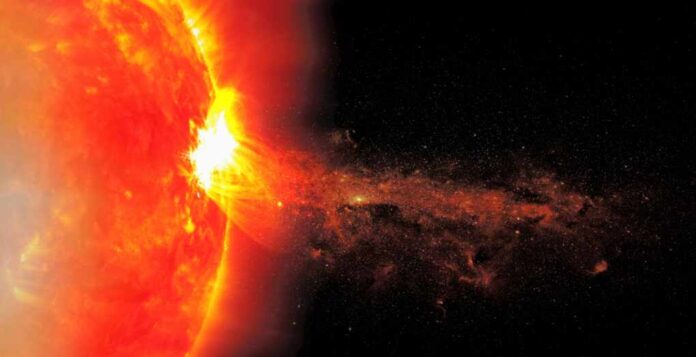
A mysterious interstellar object with unprecedented anomalous behavior has vanished behind the Sun, prompting Harvard astrophysicist Avi Loeb to question whether this visitor might be of artificial origin.
Story Highlights
- Third interstellar object ever detected exhibits bizarre “anti-tail” pointing toward the Sun
- Harvard’s Avi Loeb rates object 4/10 on his scale for potential artificial origin
- Object emits unusual chemicals including cyanide and nickel in multiple directions
- Currently hidden behind Sun, preventing direct observation and analysis
- Expected to re-emerge near Jupiter, offering new observation opportunities
Unprecedented Visitor Defies Natural Comet Behavior
The interstellar object designated 3I/ATLAS entered our solar system in July 2025, immediately drawing attention for its extraordinary characteristics. Unlike typical comets that develop tails pointing away from the Sun, this object displays a sunward-pointing “anti-tail” that contradicts established physics. The Keck II telescope in Hawaii captured detailed observations revealing chemical emissions of cyanide and nickel streaming in both sunward and anti-sunward directions, behavior never before documented in natural celestial bodies.
Astronomer Suspects Mysterious Object Is Up to No Good While It’s Hidden Behind the Sun: “If You Want to Take a Vacation, Take It Before Then” https://t.co/F06i2dGnZI
— Newt Gingrich (@newtgingrich) October 24, 2025
Scientific Community Split on Object’s True Nature
Harvard astrophysicist Avi Loeb has emerged as the leading voice questioning conventional explanations for 3I/ATLAS. Loeb, who previously challenged mainstream thinking about the interstellar visitor ‘Oumuamua in 2017, assigns this latest object a 4/10 rating on his scale for potential artificial origin. His preprint paper, awaiting peer review, argues that the object’s anomalous features warrant serious consideration of non-natural explanations. However, UCLA’s Michael Busch and other mainstream astronomers propose alternative theories based on dust grain dynamics and optical projection effects.
The timing of this discovery coincides with heightened interest in extraterrestrial intelligence research and improved detection capabilities. Only two other confirmed interstellar objects have entered our solar system: ‘Oumuamua and 2I/Borisov. While 2I/Borisov behaved like a conventional comet, both ‘Oumuamua and 3I/ATLAS have exhibited characteristics that challenge our understanding of natural space debris.
Strategic Implications for National Security and Science
The object’s unprecedented speed and size raise questions about our ability to detect and assess potential threats from space. 3I/ATLAS represents a case study in the importance of maintaining robust astronomical surveillance capabilities and avoiding premature dismissal of anomalous phenomena. The current administration’s focus on American scientific leadership becomes particularly relevant when considering our nation’s preparedness for unexpected celestial visitors, whether natural or otherwise.
NASA and ESA spacecraft, including Juno and Juice missions, may provide crucial observational opportunities when 3I/ATLAS approaches Jupiter later this year. These observations could definitively resolve the debate about the object’s nature and inform future protocols for investigating similar anomalies. The scientific community’s handling of this case will likely influence how we approach the investigation of future interstellar objects and the criteria for considering unconventional explanations.
Sources:
Daily Galaxy: Astronomers Spot Interstellar Visitor Shooting Bizarre Tendril Toward the Sun
Futurism: Mysterious Interstellar Object Has Sprouted a Tendril
ScienceDaily: Harvard Astrophysicist Suggests Mysterious Interstellar Object Could Be Alien-Made
The News: 3I/ATLAS vanishes behind Sun, new images reveal strange activity