Washington just proved it can squeeze Iran’s ports without strangling the world’s oil lifeline—and that reality check is rattling every actor who profits from chaos in the Gulf.
Quick Take
- U.S. Central Command says a new naval blockade halted traffic to and from Iranian ports in its first 24 hours, with six merchant vessels turning back.
- The operation is framed as a targeted pressure campaign on Iran’s shipping—not a closure of the Strait of Hormuz for non-Iranian traffic.
- President Trump ordered interdictions and mine-destruction after Pakistan-mediated talks reportedly failed over U.S. red lines on enrichment, proxies, and toll-free passage.
- Iran’s competing narrative—claims of control of the strait and assertions a U.S. destroyer retreated—remains unverified by U.S. sources.
Blockade mechanics: shutting Iranian ports while keeping Hormuz moving
U.S. Central Command reported that a Navy-led blockade of Iranian ports began Monday, April 13, 2026, at 10 a.m. EDT, backed by more than 10,000 personnel, about a dozen warships, and dozens of aircraft. By Tuesday morning, CENTCOM said no ships had breached the enforcement lines, and six merchant vessels reversed course back toward Iranian ports on the Gulf of Oman. The stated objective is pressure on Iran’s maritime commerce while allowing non-Iranian transit through the Strait of Hormuz.
That distinction matters because the Strait of Hormuz is not a side channel—it is a global chokepoint often estimated at roughly 20% to 30% of the world’s oil flows. U.S. messaging emphasizes a freedom-of-navigation posture for everyone except Iranian port traffic and Iranian-linked shipping. For American consumers, the political stakes are obvious: energy price shocks hit working families first, and targeted enforcement is designed to avoid the self-inflicted wound of a broad shutdown that would spike costs at home.
Diplomacy breakdown: Islamabad talks and Trump’s order
CBS News’ live updates described marathon weekend negotiations in Islamabad, mediated by Pakistan, that failed to bridge U.S. demands. The reported U.S. red lines included ending uranium enrichment, dismantling nuclear facilities, retrieving enriched uranium, expanding a regional peace framework, halting funding to Hamas, Hezbollah, and the Houthis, and keeping Hormuz open without tolls. On Sunday, April 12, President Trump said he ordered the Navy to interdict toll-paying vessels and destroy Iranian mines, coupled with warnings of retaliation for Iranian attacks.
Vice President JD Vance framed the moment as leverage: the United States holds overwhelming military and economic advantages, while Iran has relied on asymmetric threats—mines, drones, and regional proxies—to offset conventional weakness. From a limited-government perspective, Americans tend to be wary of open-ended entanglements; at the same time, they also expect the federal government to protect U.S. commerce and deter hostile regimes. The administration’s argument appears to be that a narrow, enforceable maritime action can apply pressure without committing to a full-scale war.
Competing narratives: CENTCOM claims vs. Iranian information warfare
The information environment is already contested. Iranian-linked claims circulating in video form have asserted that an IRGC warning forced a U.S. destroyer to retreat from the strait, but the research provided notes those claims are unconfirmed by U.S. sources. Iranian officials have also called the blockade “piracy,” warned of retaliation, and claimed full control of the strait for non-military vessels. This is a familiar pattern in U.S.-Iran standoffs: Tehran projects strength for domestic legitimacy and deterrence, while U.S. officials stress operational control and legality.
Military posture and escalation risk in a crowded battlespace
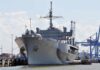
CBS also outlined a heavy U.S. naval footprint in and around the broader theater, including the USS Abraham Lincoln carrier group, multiple destroyers, and the USS Tripoli in the region, with the USS Gerald Ford operating in the Mediterranean. The same reporting referenced Iranian mines previously laid and cleared by U.S. destroyers, underscoring why mines remain a central concern in any Hormuz crisis. Even a “targeted” blockade can escalate quickly if Iran tests the perimeter with drones, small boats, or proxy attacks on shipping.
What it means for Americans: energy prices, credibility, and government trust
The near-term economic question is whether this posture stabilizes shipping confidence or triggers retaliation that rattles energy markets. The research notes disrupted shipments—including oil and fertilizer—can ripple into price spikes. Politically, the administration’s early “no breaches” message is being treated by supportive outlets as a proof of competence after years when many voters felt Washington tolerated disorder abroad and at the border at home. Skeptics, including many who distrust the “deep state,” will still demand transparent metrics: duration, costs, and a clear exit ramp.
Hormuz Open, Iran Shut: U.S. Navy’s New Day-One Victoryhttps://t.co/hWCna2cvm6
— RedState (@RedState) April 14, 2026
For now, the strongest verified claims in the provided research are procedural and operational: the blockade start time, the first-day enforcement results, and the administration’s stated aim to keep Hormuz open for non-Iranian traffic. The least verifiable pieces are the Iranian video-based claims about forcing U.S. movements and broader assertions of control. If the blockade holds without a wider shutdown, it will test a central promise of “peace through strength”: apply pressure on a hostile regime while limiting collateral damage to ordinary Americans.
Sources:
Hormuz Open, Iran Shut: U.S. Navy’s New Day-One Victory
Iran war live updates: U.S.-Iran ports blockade, Strait of Hormuz, Trump