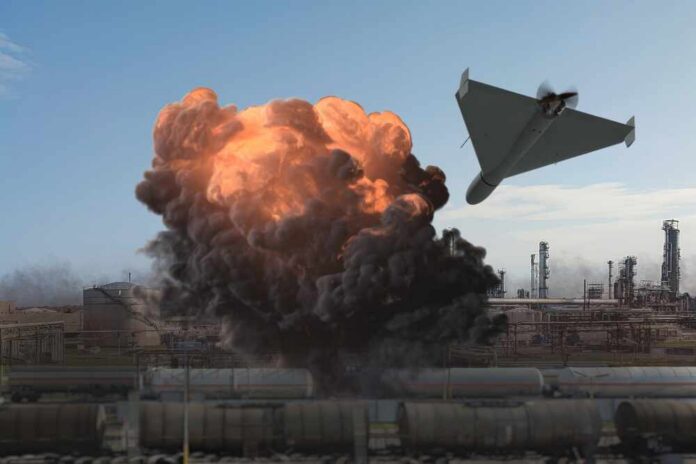
A $500, jam-proof drone is exposing an uncomfortable reality of modern war: cheap tech can outmatch billion-dollar defenses.
Story Snapshot
- Hezbollah is using fiber-optic, first-person-view (FPV) drones that can’t be stopped by typical electronic jamming.
- An April 28 strike near Shomera in Israel’s western Galilee injured 12 Israeli soldiers and destroyed a vehicle carrying artillery shells.
- Israeli reporting points to preparedness gaps against low-flying FPV threats, even as the IDF adapts with small-arms fire and new counter-drone efforts.
- Claims about drone range vary widely across sources, with Israeli accounts generally describing shorter operational ranges than pro-Hezbollah-leaning commentary.
Shomera strike shows how “cheap” weapons can hit high-value targets
Israeli forces absorbed a sharp warning on April 28 when a fiber-optic guided FPV drone hit near Shomera in the western Galilee, injuring 12 soldiers and destroying a military vehicle carrying artillery shells for an “Alpha” battery, according to reports summarized across multiple outlets. The incident stood out because it was described as the first such fiber-optic FPV attack reported in that specific area, signaling a widened threat footprint.
Fiber-optic drones change the usual defensive equation because the operator’s control and video feed travel through a cable spool rather than through radio links that can be jammed. That matters because sophisticated militaries have invested heavily in electronic warfare as a primary layer of defense against drones. When that layer is bypassed, troops often fall back on rifles, machine guns, and quick reactions—tools that can work, but do not offer the reliable, scalable protection that radar-and-jammer systems are designed to provide.
How fiber-optic FPV drones are built, and why they’re hard to defeat
Reporting describes the drones as assembled from commercially available components and 3D-printed parts, paired with cameras and a munition such as an RPG warhead. The defining feature is a fiber-optic cable spool that links the drone to its operator, a tactic widely associated with lessons from the Russia-Ukraine battlefield where jamming is intense and constant. Analysts cited in coverage note that cost scales with cable length, making the platform both modular and disposable.
Range remains the most contested technical detail. Some commentary claims extreme distances, while Israeli and other reporting describes shorter operational ranges measured in the low tens of kilometers, with one analysis suggesting the IDF initially underestimated launch distance and later assessed longer practical launch points. That discrepancy matters for civilian planning and military posture: a longer range expands the number of potential launch sites and complicates border surveillance, while shorter range concentrates risk near known corridors and positions.
A-Tayyiba attack underscored the danger to evacuations and “routine” movements
The April 26 incident in A-Tayyiba sharpened the sense that this is not only a front-line trench problem. Coverage says an FPV drone strike killed Sgt. Idan Fox and wounded six others, and a follow-up blast occurred near an evacuation helicopter during the response. Separately, reports describe additional drone incidents causing injuries in recent weeks and even the death of an Israeli defense contractor during operations in south Lebanon, reinforcing how quickly tactical drones can threaten logistics and rescue efforts.
Israel’s preparedness challenge is bigger than one border skirmish
Israeli reporting frames the drone problem as a preparedness gap rather than a mystery. FPV drones fly low, move fast, and can be guided into precise points on vehicles, positions, and convoy routes. That combination pressures commanders to harden transport routines, restrict predictable movement, and expand close-in defenses. Israel’s Defense Ministry has also signaled urgency by seeking interception solutions, a sign that existing layers are being tested in real time by evolving, low-cost attack methods.
For American readers, the strategic takeaway is broader than the Israel-Hezbollah theater. The same “cheap precision” model is spreading because it fits a modern asymmetry: a non-state actor can spend hundreds of dollars to threaten equipment worth millions and force expensive defensive adaptations. That dynamic also feeds public frustration—on the right and left—about whether governments and security establishments can keep up with real-world threats as efficiently as they fund high-dollar legacy programs.
Hezbollah's Cheap Fiber Optic Drones A Growing, Deadly Problem For Israeli Troop Convoys https://t.co/hGctMWNBzV
— zerohedge (@zerohedge) May 1, 2026
For now, the strongest verified points are the incidents themselves, the growing role of fiber-optic FPV drones, and the visible strain they place on standard counter-drone doctrine. The least settled details involve maximum range claims and the exact scale of deployment, where sources disagree and some outlets appear more prone to amplification than verification. What is not in dispute is the core trend: inexpensive, jam-resistant drones are forcing costly changes and exposing uncomfortable vulnerabilities.
Sources:
Hezbollah’s Cheap Fibre Optic Drones A Growing, Deadly Problem For Israeli Troop Convoys
Calcalistech report on fiber-optic FPV drones and Israel’s countermeasures
Ynet report on Hezbollah importing Ukraine war drone tactics
Fatal Hezbollah attack exposes gaps in IDF preparedness for first-person-view drones
Left in Disbelief: Israel in Panic Over Hezbollah FPV Drone Nightmare