

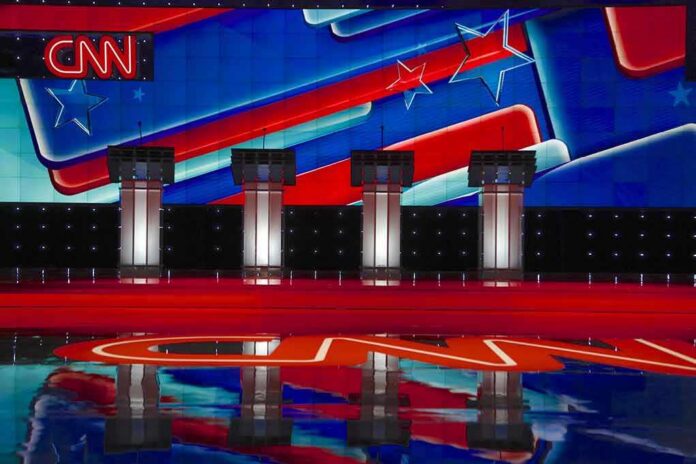
A CNN panelist’s on-air outburst over President Trump’s $5,000 “dividend” promise captured a larger fight over money, math, and power in Washington.
Story Snapshot
- President Trump tied $5,000 payments to Republicans winning both chambers of Congress.
- Trump framed the payout as a national “dividend,” with allies pointing to tariffs as funding.
- Analysts say the plan could cost over $1 trillion, far above tariff receipts.
- Legal experts say Congress would need to approve any such spending.
What Trump Promised And Why It Lit A Firestorm
President Trump told supporters he would send every American adult $5,000 if Republicans control the House of Representatives and the United States Senate after the midterms. He called the payout a “dividend,” comparing it to a company sharing profits with owners. Supporters highlighted tariff revenue as the source. Vice President JD Vance and others have pushed that rationale in recent media hits, echoing Trump’s trade-first message. The pledge landed weeks before voting, making it a central campaign flashpoint.
Independent journalist Brad Polumbo blasted the idea during a CNN segment, calling it unrealistic and mocking the claim that Congress was not needed to approve it. The clash spread online because it taps a shared public worry: big promises with fuzzy math. Many voters across the spectrum feel leaders chase headlines while ducking hard trade-offs. The fight over this plan has become a test of trust, process, and whether Washington still plays by its own rules.
The Money Problem: Costs Versus Tariff Revenue
Outside estimates peg the gross cost above $1 trillion, given roughly 240 million adult citizens who could qualify. Reuters reported that tariff collections do not approach that scale, which leaves a large gap between the proposed funding source and the promised checks. Past “tariff dividend” ideas also ran into the numbers wall. Analysts previously found that projected costs outpaced likely tariff revenue even under generous assumptions, raising doubts about fiscal feasibility. This is why critics warn the math does not work.
The administration’s announcement did not include a line-item funding plan, offsets, or a schedule for payments. That absence matters. Budget watchdogs and market observers judge programs on cash flows and legal authority. Without a clear revenue stream, the Treasury would need Congress to pass an appropriation. The lack of details signals that major steps—committee text, budget scores, and timelines—remain undone. Until then, the plan sits as a campaign promise rather than an executable policy.
The Law Problem: Can A President Send Checks Alone?
Legal experts told reporters that the Constitution requires congressional appropriations to spend federal money. That means any broad payout needs a law passed by Congress and signed by the president. CBS also reported that Trump said he did not think Congress needed to approve the payments, which conflicts with standard appropriations practice and fueled more pushback. Even some Republicans signaled doubts, citing inflation and deficit risks if the plan advanced without clear funding.
A Republican senator said he would consider introducing supportive legislation, which could offer one path forward if party leaders align on scope and pay-fors. A bill could define the program as an appropriation, tax rebate, or tariff refund, each with different budget effects. It would also force a real score from the Congressional Budget Office. That would show whether tariffs, spending cuts, or new borrowing would carry the plan. Until then, lawmakers and voters are arguing in the dark.
Why This Resonates With Voters Who Feel Locked Out
Many Americans see the $5,000 promise through a broader lens of broken systems and elite impunity. People on the right recall high prices and stalled wages and want leaders to return money to households. People on the left see growing gaps between the wealthy and everyone else and doubt windfalls that skip hard policy work. Both sides fear that Washington sells big checks while passing the bill to working families later through debt or higher costs. The skepticism is shared, even if the reasons differ.
Trump says the $5,000 dividend "will happen", as elected Republicans line up publicly against it.
He gave no new detail on timing or funding, arguing Americans deserve to benefit from what he described as trillions of dollars of economic development and investment: "When I say…
— Tiberiade (@tiberiadex) September 12, 2026
That is why one sharp exchange on television mattered. The outburst was not only about a number. It was about who decides, who pays, and whether rules still bind the powerful. The next real test is simple: Does a bill appear, with math that adds up and a legal path that holds up? If not, the “dividend” will join a long list of splashy promises that died in the swamp—another sign to many that the system talks big and delivers little.
Sources:
mediaite.com, abcnews.com, businessinsider.com, reuters.com, nbc4i.com, newsday.com, economictimes.indiatimes.com, cnbc.com, cbsnews.com