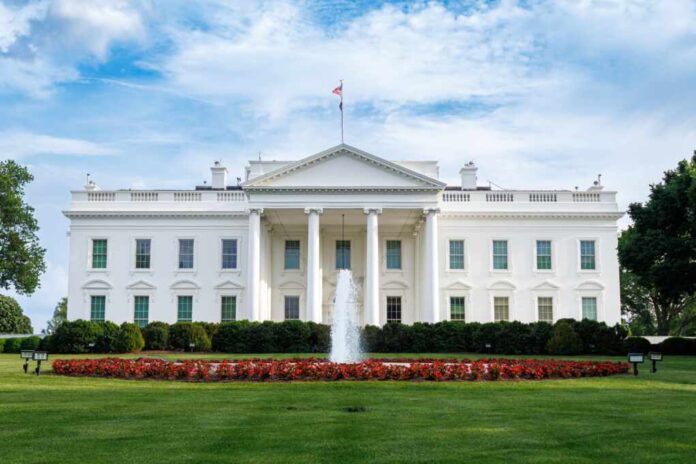
A massive White House expansion project, led by President Trump, raises questions about historic preservation and executive authority.
Story Highlights
- Part of the White House East Wing demolished for a new ballroom.
- Project funded by private donors, bypassing federal budget constraints.
- Construction proceeds amid a federal shutdown, sparking political debate.
- Regulatory approval for full plans remains pending.
White House Ballroom Project Sparks Controversy
In a bold move that has stirred both admiration and criticism, President Trump has initiated a significant expansion of the White House. The East Wing is being partially demolished to make room for a new $250 million ballroom, funded entirely by private donors. This development, which began in October 2025, is proceeding even as the federal government experiences a shutdown, raising questions about priorities and the use of private funds for public buildings.
The new ballroom is set to accommodate up to 999 guests, far exceeding the capacity of the historic East Room. However, the project has not yet received full approval from the National Capital Planning Commission (NCPC), which oversees such constructions in Washington, D.C. The NCPC’s role has been overshadowed by the project’s reliance on private funding, which allows it to continue despite the lack of federal oversight.
👀💥WHITE HOUSE EAST WING BEING DEMOLISHED TO MAKE WAY FOR TRUMP’S NEW 90,000-SQ-FT BALLROOM
Demolition crews are removing part of the East Wing for a privately funded ballroom planned to seat 650 — more than triple the East Room capacity.
📹 tessaron_news_3#WhiteHouse #Trump pic.twitter.com/jMHF8nyoOo
— Kristy Tallman (@KristyTallman) October 20, 2025
Private Funding Allows Construction Amid Shutdown
The private financing of the ballroom has sparked a broader debate about the precedent it sets for future public projects. With the federal government unable to fund such an initiative during a shutdown, Trump’s use of donor money circumvents traditional budgetary constraints. This approach has been lauded by some conservatives for its ingenuity, yet criticized by others for potentially undermining regulatory checks and balances.
Construction is being managed by Clark Construction, with a contract valued at $200 million. The entire project is expected to be completed by 2029, although experts have described this timeline as overly optimistic given the scale of the work and the regulatory hurdles that remain unaddressed.
Implications for Historic Preservation
Preservationists express concern that the demolition and expansion could permanently alter the historic integrity of the White House complex. The East Wing, originally constructed in 1902, has historical significance that could be compromised by such large-scale modifications. The balance between modernization and preservation remains a contentious issue, with critics arguing that this project prioritizes luxury over legacy.
As the project progresses, it will likely continue to be a point of contention in political and public discourse, reflecting broader debates over the role of private money in public spaces and the preservation of national heritage.
Sources:
White House State Ballroom
The White House Announces White House Ballroom Construction to Begin