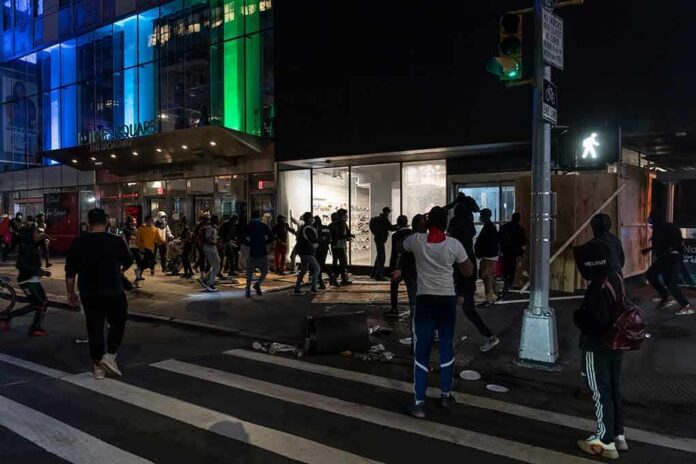
Across major European cities, rioters torched streets while Palestinian flags and far-left symbols waved in the same crowds, raising urgent questions about who is steering the unrest and why it spread so fast.
Story Highlights
- Palestinian flags appeared beside anarchist and Antifa symbols in German protests.
- French unrest featured Palestinian and Algerian flags and flag burnings in Lyon.
- Pro-Palestinian groups were reported among France’s protest backers, but direct control is unproven.
- Mainstream outlets link the larger marches to cost-of-living and school grievances, not foreign direction.
What happened across Europe this week
News outlets in Europe reported violent clashes, fires, and looting in several countries. In Germany, demonstrations erupted in about 30 cities on October 31. Reporters described fires and damage in Hamburg and Frankfurt. At Berlin’s Platz des 18. März, Palestinian flags were visible near anarchist and Antifa logos, suggesting a mix of causes inside the same crowds. In France, protests included Palestinian and Algerian flags in central Paris, while some groups later rioted apart from larger rallies.
French footage from Lyon showed protesters burning United States and Israeli flags and chanting harsh anti-Israel slogans. Those scenes circulated widely and fueled claims that Gaza activism and local anger had merged on the streets. Reports also tied parts of the French protest landscape to left-wing and pro-Palestinian groups. A roundup cited communist, revolutionary-socialist, Muslim student, and Palestinian-solidarity organizations among dozens of players that amplified or joined events. These details fed a narrative of ideological overlap across borders.
What the flags prove—and what they do not
Palestinian flags, keffiyehs, and chants establish that Gaza solidarity was present where unrest broke out. They also show that symbols tied to the far left stood nearby in at least one German hotspot. But symbols are not chains of command. The reports do not prove that pro-Palestinian groups planned or ordered arson or attacks. They also do not show a single cross-border leader or funder. The evidence supports overlap in imagery, not clear operational control.
Some coverage named specific pro-Palestinian groups in France. Urgence Palestine was described as attending October demonstrations, and a branch of Association France Palestine Solidarité publicly backed them. That shows organizational presence. Yet no supplied record links those groups to specific criminal acts during riots. Without arrest logs, indictments, or court findings tying members to acts, the gap remains. Readers should separate attendance, amplification, and actual violent conduct.
How mainstream outlets frame the same unrest
Major outlets described hundreds of thousands marching over school conditions, living costs, and pressure on family budgets. The British Broadcasting Corporation reported large, mostly peaceful marches in France before clashes broke out. It cited anger over staff shortages, crowded classrooms, and old buildings. Reuters highlighted cost-of-living pain, poor schools, housing problems, corruption, and feeling ignored by leaders as the main drivers of the protest wave.
This frame does not deny that Palestinian symbols appeared. It says the big engine is domestic strain. The cost squeeze and failing services push people into the streets. Smaller groups may then clash with police or set fires as night falls. That pattern, reported in France, warns us not to treat every flag as proof of command. Peaceful majorities can share space with violent fringes that grab the cameras.
Why this matters for readers in the United States
These scenes will echo in U.S. debates over public safety, migration, and foreign influence. Many Americans on the right and left already believe elites let disorder fester while everyday people pay the price. European leaders also face anger over costs, schools, and trust in institutions. When governments ignore basic needs, movements mix. That leaves room for outside causes to ride local anger and for bad actors to hide inside big crowds.
To move past suspicion, officials should release hard records. Police and prosecutors can publish anonymized arrest data, charge sheets, and court outcomes that state who did what, and whether any group ties exist. Lawful reviews of organizer communications and funding in criminal cases can test claims of coordination. Clear facts will help citizens judge whether this wave was mostly about broken schools and bills—or also about organized networks steering violence.
Sources:
kompas.id, theage.com.au, ianslive.in, algemeiner.com, timesofisrael.com, bbc.com, reuters.com