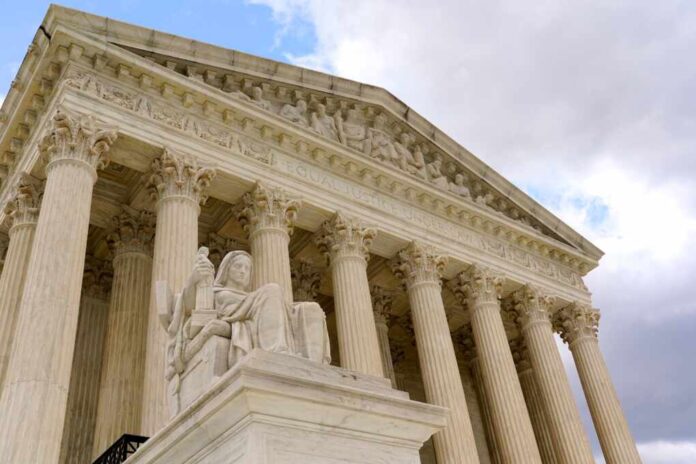
Supreme Court conservatives signal strong support for state bans protecting girls’ sports from biological male advantages, delivering a potential victory for fairness and Title IX.
Story Highlights
- The majority of justices, led by conservatives, showed skepticism toward challenges against Idaho and West Virginia bans during January 13, 2026 oral arguments.
- The Trump administration backs states, arguing laws ensure fairness in women’s sports amid scientific uncertainty on hormone effects.
- 27 states already enforce similar protections; ruling could affirm biological sex categories nationwide.
- Cases involve transgender plaintiffs on puberty blockers, but Court leans toward upholding categorical bans.
Oral Arguments Reveal Conservative Tilt
On January 13, 2026, the U.S. Supreme Court heard three-and-a-half hours of arguments in cases from Idaho and West Virginia. These challenge state laws barring transgender women and girls from women’s school sports teams. Conservative justices including Thomas, Alito, Kavanaugh, and Barrett expressed doubt about challengers’ claims. They prioritized fairness for cisgender female athletes. Justice Kavanaugh highlighted states’ rights amid uncertainty over hormone therapy’s impact on physical advantages. This stance aligns with protecting Title IX gains for girls’ sports over the past 50 years.
https://youtu.be/W5RGj3UJYBQ?si=oqSQmfpFGNbUJFkN
State Laws Defend Biological Fairness
Idaho enacted its ban first, prompting the 9th Circuit to block enforcement. That court cited 14th Amendment equal protection violations and invasive sex verification issues. West Virginia followed with a similar law, blocked by the 4th Circuit under Title IX sex discrimination rules. Both states, backed by Attorney General Raúl Labrador in Idaho, defend the measures for safety and competitive equity. The Trump administration, through Hashim Mooppan, argued the laws achieve a reasonable fit without needing perfect proof of advantages. Transgender plaintiffs Lindsay Hecox and Becky Pepper-Jackson, on hormones and blockers, seek exceptions via ACLU representation.
Justice Perspectives Favor State Authority
Chief Justice Roberts questioned broad national implications of striking down state laws. Justice Alito noted concerns from cisgender girls facing unfair competition. Justice Gorsuch probed whether states must fully prove hormone therapy erases all edges but remained cautious. Liberal justices like Jackson and Sotomayor explored narrow as-applied rulings for medicated athletes. Overall, conservative majority appeared poised to defer to states. This reflects common-sense recognition that biological males retain advantages, safeguarding opportunities women fought for under Title IX since 1972.
Post-Bostock v. Clayton County in 2020, which extended employment protections but ignored sports, states responded to protect female categories. Half the states now ban transgender girls in girls’ sports; the other half allow participation, creating inconsistency. A Supreme Court upholding would validate 27 similar laws and impact roughly 122,000 transgender high school athletes, just 1% of total participants.
Implications for Women’s Sports and Families
A decision expected by June 2026 could solidify biological sex separations in K-12 sports. This would benefit millions of cisgender girls by preserving scholarships, records, and safety. Schools face compliance challenges, but precedent would guide high school federations nationwide. Politically, it reinforces state-led solutions against federal overreach, echoing conservative values of limited government and family priorities. Long-term, it may limit transgender inclusion pushes, protecting the integrity of women’s athletics that leftist policies have undermined.
Conservative justices distinguished these bans from anti-trans discrimination, noting transgender boys compete on boys’ teams without issue. This balanced approach upholds equal protection without eroding traditional sex-based categories essential to Title IX.
Sources:
Supreme Court appears likely to uphold transgender athlete bans
Supreme Court appears to uphold bans on transgender girls in girls’ sports
Five takeaways from the Supreme Court’s showdown over transgender athletes
Supreme Court Concludes Oral Arguments in Historic Transgender Rights Hearing