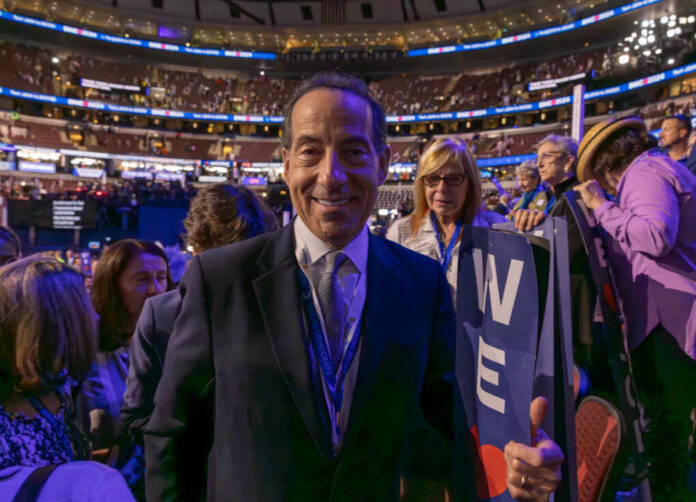
House Democrats are trying to turn the 25th Amendment into a political lever—demanding President Trump take a cognitive exam even though they lack the votes and the constitutional pathway to force removal.
Quick Take
- Rep. Jamie Raskin and more than 70 House Democrats asked the White House physician to conduct a comprehensive cognitive exam of President Trump and brief Congress on the results.
- Democrats are pairing the demand with renewed talk of invoking the 25th Amendment, a mechanism that would require Vice President JD Vance and Trump’s Cabinet to act.
- The push follows Trump’s heated rhetoric during a confrontation with Iran, even after a reported two-week ceasefire was announced.
- Because Republicans control Congress and the White House, the effort is widely described as a long-shot—and it underscores how “fitness” debates have become a recurring partisan weapon.
Raskin’s demand targets the White House physician, not the ballot box
Rep. Jamie Raskin, the top Democrat on the House Judiciary Committee, formally requested that the White House physician administer a neurological and “neurophysical” evaluation of President Donald Trump within two weeks and provide the findings to Congress. The request also seeks a briefing for lawmakers, framing the issue as a public-interest question about presidential capacity rather than a conventional political dispute. The demand has drawn support from more than 70 House Democrats.
The timing matters because it comes amid a larger Democratic effort to revive discussion of the 25th Amendment’s “unable to discharge the powers and duties” standard. Raskin has argued that Republicans previously elevated concerns about President Joe Biden’s cognitive fitness and pushed oversight of the White House medical operation. That prior episode gives Democrats a procedural talking point, even if it does not change the core obstacle: medical demands do not equal constitutional authority to remove a president.
What the 25th Amendment actually requires—and why it’s a steep climb
Section 4 of the 25th Amendment, ratified in 1967, creates a process for transferring power if a president is deemed unable to serve. It starts with the vice president and a majority of the Cabinet declaring the president unfit. If the president contests that declaration, Congress becomes involved, and a two-thirds vote in both the House and Senate is required to keep the vice president acting as president. The amendment has never been used to involuntarily remove a president.
Those thresholds explain why many analysts describe the Democratic strategy as a long-shot. Democrats do not control either chamber of Congress in 2026, and the decision to initiate Section 4 would rest primarily with Vice President JD Vance and Trump’s Cabinet. The research provided does not document any Cabinet member signaling support for such a move, nor does it include public commitments from Vance. Without that executive-branch trigger, Democrats can hold briefings and issue letters, but they cannot compel the constitutional mechanism to start.
Iran rhetoric ignited the latest flashpoint, but the record is still incomplete
The latest round of “fitness” demands followed Trump’s intensifying conflict with Iran, including remarks Democrats cited as alarming, such as a threat to destroy “a whole civilization” in Iran. Democrats have argued the comments raise concerns about judgment in a high-stakes national security context, and Raskin used severe language in describing the implications of such rhetoric. Afterward, a two-week ceasefire with Iran was announced, but the Democratic push did not subside.
Important gaps remain in what’s publicly known from the provided research. No source included here documents how the White House physician has responded to the request or whether the administration intends to provide any additional health disclosure. The research also does not detail any internal Cabinet deliberations, which is the practical center of gravity for the 25th Amendment. In the absence of that information, the story is less about imminent removal and more about political messaging and institutional pressure.
A familiar Washington cycle: cognitive testing as oversight, then as a weapon
One reason the episode is resonating is that it fits a pattern voters across the spectrum have watched for years: health and competence questions become tools for partisan conflict rather than neutral standards applied consistently. Raskin explicitly referenced earlier Republican efforts aimed at Biden, including oversight actions involving the White House physician. That history makes it harder for either party to claim pure motives, and it reinforces public cynicism that Congress prioritizes “gotcha” politics over the everyday economic and security concerns families actually feel.
NEW>> Recycling Raskin: Democrats Demand Trump Undergo Yet Another Cognitive Test in 25th Amendment Pushhttps://t.co/NVWdbcxzNM pic.twitter.com/kdoAStquJK
— Twitchy Team (@TwitchyTeam) April 11, 2026
For conservatives, the key issue is whether constitutional mechanisms designed for genuine incapacity are being stretched into routine opposition tactics—especially when elections and legislative fights already exist for accountability. For liberals, the concern is whether strong executive rhetoric signals instability in a volatile world. The practical reality in 2026 is that the numbers and the constitutional design put the decisive power with Vance, the Cabinet, and large supermajorities in Congress, not with press conferences and letters.
Sources:
Dems dodge Trump removal as party weighs 25th Amendment move
Trump cognitive exam: Jamie Raskin calls for test after Iran rhetoric
Democrats demand Trump undergo cognitive assessment after disturbing rhetoric on Iran war