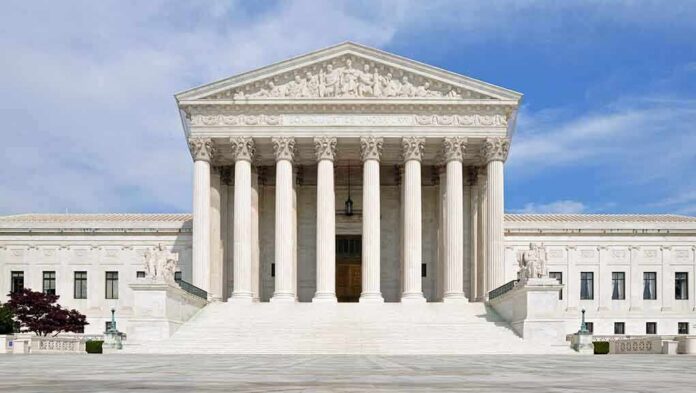
The Supreme Court opened its term by taking a case that could shut down dozens of climate-damage lawsuits nationwide, not just Boulder’s.
Story Snapshot
- The case tests if federal law blocks Boulder’s state-law claims against ExxonMobil and Suncor.
- Colorado’s top court let Boulder’s claims proceed under state law in 2025.
- Energy companies say only federal law can govern climate harms and policy.
- The ruling could shape who pays for wildfire, flood, and other local climate costs.
What the Supreme Court Is Being Asked to Decide
The United States Supreme Court agreed to hear Suncor Energy and ExxonMobil’s appeal in a case brought by Boulder County and the City of Boulder. The justices will weigh whether federal law preempts state consumer-protection and tort claims tied to climate harms, and whether the case belongs in state court at all. The docket lists the dispute as No. 25-170, with briefing focused on federal preemption and jurisdiction rather than the truth of Boulder’s factual allegations.
Suncor and ExxonMobil argue that state lawsuits like Boulder’s are backdoor attempts to regulate emissions, which Congress assigned to federal law. Their petition asks the Court to hold that claims about global climate effects cannot proceed under state law because they intrude on national policy and interstate matters. Several filings frame the issue as one of constitutional structure and statutory design, not who is right about climate science or local damage totals.
How Boulder’s Case Reached the High Court
Boulder and two Colorado counties first filed suit in 2018, seeking money for local costs they tie to climate change, including floods and wildfire impacts. After years of procedural fights over forum, the Colorado Supreme Court ruled in May 2025 that the claims could move forward under Colorado law and were not swept away by the federal Clean Air Act. That state-court green light set up the current appeal to the nation’s highest court.
Reporting and case trackers show the dispute has ping-ponged across courts for years, with companies trying to move or dismiss the case while Boulder pushed to keep it in state court. The United States Supreme Court’s choice to hear the appeal now signals interest in settling whether such state-law climate suits can proceed at all. Court-watchers note the ruling will likely reach far beyond Colorado to many similar city and state cases.
What Each Side Says Is at Stake
Boulder says the companies deceived the public about climate risks and should help pay for local costs, from flood control to wildfire response. It argues these are classic state-law claims about misleading conduct and product impacts, not an attempt to set emission rules. Supporters say letting juries hear evidence on deception and damages fits long-standing state powers to police fraud and protect residents from harm.
The Supreme Court will hear arguments Monday over a bid by Exxon Mobil and Suncor Energy to block a lawsuit filed by the city and county of Boulder over the effects of climate change. https://t.co/9huv2wHUH5
— CBS News (@CBSNews) October 4, 2026
Suncor and ExxonMobil counter that climate change is a global issue that cannot be sliced into local liability under one state’s laws. They warn that allowing state courts to set damages would create a patchwork that overrides national policy and burdens consumers with higher energy costs. Their briefs urge the Court to say that federal law governs here and to end the wave of state-filed climate damages suits before expensive discovery and trials begin.
Why This Fight Hits Nerves on Both Left and Right
Many Americans see a pattern where the powerful avoid accountability while everyday people shoulder rising costs. To some conservatives, state suits risk letting judges, not lawmakers, set national energy policy and prices. To some liberals, blocking these cases looks like shielding big companies from claims of deception and local harm. Both sides share a worry that complex cases move for years while communities face fires, floods, and higher bills with little relief in sight.
What to Watch Next
Oral arguments will focus on two questions: Does federal law block these state claims, and which court system should hear them? A decision narrowing state authority could end or stall many local cases. A ruling preserving state-law paths could open the door to trials and discovery on corporate knowledge and marketing. Either way, the opinion will set ground rules for who pays when climate risks hit homes, roads, and local budgets across the country.
Sources:
cbsnews.com, bouldercounty.gov, washingtonexaminer.com, scotusblog.com, earthrights.org, climatecasechart.com, cnn.com, vox.com