America’s most powerful naval assets face a technological nightmare that threatens to render decades of military superiority obsolete overnight.
Story Snapshot
- China’s “carrier killer” missiles can strike U.S. aircraft carriers up to 4,000 kilometers away, including Guam
- USS Abraham Lincoln Strike Group abruptly redirected from South China Sea to Middle East amid mounting threats
- Advanced anti-access/area-denial systems pose greater risk than traditional nation-state adversaries
- Navy forced to adapt decades-old carrier doctrine to counter hypersonic missile technology
Missile Technology Outpaces Naval Defenses
China’s DF-21D and DF-26 ballistic missiles represent the most credible threat to American aircraft carriers since World War II. These weapons, dubbed “carrier killers,” feature maneuverable reentry vehicles and dual-capable warheads that can penetrate traditional naval defenses. The DF-26’s 4,000-kilometer range places critical U.S. installations like Guam within striking distance, fundamentally altering Pacific naval strategy. This technological advancement forces American carriers to operate outside their optimal engagement zones, reducing their effectiveness.
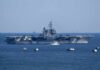
The USS Abraham Lincoln Carrier Strike Group’s recent deployment demonstrates these mounting challenges. After arriving in Guam on December 12, 2025, the strike group conducted patrols in the Philippine and South China Seas to challenge Beijing’s territorial claims. However, the entire formation operated within range of China’s missile envelope, creating unprecedented vulnerability for America’s premier power projection platform.
Pentagon moving USS Abraham Lincoln carrier strike group from South China Sea to Middle East amid Iran tensions.
Expected arrival in about a week.
Do you back Trump helping Iranians topple Khamenei’s regime?
A. Hell yeah
B. NoVia @alexsalvinews pic.twitter.com/u8i27rS0Ge
— 𝔉🅰𝒏 Karoline Leavitt (@WHLeavitt) January 15, 2026
Strategic Repositioning Under Fire
Admiral Daryl Caudle’s emphasis on repositioning carrier strike groups globally within two weeks highlights the Navy’s reactive posture against advanced missile threats. Lincoln’s abrupt redirect from the South China Sea to the Middle East in January 2026 exemplifies this challenge. Live-fire drills conducted near Scarborough Shoal on January 8 included Phalanx Close-In Weapons System exercises specifically designed to counter incoming missiles and aircraft, revealing genuine concern about carrier survivability.
This rapid repositioning capability, while impressive, exposes a fundamental weakness in American naval strategy. Carriers that once dominated maritime regions now retreat when faced with sophisticated anti-ship ballistic missiles. The Pentagon’s decision to redeploy the Lincoln Strike Group demonstrates how advanced weaponry forces strategic compromises, leaving allies in contested regions with reduced American presence and protection.
Constitutional Implications of Naval Vulnerability
The erosion of carrier effectiveness undermines America’s constitutional duty to provide for the common defense and protect national interests abroad. When technological threats force strategic withdrawals, they effectively limit American sovereignty and influence in critical regions. The South China Sea handles trillions in annual trade, and reduced carrier presence emboldens adversaries to challenge freedom of navigation principles essential to American commerce and allied security.
Defense experts increasingly question carrier relevance in high-end conflicts, forcing massive investments in countermeasures and defensive systems. This technological arms race diverts resources from other military priorities while potentially rendering America’s most expensive naval assets vulnerable to relatively inexpensive missile systems. The implications extend beyond military readiness to fundamental questions about defending American interests against asymmetric technological threats that bypass traditional deterrence mechanisms.
https://youtu.be/6f0k6vTPlvA?si=Y8VmrMSJIB3bwXOa
Sources:
Why Golden Fleet Will Sail – CSIS
The U.S. Navy Sent a Nuclear Aircraft Carrier and Seawolf-Class Stealth Sub Into China’s Backyard – 19FortyFive
U.S. Navy Redirects USS Abraham Lincoln Strike Group Toward Middle East as Iran Tensions Surge – Army Recognition
US Aircraft Carrier Steams South China Sea to Mideast After Trump Threat Against Iran – South China Morning Post
In Defense of the Aircraft Carrier – The National Interest
US Navy Carrier Absence Middle East Iran Crisis Deterrence Gap – Defence Security Asia
Naval Aviation: Preparing for the Next 50 Years – USNI Proceedings