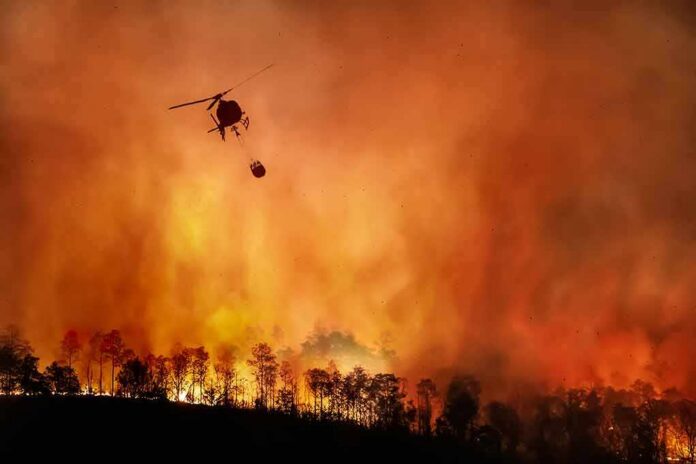
British Columbia’s wildfire crisis pushed the province into a state of emergency as more than 20,000 people fled fast-moving flames near Okanagan Lake.
Quick Take
- The province declared a **province-wide state of emergency** because wildfires were spreading fast across British Columbia.
- More than **20,000 people** were forced to leave homes and communities, with thousands more on alert.
- The Bald Range wildfire grew quickly and was reported to have burned more than 100 square kilometers in hours.
- Officials said the emergency gives the province extra powers to restrict travel and secure housing for evacuees.
Provincewide Emergency Powers Kick In
Premier David Eby announced the state of emergency on Saturday after wildfire activity surged across the province. British Columbia Wildfire Service and EmergencyInfoBC both showed active emergency response measures, including evacuation guidance and support for people forced from their homes.
Kelly Greene, the minister of emergency management and climate readiness, said the declaration gives the province “additional powers,” including the ability to restrict travel and secure accommodations for evacuees. That matters because emergency orders are not just a signal of concern. They can change what officials are allowed to do when roads, shelters, and hotels are under pressure.
Evacuations Grew by the Hour
The evacuation numbers climbed fast as the fire situation worsened. The Associated Press reported that more than 20,000 people were forced to flee, while CBC put the number at about 21,700 displaced in British Columbia, with another 9,700 on evacuation alert.
That gap does not change the larger picture. It shows how wildfire totals can shift as orders, alerts, and displacement change from hour to hour. Provincial updates also showed a broader fire season under strain, with 129 active wildfires reported in one government briefing and 50 listed as out of control.
Bald Range Fire Drove the Crisis
The Bald Range wildfire was the main driver of the sudden emergency. AP reported that it grew to more than 100 square kilometers and raced roughly 15 kilometers toward Okanagan Lake within hours, while wildfire officials described the conditions as “explosive.”
That speed helps explain why the province moved from warnings to emergency powers so quickly. AP also reported that officials saw significant structure loss, but they could not fully assess damage because the area remained an active fire zone. In other words, the fire was still moving while the province was trying to count the cost.
A Broader Fire Season, Not a One-Off
This emergency fit into a much wider fire season, not a single isolated blaze. CBC reported that more than 100 wildfires were burning across British Columbia when the province declared the emergency, and provincial wildfire history records show this season became the longest provincial state of emergency in British Columbia history and the first since 2003.
That larger context matters for people on both sides of the political divide. Residents frustrated by weak government response can see why emergency powers were needed. At the same time, people worried about broad executive authority can see why the province’s decision drew close attention, especially when officials were still working with incomplete damage counts and changing evacuation figures.
🔴 British Columbia is set to receive federal assistance as wildfires force evacuations across the region.
• The government is mobilizing resources to support affected communities.
• Evacuations are ongoing in multiple areas due to the severity of the fires.📌 Source:…
— Open Source Intelligence (@osint42) August 9, 2026
Sources:
youtube.com, abcnews.com, www2.gov.bc.ca, vancouver.citynews.ca