As Iran fires missiles toward a U.S. command hub in Jordan, American-made defenses light up the sky and raise hard questions about just how close Tehran came to hitting our troops.
Story Snapshot
- Jordan’s military says it intercepted about 20 missiles fired from Iran toward the Azraq region that hosts a key U.S. base.[1]
- Reports and videos show U.S.-operated Patriot missile defenses and Jordanian jets blasting Iranian missiles out of the night sky.[2][3]
- Counts of incoming missiles vary across outlets, but all agree Iranian projectiles crossed Jordan’s airspace and were shot down.[1][3][5]
- The clash highlights how Iran is testing U.S. resolve, regional allies, and missile defenses while Americans again stand in harm’s way.[2][3]
Iran Targets U.S. Command Center, Jordan Steps In
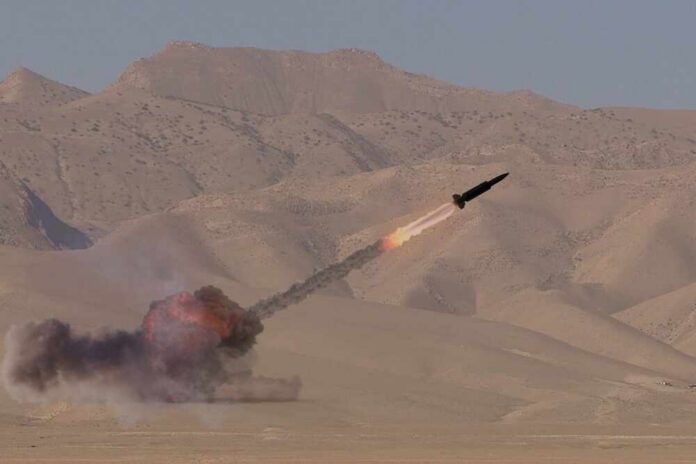
Jordan’s armed forces say they shot down about 20 missiles launched from Iran toward the Azraq area in central-eastern Jordan, near a major U.S. command center and air base.[1] A statement quoted by regional media says the missiles were intercepted at dawn and fell as fragments without causing injuries or damage.[1] The Islamic Revolutionary Guard Corps in Iran had announced it was firing at a U.S. command center on Jordanian soil, a direct challenge to American forces and their hosts.[1]
Video and eyewitness accounts line up with the Jordanian statement. Residents across northern and central Jordan reported loud blasts and bright streaks of light as interceptors met incoming missiles over cities like Zarqa.[2][5] A news report describes the night sky “lit up over Jordan” as Iranian missiles and U.S. Patriot systems engaged in a “high-stakes interception” near the Azraq region, home to the Muwaffaq Salti Air Base where U.S. troops operate.[2][3] Authorities later confirmed debris fell in Jordan but again reported no casualties.[2]
Confusing Missile Counts, Clear Pattern of Attack
Different outlets give different missile counts, which is common in fast-moving wartime reports. One report says Jordan intercepted 20 missiles over the Azraq area.[1] Another recounts a Jordanian statement about shooting down five missiles aimed at the same region.[2][4][5] Other summaries talk about 13 ballistic missiles, or a wider set of 49 drones and missiles intercepted during the broader Iranian strike campaign across the region.[3] The numbers shift, but the pattern is clear: Iranian missiles crossed Jordanian airspace and were engaged.
Analysts note that such confusion often happens in early hours of air-defense battles, when radar tracks, overlapping intercepts, and mixed drones and missiles make counting hard.[3] Jordan’s armed forces are also not operating alone. Reports say U.S. troops in Jordan run Patriot missile defenses designed to shoot down ballistic threats before they reach their targets.[2][3] That means some missiles may have been engaged by Jordanian aircraft, some by ground-based systems, and some by American crews, making simple tallies even harder.[2][3]
American Forces in the Crosshairs Again
This missile clash fits into a bigger Iranian campaign aimed at U.S. and allied positions across the Middle East.[3] Iran has launched waves of drones and missiles toward American facilities in Jordan and elsewhere, trying to raise the cost of U.S. presence and test the limits of Washington’s patience.[2][3] During one wider attack in late February, Jordanian and U.S. forces together intercepted 49 drones and missiles, including 13 ballistic missiles, that entered the kingdom’s airspace.[3] Tehran claimed it hit hangars and command centers, while Jordan said all five missiles in that strike were shot down.[3]
🇯🇴 The First Order Consequence:
Jordan’s reported interception of 20 missiles launched from Iran suggests an immediate air-defense action that, if accurate, would reduce the number of incoming warheads reaching intended targets and may bolster public and institutional confidence… https://t.co/XPVoeK00BP— U.S.A.I. 🇺🇸 (@researchUSAI) June 11, 2026
For American conservatives, the picture is troubling but familiar. Once again, U.S. troops sit on foreign soil while an aggressive regime fires ballistic missiles nearby, trusting that complex and expensive systems will work every single time. Iran’s rulers are willing to gamble with regional war to push the United States out and weaken partners like Jordan and Israel.[2][3] Every interception is a win, but every launch is a warning: one failure could cost American lives and drag our country deeper into conflict.
Sources:
[1] Web – Jordan’s military says intercepted 20 missiles launched from Iran
[2] Web – Jordan intercepts 20 missiles launched from Iran , no injuries …
[3] Web – Jordan says it intercepted five Iranian missiles, reports no injuries …
[4] Web – Jordan’s Air Defense Intercepts 13 Iranian Ballistic Missiles
[5] Web – Jordan’s Armed Forces said on Wednesday that air defense systems …