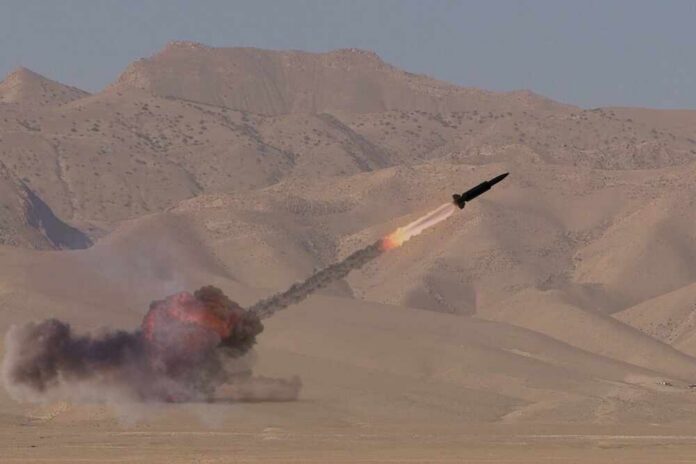
A new Air Force missile plan could either secure American skies for decades or become another billion-dollar gamble that leaves taxpayers holding the bag.
Story Snapshot
- Air Force planners want a new Air Force Long Range Weapon with a minimum 1,000‑nautical‑mile reach for air and surface targets.
- The missile could let U.S. fighters destroy enemy tankers and radar planes far behind the front line, protecting American crews from dense air defenses.[2]
- No contractor, budget line, or flight tests yet confirm this weapon is real beyond the planning stage.[3]
- Cheaper stand‑off missiles like Extended Range Attack Munition and AGM‑190A already offer long range at far lower complexity.[5]
Air Force Chases Extreme Range To Beat Future Threats
The United States Air Force Life Cycle Management Center has posted notice for a classified industry event to brief contractors on a new “Air Force Long Range Weapon” concept.[2] The plan calls for missile variants that can hit both air and surface targets from at least 1,000 nautical miles away, roughly 1,150 regular miles.[2] That is about ten times the reach of today’s most advanced AIM‑120 air‑to‑air missiles, and it is aimed at fights in highly contested planning scenarios labeled 2.1 and 7.1.[3] For conservative readers, this shows the service is thinking ahead to wars where China or other rivals try to push American aircraft far from the fight and threaten tankers and support planes deep in the rear.[5]
Air Force documents and open reporting say this long‑range weapon would come in two forms: an air‑to‑air “AWACS killer” missile and an air‑to‑surface strike version.[2] The air‑to‑air missile would target high‑value radar planes, tankers, bombers, and other support aircraft that now often sit far behind enemy lines.[3] The air‑to‑surface version would give fighters a way to hit key bases, command posts, or missile sites while staying far outside thick enemy air defenses.[2] If such a weapon works, it could let smaller U.S. fighter formations punch well above their weight, supporting deterrence without needing endless numbers of new bombers.
Big Promises, But No Proof Or Price Tag Yet
The notice and media reports are clear on one key point: this missile is still only at the requirement and discussion stage.[2] There is no public record of a development contract, no chosen builder, and no unit cost projection, unlike the Long Range Standoff nuclear cruise missile, which already has a sole‑source contract with Raytheon and an estimated $14 million price per weapon.[4] Skeptical analysts note that the Air Force itself admits there are “questions” about what it would take to build a feasible 1,000‑nautical‑mile fighter‑launched missile and what aircraft might carry it.[3] That uncertainty matters to taxpayers who have seen too many programs start with bold press releases, then slip schedules and explode in cost.
Technical details raise more concern for prudent conservatives who value both strength and fiscal discipline. The industry notice and expert coverage suggest this missile may need a multi‑stage or air‑launched ballistic‑like design to reach such extreme distances.[3] That kind of “exotic” architecture is far more complex than today’s proven subsonic cruise missiles, increasing risk of delays and failures. Targeting is also unsolved; the Air Force states these weapons cannot rely on the launching aircraft’s own sensors to track targets at 1,000 miles.[3] That means deep dependence on broad “kill webs” of off‑board sensors, satellites, and networks—exactly the sort of fragile, expensive digital grid that worries many conservatives when Washington leans too hard on tech buzzwords instead of rugged, simple tools.
Cheaper Stand‑Off Options Already In The Pipeline
At the same time, the Air Force is making real progress on more modest, practical stand‑off missiles that fit a fiscally conservative mindset.[2] The Extended Range Attack Munition program, for example, has moved from contract award to live‑warhead test in only sixteen months and is billed as a cost‑effective cruise missile meant to provide “affordable mass” for long‑range strikes.[8] ERAM’s reported range of about 250 nautical miles still lets launch aircraft stay outside many advanced surface‑to‑air missile envelopes while keeping size and complexity under control.[6] Similarly, the new AGM‑190A, born from the Small Cruise Missile project, has already demonstrated a stand‑off range beyond 400 nautical miles and focuses on lower cost and rapid adaptability.[5] These weapons show that American engineers can extend reach without racing straight to the most extreme, risky requirement.
For families watching defense spending and worried about federal debt, the contrast is sharp. On one side, there are nuclear and hypersonic efforts like Long Range Standoff and Air Launched Rapid Response Weapon that come with multi‑billion‑dollar contracts and unit costs in the tens of millions, often after years of technical hurdles.[1] On the other, there are leaner programs like ERAM and AGM‑190A designed to be built in large numbers, providing depth and deterrence without blowing up the budget.[6] A 1,000‑mile Air Force Long Range Weapon could be a powerful tool against communist regimes and other hostile powers, but without a clear price, schedule, or test data, it also risks becoming another “gold‑plated” project that drains resources from proven stand‑off options and from core readiness.
Sources:
[1] Web – Air Force Eyes New Stand-Off Missile with 1,000-Nautical Mile Range
[2] Web – Long Range Standoff Weapon
[3] Web – Testing Shows Progress on Key Air Force Missiles and Bombs
[4] Web – USAF Wants Air-To-Air Missile With A Whopping 1,000-Mile Range
[5] YouTube – U.S. Air Force seeks producers for new nuclear cruise missile
[6] Web – US Air Force designates new long-range cruise missile AGM-190A
[8] Web – Historic weapons milestone! The U.S. Air Force just proved its new …