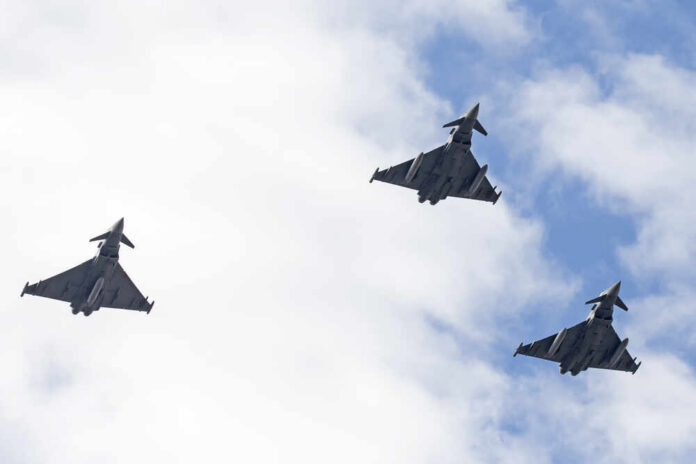
A Navy icon nearly died in the 1980s, but the story behind its supposed rescue doesn’t match the Pentagon’s own records—raising questions about what really kept the F-14 flying while defense contractors and bureaucrats battled over billions.
Story Snapshot
- Claims of a 1986 General Electric re-engaging program saving the F-14 lack documentation in official Navy records
- Secretary of Defense Dick Cheney blocked F-14D production in 1989, calling it a wasteful “jobs program” affecting 80,000 workers
- The Tomcat served 32 years despite mounting safety issues, maintenance nightmares, and replacement plans repeatedly shelved
- Post-retirement, the Pentagon shredded F-14 parts to prevent Iran from obtaining spares for its aging fleet
The Missing Engine Story
The premise that General Electric re-engine the F-14 Tomcat in 1986 and saved it from cancellation lacks verification in Navy procurement records and official documentation. While the F-14 faced multiple cancellation threats throughout the 1980s and early 1990s, no specific engine modification program by GE in 1986 appears in available sources. The aircraft did receive various upgrades during its service life, including the LANTIRN pod system in the 1990s for precision ground attacks, but the claim of a lifesaving engine overhaul remains unsubstantiated. This gap raises concerns about defense industry narratives that may overstate contractor contributions while obscuring bureaucratic mismanagement.
Cheney’s Jobs Program Accusation
In 1989, Defense Secretary Dick Cheney refused to approve additional F-14D purchases, halting production after just 37 new aircraft were built, with 18 more created through F-14A conversions. Cheney characterized the program as a “jobs program” rather than a military necessity, planning to replace it with a non-Grumman fighter. The decision threatened approximately 80,000 Grumman employees, subcontractors, and support personnel. This mirrors frustrations today with defense procurement that prioritizes contractor profits and employment over genuine national security needs. The Navy had announced plans in 1988 for a carrier-based F-22 variant, but the Soviet Union’s collapse and shrinking budgets killed that program by 1991.
Safety and Cost Realities
The F-14’s retirement in September 2006 resulted from harsh operational realities, not political whims. The aging fighter demanded extensive and expensive maintenance, with recurring safety concerns making each sortie costly and risky. The aircraft was prone to flat spins—a dangerous horizontal spinning condition forcing crew ejection. Technological obsolescence became undeniable as the Tomcat could not match newer stealth jets and advanced electronic systems. The F/A-18E/F Super Hornet, while slower, proved more reliable, easier to maintain, and better suited for carrier operations. These facts highlight a pattern where legacy systems drain resources long after their effectiveness wanes, a problem plaguing today’s defense budgets.
The Iranian Connection
After the F-14’s final flight on October 4, 2006, delivering Bureau Number 164603 to New York, the Pentagon took extraordinary measures to prevent spare parts from reaching Iran. In 2008, the Department of Defense banned F-14 component sales after Iran attempted to purchase parts for its pre-1979 Islamic Revolution-era Tomcat fleet. Remaining stock was ordered shredded. Iran had received F-14s under the Shah’s regime, and decades later still operated a small number. This post-retirement destruction underscores legitimate security concerns, yet also reflects how American defense policies create long-term complications. The shredding decision, while prudent, also destroyed museum-quality parts and historical artifacts, erasing evidence of taxpayer investments spanning three decades.
The F-14 Tomcat served from 1974 to 2006, flying combat missions in Desert Storm, the Balkans, Afghanistan, and Iraq. Grumman produced 712 aircraft between 1969 and 1991. While the fighter earned iconic status, the unverified re-engaging story serves as a reminder to scrutinize defense contractor claims and Pentagon narratives that may obscure mismanagement, cost overruns, and questionable procurement decisions that burden taxpayers and service members alike.
Sources:
Grumman F-14 Tomcat – Wikipedia
Today in Aviation History: Grumman F-14 Tomcat Retires from U.S. Naval Service
The Real Top Gun Story: Last US Navy F-14 Tomcat
Why US F-14 Tomcats Were Destroyed in Arizona Desert