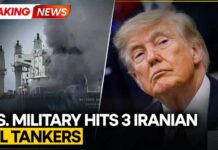
President Trump’s vow to keep bombing Iran until its leaders “come to the table” is turning U.S. firepower into a bargaining chip that could reshape the Middle East – and Washington’s own democracy.
Story Snapshot
- President Trump has already ordered major strikes on Iranian nuclear sites and key military targets, and says more attacks are on the table.
- The White House openly links continued bombing to forcing Iran into a deal, blending war-fighting with hardball negotiation.
- Critics warn the goals and legal basis for the Iran campaign keep shifting, raising fears of a “forever war” run from the top with little oversight.
- Americans across the political spectrum see another distant war as proof that Washington’s elites ignore everyday economic and security worries at home.
Trump’s latest threats: bombs as leverage, not last resort
President Trump and his national security team are now saying the quiet part out loud: ongoing and future airstrikes on Iran are not just about destroying targets, but about forcing Tehran to agree to Washington’s terms. After new strikes on Iranian sites near the Strait of Hormuz, Trump warned that he would “bomb the hell out of them” if Iran’s leaders did not reach a deal soon. His defense secretary described the strikes as a way to “advance our military objectives and also strengthen our diplomatic stance,” adding that if “negotiations require the use of bombs, then we will proceed with that approach.” That message confirms what many Americans on both the right and left already suspect: in today’s Washington, war itself has become another tool in a high-stakes power game, managed by a small circle of officials far from public view.
The United States has already shown it will follow through on these threats. In 2025, U.S. forces, working with Israel, carried out a surprise night-time operation that hit three of Iran’s most important nuclear sites at Fordow, Natanz, and Isfahan. President Trump later posted that the “very successful attack” had completely destroyed key nuclear facilities and warned Iran that more strikes would follow if it did not “pursue peace.” This June, he again approved waves of strikes against Iranian military targets, while Central Command said it was hitting command centers, missile and drone facilities, and air defenses across the country. To many Americans watching from home, this looks less like a limited mission and more like an open-ended campaign that can be dialed up or down whenever the White House decides.
Shifting goals and legal worries fuel deep public distrust
From the start of the Iran conflict, President Trump’s stated goals have moved in ways that unsettle both conservative and liberal skeptics. At different times, he has said the aim is to stop Iran from getting a nuclear bomb, destroy its missile program, wipe out its navy, punish it for killing U.S. soldiers, and even encourage Iranians to “reclaim your country,” which sounds like regime change. In a letter to Congress explaining earlier strikes, the White House leaned on broad claims of protecting American interests, but did not point to a single specific, imminent attack. For citizens who remember how shifting stories sold past wars, that feels like the same movie playing again, with new actors but the same script. Many now ask whether this war is really about safety, or about political power, defense contracts, and an unelected security class that never seems to lose its influence.
These doubts cut across party lines because they tap into a larger frustration: the sense that the federal government listens more to generals, lobbyists, and foreign partners than to working families. Critics note that while Washington finds hundreds of billions for overseas operations, many Americans still struggle with high prices, medical debt, and weak local economies. Some conservatives see the Iran campaign as another adventure driven by globalist priorities instead of “America First” repair at home. Some liberals see it as proof that there is always money for missiles but not for schools, Social Security, or crumbling bridges. Both camps worry that Congress has mostly watched from the sidelines while one man and a small team decide when the country goes to war, then uses classified claims to justify each new round of strikes.
Threats, pauses, and the risk of a forever war run by elites
The pattern of threats, strikes, and sudden pauses has added to the sense of volatility and elite control. Trump has more than once canceled planned attacks at the last minute, telling the public that a deal with Iran is “close” and that peace is within reach, only to resume bombing days or weeks later when talks stall. U.S. Central Command has reported strings of strike nights in a row, including a thirteenth straight night targeting Iranian military infrastructure and maritime capabilities. Analysts now warn that the Iran campaign is drifting into the kind of “forever war” the country thought it had left behind, with no clear end state, vague benchmarks, and a public kept in the dark about real costs in dollars and lives. For Americans who believe the system is rigged by a “deep state” of permanent insiders, this stop‑start bombing feels like one more sign that the same small group makes the biggest decisions, while ordinary citizens and even many lawmakers are expected to simply fall in line.
ONE ISLAND MOVES 90% OF IRAN’S OIL. TONIGHT, THE REPORTED TARGET LIST WIDENS TO THE GRID BEHIND IT.
Kharg Island sits in the northern Persian Gulf, a coral outcrop about a third the size of Manhattan. Roughly 90% of Iran’s crude exports load through it. Five months into the… pic.twitter.com/MNo7LbcPS2
— citizenGlobe (@citizenGlobeX) August 1, 2026
The stakes go far beyond Iran’s borders. Every missile the United States fires in the Gulf adds new risk of a wider regional war that could disrupt oil flows, spike energy prices, and drive up inflation at home yet again. That would hit American workers who already struggle to cover gas, heating, and food costs. At the same time, every time the White House uses war as a bargaining chip, it sets a precedent future presidents of either party can follow. If bombing becomes just another “option on the table” in every standoff, the nation drifts further from the founders’ vision of a republic where the people, through Congress, decide when to fight. Many Americans on both left and right may not agree on Iran, but they do agree on this: a government that can start and stretch wars with shifting reasons, thin oversight, and little honesty is a government that has forgotten who it is supposed to serve.
Sources:
facebook.com, bbc.com, cnbc.com, reuters.com, youtube.com, cbsnews.com, cnn.com, nbcnews.com, usatoday.com, en.wikipedia.org, npr.org, nytimes.com