

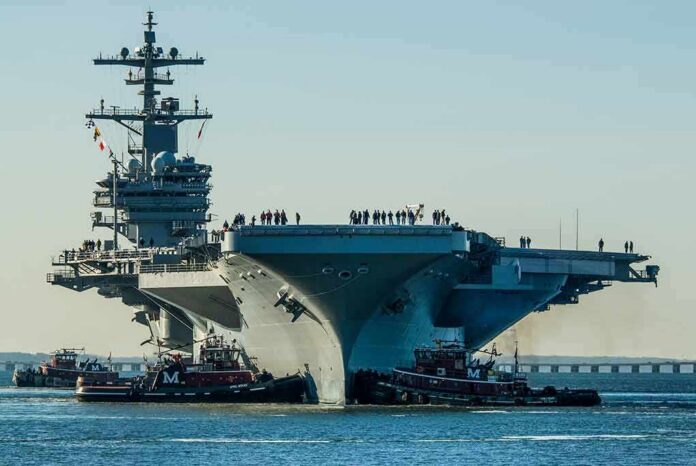
The Navy just spent 15 months fixing a frontline aircraft carrier it now plans to retire before its replacement is even ready — raising fresh questions about who, exactly, Washington’s defense choices are serving.
Story Snapshot
- USS Dwight D. Eisenhower finished a major repair and overhaul early and is back in service.
- The carrier is expected to stay in the fleet only until around 2030 despite its renewed condition.
- Her planned retirement will come before new carrier USS Enterprise is fully ready to take over.
- The timing fuels wider concerns that Pentagon planning favors budgets and bureaucracy over real readiness.
Major overhaul brings “Mighty Ike” back to the fleet
USS Dwight D. Eisenhower, one of the Navy’s oldest nuclear-powered aircraft carriers, has finished a 15‑month Planned Incremental Availability at Norfolk Naval Shipyard in Virginia. This maintenance period included extensive repair, overhaul, inspection, and modernization to keep the ship able to meet future operational demands. The Navy reported that Eisenhower completed sea trials on April 24, 2026, ahead of schedule, marking the early finish of the availability and her formal delivery back to the fleet. For sailors and shipyard workers, this was a major win after months of hard, detailed work on a complex warship.
Sea trials are the key test where crews take the ship to sea and push major systems under real-world conditions. According to Navy statements, Eisenhower’s trials allowed the crew to check propulsion, combat systems, flight deck operations, and damage control readiness to prove that the repairs and upgrades worked as planned. Passing these trials means the carrier is again considered ready to move toward deployment, even though she still must complete training and certification with her air wing before being fully combat-ready. For now, the ship has returned to Naval Station Norfolk and is once again “available for deployment” while leaders decide her next mission.
A refreshed ship on a short countdown to retirement
Even as Eisenhower returns to duty, the Navy has made clear that her remaining service life is limited. The carrier, commissioned in 1977, is the second-oldest in the fleet and has already gone through a costly mid-life refueling and modernization to stretch her usefulness over a planned 50‑year lifespan. Navy planning documents and public reporting say Eisenhower is scheduled to be replaced around 2029 by the new USS Enterprise, a Gerald R. Ford–class carrier still under construction. More recent guidance has pushed her retirement into the “early 2030s,” with many observers expecting the service to target about 2030 as a practical end date.
This timeline means the Navy has just invested a large chunk of time, money, and labor into a ship it expects to retire only a few years later. The recent Planned Incremental Availability was not a minor tune‑up; it involved thousands of workers and tens of thousands of work days to overhaul key systems. From a basic readiness view, the overhaul makes sense: until Enterprise is fully tested and ready, Eisenhower helps cover global missions. But for citizens already skeptical of federal spending, the idea of fixing a ship deeply only to send it to the scrapyard by about 2030 looks like another example of short‑sighted planning and budget games that do not match common‑sense expectations.
Carrier gaps, global demands, and fears of elite mismanagement
Retiring Eisenhower around 2030 while Enterprise is still ramping up creates the risk of a gap in carrier strength during a tense world period. The United States relies on large carriers to show presence in hotspots like the Middle East, Europe, and the Western Pacific, especially as tensions with Iran and China stay high. When one older ship leaves service before its replacement is fully ready, commanders have fewer options and crews face longer deployments to cover the same ground. For families of sailors and taxpayers alike, that feels like Washington asking more from regular people while its own planning fails to keep pace.
USS Dwight D. Eisenhower (CVN 69) Nimitz-class aircraft carrier coming into Norfolk, Virginia – July 27, 2026 SRC: FB- Hampton Roads & Chesapeake Bay Ship Watchers / Ken Dixon 📸 pic.twitter.com/4luF3e5Zob
— WarshipCam (@WarshipCam) July 27, 2026
This story also fits a larger pattern that bothers both conservatives and liberals: big decisions seem shaped more by budget cycles, defense industry timelines, and bureaucratic targets than by the everyday reality of frontline forces. The Navy proudly calls Eisenhower’s overhaul and early sea trials a “significant milestone” and a “timely delivery back to the fleet,” yet the same system is steering her toward retirement not long after those repairs pay off. To many citizens, that looks like the deep state logic of spreadsheets and promotion paths winning out over steady readiness and long-term value.
What the Ike timeline tells us about the system
For conservatives frustrated with years of huge federal budgets and little visible payoff, Eisenhower’s case can feel like more proof that Washington spends billions while still struggling to field a stable, modern carrier force. For liberals worried about growing gaps between rich and poor, the idea of pouring resources into a ship only to retire it soon after raises hard questions about who benefits most from defense contracts and complex life‑cycle plans. Both sides see a Navy squeezed between old ships that cost more to maintain and new ones that arrive late or over budget.
None of this means the recent work on Eisenhower was wasteful in a simple sense; until Enterprise and her sister ships are truly ready, the nation still needs “Mighty Ike” to carry aircraft and show strength overseas. But the decision to repair now and retire soon highlights a deeper issue: Americans across the spectrum feel the federal government, including the Pentagon, is no longer run with common sense or long‑term focus. Eisenhower’s story shows how even success on the waterfront can still leave the public asking whether elites are steering the country toward a safer future, or just managing decline while ordinary citizens pay the price.
Sources:
19fortyfive.com, usff.navy.mil, thedefensepost.com, seaforces.org, youtube.com, dvidshub.net