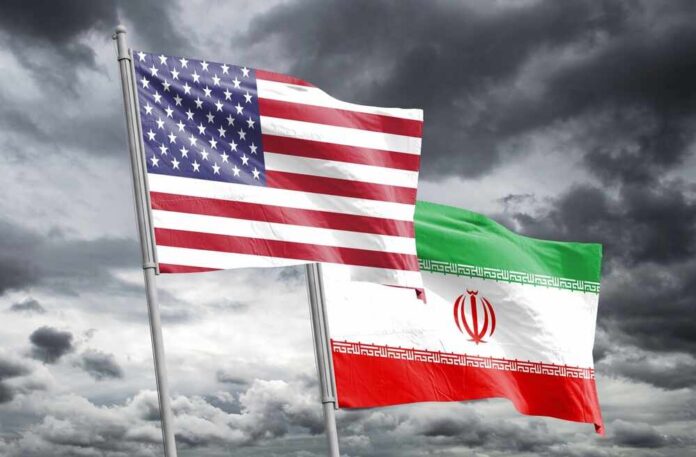
President Trump signed a 14-point agreement with Iran at a dinner in Versailles — but the deal’s toughest questions are still unanswered, and critics on both sides are already pushing back.
Story Highlights
- Trump signed a Memorandum of Understanding with Iran during a dinner at Versailles, calling it a hard-won achievement.
- The 14-point deal calls for an immediate halt to military actions on all fronts, including Lebanon, and reopens the Strait of Hormuz to shipping.
- Iran commits to never developing nuclear weapons, but the deal defers key details — like what happens to Iran’s stockpile of enriched uranium — to later talks.
- Both sides have 60 days to negotiate a final, permanent settlement, and sanctions relief only kicks in if Iran complies.
Trump Signs Deal at Versailles Dinner
President Trump signed the Memorandum of Understanding with Iran during a dinner in Versailles, France, telling reporters: “This was not easy, I can tell you.” The agreement, mediated by Pakistan and Qatar, was presented as a 60-day framework to end the conflict that began February 28, 2026. Both sides agreed to stop military operations immediately on all fronts. The U.S. lifted its naval blockade of Iranian ports in return.
The deal’s 14 points include Iran’s pledge to never develop or acquire nuclear weapons, the reopening of the Strait of Hormuz to commercial shipping at no charge, and a promise to build a $300 billion reconstruction and economic development fund for Iran. The U.S. is not required to fund that package directly. Sanctions relief will only follow if Iran complies with the terms — no compliance, no money released.
Strait of Hormuz Back Open for Business
Iran’s blockade of the Strait of Hormuz — the narrow waterway that carries roughly 20% of the world’s oil — caused fuel shortages and price spikes across Asia and beyond. Under the new deal, Iran must clear mines it planted in the strait and restore free passage for commercial vessels. The toll-free passage provision lasts for the 60-day negotiating window, with the long-term arrangement to be worked out later by Iran, Oman, and Gulf states.
The conflict disrupted global energy markets hard and fast. Iran had been selectively allowing ships through — charging heavy tolls to some while blocking others entirely. Getting the strait open again was a top U.S. priority from the start of the conflict. Trump’s team sees the reopening as a concrete win, even if the permanent rules for the waterway remain unsettled.
Big Questions Still Unanswered
The deal’s biggest weakness is what it leaves for later. Iran’s stockpile of highly enriched uranium — the material closest to weapons-grade — is not addressed in the current text. That issue, along with detailed sanctions relief terms and the full nuclear compliance plan, gets pushed into the 60-day negotiation window. Some critics call this kicking the hardest problems down the road rather than solving them.
President Trump has made a terrible agreement with Iran. Trump's attacking Iran was based upon destroying or removing it's uranium from Iran. The only things that Trump has obtained is high inflation in the U. S. & other countries and poor management of our military leadership.
— Kenneth Staggs (@KennethKestaggs) June 15, 2026
Enforcement is also thin. Reports say the memorandum does not include new weapons inspectors or binding sanctions triggers. One account described the deal as having “nothing enforceable in the deal itself,” with compliance resting on deterrence and goodwill. Some Trump allies in Congress have also raised concerns, arguing the deal may reward Iran before the real work is done. The 2015 Joint Comprehensive Plan of Action (JCPOA) under President Obama followed a similar framework structure — and ultimately collapsed when Trump withdrew from it in his first term. The pattern of framework deals that fall apart during implementation is a real risk here. Still, Trump’s team argues the conditions-based sanctions relief and the military pressure behind the deal make this different. The next 60 days will show whether that confidence is warranted.
Sources:
[1] YouTube – ‘This was not easy I can tell you’: Trump signs Iran agreement during …
[2] Web – Read the Full Text of the 14-Point Agreement Between the U.S. and …
[3] Web – Read: US officials release 14-point Iran peace plan – DW.com
[4] Web – What’s in the US-Iran agreement? – BBC
[5] Web – Trump and Iran’s president digitally sign MOU with terms to end war
[6] Web – Read the 14 points of the agreement between Iran and the U.S.
[7] Web – What’s in the Iran deal Trump says he’s ready to sign – Axios
[8] Web – White House officials unveil details of 14-point plan with Iran
[9] YouTube – Leaked US–Iran deal: What’s in the 14-point plan? | DW News
[10] YouTube – US-Iran deal details revealed, Trump signs memorandum …
[11] Web – 5 reasons Trump allies don’t like his Iran deal – The Hill
[12] YouTube – Analysts say US-Iran Hormuz MoU is a time‑buying ceasefire, not a …
[13] Web – Iran nuclear deal – Wikipedia
[14] Web – U.S. and Iran Close in on a Framework Accord – The Soufan Center
[15] Web – Iran-U.S. negotiators have agreed to broad principles of agreement …
[16] Web – Key takeaways from the 14-point memorandum of understanding …
[17] YouTube – Expert breaks down U.S.-Iran ceasefire deal and …
[18] Web – A senior Trump administration official said the U.S. and Iran are …
[19] Web – Experts React: The US and Iran Reach an Agreement
[20] Web – A History of US-Iranian Relations – Middle East Studies Center
[21] Web – US-Iran Relations: A Complex History of Conflict and Change
[22] Web – Iran–United States relations – Wikipedia
[23] YouTube – The history of US-Iran relations – from friendly to violent | The …
[24] Web – 2026 Iran war | Explained, United States, Israel, Strait of Hormuz …
[25] Web – The result of weeks of intense diplomacy, the interim agreement …
[26] Web – Iran’s Strategic Options: Rethinking Negotiation with America