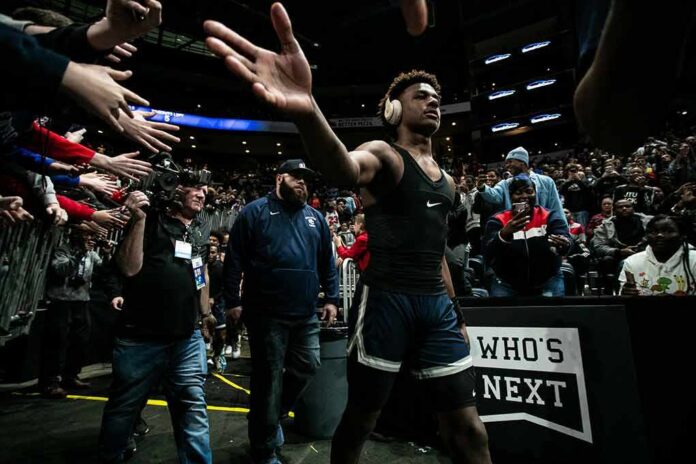
One combustible minute outside an arena can now script the entire night: Enes Kanter Freedom’s pregame run‑in with hostile spectators in Chicago shows how small sparks at the edge of women’s basketball—phone cameras rolling, politics in tow—can ignite into the main event.
At a Glance
- Freedom encountered a hostile cluster of spectators outside Wintrust Arena before Sky–Fever, with insults and obscene gestures captured on video and reported across outlets.
- At least one heckler used a racial slur and profanities; security positioned around Freedom as the crowd pressed in.
- Freedom had been visible around the venue and wore a “Woman” T‑shirt linked to ongoing debates that have intensified fan reactions.
- The episode fits a wider pattern: small in‑person flashpoints, amplified online, rapidly reframed as culture‑war proxies in women’s sports.
What Happened Outside the Arena
As Freedom approached Wintrust Arena for the Chicago Sky–Indiana Fever game, a group of spectators closed in with taunts. One fan stepped directly to him and flipped a middle finger; others shouted that he had been a “sorry” player and should leave. Coverage described event security bracketing Freedom to get him through the scrum. In his own contemporaneous post, he framed the scene as “getting attacked” before the game; multiple outlets published the clip and echoed the description of a hostile crowd at the entrance. Sports Yahoo highlighted a particularly ugly line from the crowd—“b*tch ass n*gga!”—amid a string of profanities and goading.
None of this unfolded in a vacuum. Freedom had been in circulation before tipoff, recorded on social media, and, according to local reporting, wearing a T‑shirt reading “Woman”—an unmistakable signal inside an ongoing public argument about sex, gender identity, and women’s sport. That wardrobe choice and Freedom’s visible presence made him both recognizable and, for detractors, a tempting provocation target at the door.
How Small Flashpoints Become the Night’s Story
Women’s basketball has matured into a dense media ecosystem where game‑adjacent moments—tunnel encounters, warmup signage, celebrity arrivals—regularly compete with the run of play. The dynamic is structural: a handful of heated voices at street level meet a swarm of phones, then are uploaded into partisan sports channels and general‑interest feeds, where the raw tone is amplified, clipped, and relabeled. Studies of online abuse patterns in sport help explain the velocity. World Athletics’ analysis of the Tokyo Olympics found that the majority of identified abusive posts targeted women, much of it sexist or racist in character; the finding underscores why any confrontation at a women’s event tends to be quickly coded as part of a broader culture fight rather than an isolated dust‑up. The same amplification loop normalizes incivility around live competition; even mainstream treatments have treated swearing, spitting, and slurs as creeping features of modern spectator culture rather than aberrations.
That is the pipeline Freedom’s entrance moment traveled. A short, tense episode at the curb—gestures, slurs, cameras—became an argument about athlete safety, respect for women’s sports spaces, and the role of political messaging in the arena footprint. The clip’s power was not evidentiary so much as catalytic: it set the frame for how the rest of the night would be covered and remembered.
Security, Speech, and the Edge of the Arena
Sport has always tolerated a wide range of fan speech; the line usually hardens at targeted slurs, threats, and sustained harassment. Venues walk a legal and operational tightrope: they want emotionally charged environments that sell tickets and television, yet must police conduct that crosses policy or law. When a recognizable figure engages a polarized issue at the threshold—literally outside the turnstiles—those tensions concentrate. The reports from Wintrust Arena describe a textbook pressure point: a conspicuous personality, a charged message, and a small contingent eager to perform hostility on camera. At that moment, the best security practice is clear and unglamorous—tighten the protective envelope, move the subject efficiently, avoid escalation—and that is what descriptions of the scene suggest happened.
It is also where policy gaps show. Many leagues have codified in‑seat behavior standards and ejection triggers, but the gray zone just beyond the gate, where venue authority blurs into public space, remains inconsistent. The result is predictable variability: a “mob” in one headline, a “handful of hecklers” in another, and limited recourse for anyone seeking accountability beyond admonitions to be better fans.
Why This Specific Confrontation Resonated
Freedom is not an anonymous attendee. He is a former NBA center whose activism has been explicit, sometimes confrontational, and, in women’s‑sports contexts, guaranteed to draw reaction. The “Woman” T‑shirt was not incidental costuming; it functioned as a portable placard in an arena already roiled by simmering debates about who plays, who belongs courtside, and why. Local reporting placed him at the venue earlier, filming interactions that later bled into the narrative arc of the game night itself. Once that’s the tableau—an established provocateur to some, a truth‑teller to others—any heckling does more than sting; it assigns roles. The crowd becomes the censorious mob or the righteous pushback; Freedom becomes the embattled guest or the instigator who got what he came for. The footage ensures everyone can pick their cut.
There is also a pragmatic reason the clip traveled: it is concrete. Unlike abstract accusations of bias or mistreatment, you can see the faces, hear the slur, and watch security moving bodies between bodies. That visibility creates obligations as well as heat. Leagues and venues cannot credibly champion growth in women’s basketball while waving off the reality that game‑adjacent spaces are becoming performance stages for ideological confrontation. They need to design around it.
What Better Looks Like for Teams and Venues
The fixes are not dramatic; they are disciplined. First, treat exterior perimeters as extensions of the guest‑experience footprint on game days: clear wayfinding, defined ingress lanes, and visible, trained staff who can separate flashpoints quickly without creating a spectacle. Second, publish a unified code of conduct that applies from curb to court and make the sanctions real—loss of ticket privileges travels fast by word of mouth. Third, professionalize incident documentation at the perimeter level with body‑worn cameras for key posts and a frictionless channel for reporting; you cannot deter what you do not record. Finally, invest in communications that de‑escalate in the moment and de‑politicize after the fact: release straight, time‑stamped summaries of material incidents so that one participant’s caption does not have to stand in for the institutional record.
None of this chills speech. It refocuses it: cheer loudly, boo if you must, disagree even stridently—but do it inside rules that protect participants, staff, and fellow spectators. Given the documented prevalence of gendered and racialized abuse aimed at female athletes online, a coherent perimeter policy is not a luxury for women’s basketball; it is table stakes for sustainable growth.
Trending Sports (WNBA): Former NBA player Enes Kanter was heckled outside of Wintrust Arena before Sunday's Fever/Sky game and during the game he got ejected from the arena after Sky's Natasha Cloud had words to say to him. #WNBA pic.twitter.com/gehWoi5xC5
— Justin David Kish • Sports Journalist (@JustinDavidKish) August 24, 2026
The Takeaway
Freedom’s entrance to Wintrust Arena was met with a hostile pocket of fans, captured on video and corroborated in multiple reports—a brief, ugly exchange featuring slurs and gestures that required security to buffer his path. The moment mattered less for its length than for what it revealed: the edges of women’s basketball are now contested space where identity politics, fan performance, and smartphone theater collide. If leagues want the sport to keep expanding, they will need to govern those edges with the same seriousness they bring to the court.
Sources:
nytimes.com, sports.yahoo.com, abc7news.com, foxnews.com