The real nightmare for America’s supercarriers is not being sunk to the ocean floor, but having their flight decks turned into burning, unusable metal airfields that knock out U.S. power projection without a single ship going down.
Story Snapshot
- Modern U.S. carriers are built to survive hits, but their exposed flight decks and aircraft remain highly vulnerable to fire and “mission kill” damage.
- Analysts warn China and Iran can focus on disabling flight operations, not sinking ships, using missiles, drones, and other area denial weapons.
- Historical carrier deck fires show that even small explosions can shut down huge warships for months and kill dozens of sailors.
- This vulnerability raises hard questions about whether Washington’s elites are truly protecting the fleet that underpins American global power.
Why Lighting a Flight Deck on Fire Can Beat Sinking a Carrier
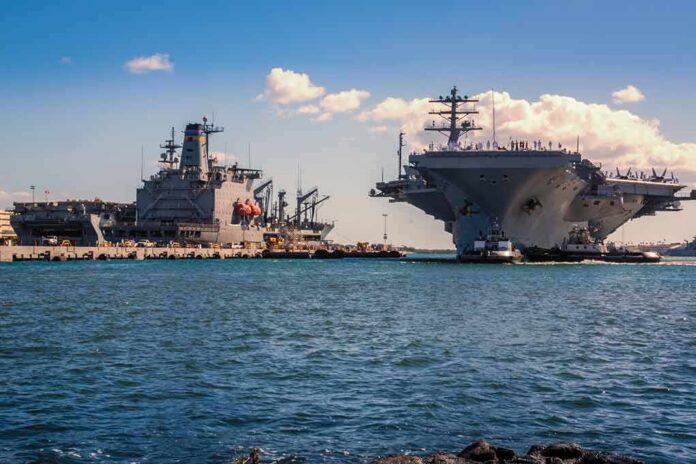
Defense analysts increasingly argue that adversaries like China and Iran do not have to send U.S. Navy aircraft carriers to the bottom of the sea to neutralize them; they only need to wreck the flight deck, parked jets, and launch systems so the ship can no longer fly aircraft. A carrier is valuable because it is a floating airbase. If missiles, drones, or other weapons punch holes in the deck, destroy catapults, or burn fuel systems, the ship may remain afloat but the combat mission is over. This idea is called a “mission kill,” and it reflects a shift away from thinking only about sinking ships toward targeting the weakest operational point: the aviation complex on top of the hull.
Historical experience backs up these fears. Naval commentary recalls that relatively small explosive events on the flight decks of the carriers USS Oriskany, USS Forrestal, and USS Enterprise totally disabled them, even though they did not sink. These ships were crippled because fire and blast tore through tightly packed aircraft, fuel, and weapons, turning the deck into a deadly chain reaction zone. In each case, the carrier had to leave the fight and undergo lengthy repairs. This pattern shows that a well-placed hit that causes a large fire can sideline a giant ship for months without breaching the hull. For adversaries looking for cost-effective ways to blunt American power, that is an attractive option.
The Flight Deck: Four Dangerous Acres Sitting in Harm’s Way
The U.S. Navy itself calls the carrier flight deck one of the most hazardous workplaces in the world, even in peacetime. Technical Navy documents describe it as a major fire risk, with millions of gallons of jet fuel stored on board and constant fueling, defueling, and weapons handling taking place just below or on the deck. Heavy machinery, spinning propellers, jet exhaust, and live munitions sit within a few feet of each other. During normal operations, this already leads to hundreds of injuries and deaths over the years. In a wartime strike, those same factors become the ingredients for explosive fires that can leap from plane to plane and spread into hangars, power systems, and control spaces.
Design choices also add to the risk. Many American carriers place armor at the hangar deck, treating the flight deck and hangar spaces as superstructure rather than heavily protected vital areas. Historical analysis of armored flight decks notes that this leaves the upper sections more vulnerable to bomb blasts and explosions. Modern missiles designed to penetrate hardened surfaces could punch through the deck and detonate inside busy aviation spaces, magnifying damage. Analysts warn that missiles or drones do not have to be perfect “carrier killers” to be effective; if they trigger a big enough fire among aircraft, fuel hoses, and weapons on deck, they can force the carrier to withdraw.
China, Iran, and the Shift Toward Mission Kill Strategies
China and Iran have spent years building what military planners call anti-access and area denial systems, meant to push U.S. carriers far from key regions and make operating near their shores risky. China’s DF-21D ballistic missile, often labeled a “carrier killer,” is widely described by analysts as designed less to guarantee sinking a carrier and more to achieve a mission kill—wrecking the deck and forcing the ship to limp back to port. Commentators note that Beijing understands sinking a carrier would not defeat the United States outright but would invite massive retaliation, so disabling flight operations may be the more realistic goal. Iran, meanwhile, has invested in missiles, drones, and fast attack craft aimed at harassing and overwhelming larger U.S. ships, even though many experts say Tehran lacks the capability to reliably sink a modern supercarrier.
Those same experts stress that U.S. carriers are still very hard to sink. They have double hulls, complex internal compartments, and strong damage control teams trained to fight fires and flooding. Shock trials and safety upgrades aim to ensure the ships can survive mines, torpedoes, and nearby blasts. Supporters of the carrier fleet argue that modern defensive envelopes, including escort ships, anti-missile interceptors, and electronic warfare, make it extremely difficult for an enemy to score hits at all. Yet even optimistic voices admit that a successful hit could temporarily disable flight operations or degrade combat effectiveness, short of sinking the ship. That is where the mission kill debate becomes most serious.
What This Means for American Power—and for Distrust of Washington
For decades, both Republican and Democratic leaders have treated carriers as symbols of American reach and as proof that the United States can protect trade routes, allies, and energy supplies far from home. Now, open-source reports and war games suggest that rivals like China, Russia, Iran, and North Korea are working specifically to exploit the flight deck vulnerability and other weak points in carrier operations. Analysts warn that swarms of drones, hypersonic missiles, or coordinated salvos could slip through defenses and strike exposed decks crowded with jets and fuel. If that happened, the United States might watch a $13 billion supercarrier survive structurally yet sit dead in the water as a combat asset. For many Americans already angry at “deep state” elites, this raises a blunt question: has the federal government invested enough in protecting the very ships it uses to project power and justify global commitments?
Critics argue that Washington’s political class talks a lot about “readiness” while carriers face growing threats and limited new protections for the flight deck itself. Some call for dispersing air power across more, smaller ships or land bases, rather than trusting so much to a few enormous targets. Others want tougher deck armor, better firefighting technology, and more focus on defending against cheap drones and missiles designed to start fires rather than sink ships. For citizens worried that the government puts image and contracts ahead of real security, the carrier vulnerability debate fits a familiar pattern: impressive hardware, reassuring speeches, and unresolved weaknesses that adversaries study every day. Whether leaders truly fix these issues will say a lot about whose safety—ordinary sailors and taxpayers or entrenched elites—really comes first.
Sources:
oig.dot.gov, armouredcarriers.com, usni.org, youtube.com, nationalinterest.org, lexingtoninstitute.org, msn.com, apps.dtic.mil, airpac.navy.mil, english.almayadeen.net, navysbir.us, upload.wikimedia.org, academic.oup.com