

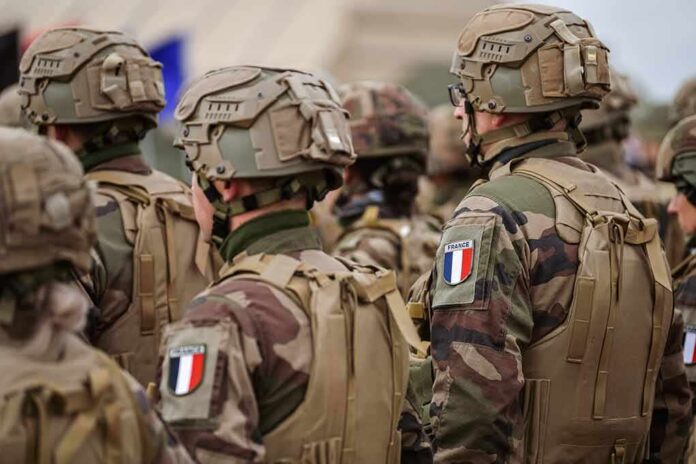
France admitted a small military presence in Ukraine while blasting Russia’s charge of “direct participation,” sharpening a risky gray zone between aid and war.
Story Snapshot
- RFI reported a confidential French mission, “Volia,” inside Ukraine for training and maintenance.
- Paris confirmed a very limited, non-combat presence far from the front, focused on training and equipment.
- Russia’s Sergei Lavrov labeled the French role “direct participation,” without public proof of combat.
- The dispute exposes how secrecy and shifting lines blur support and warfare in Europe.
What Paris Confirmed, And What It Denied
French officials told lawmakers there is a very limited deployment in Ukraine. They said the mission is training and equipment maintenance, with no intent to fight and activity located far from front lines. This came after media reports revealed a quiet French presence. The French account stresses non-combat tasks and small teams. An unnamed source also told reporters that any combat role is excluded. Paris seeks to draw a bright line: assistance, not warfare.
French broadcaster RFI reported that French personnel have operated for months under a confidential effort named “Volia.” The report described training for Ukrainian forces and technical support for complex gear. It said the mission was not a combat operation and that France had not publicly acknowledged it until now. Other outlets echoed that the structure is light and modular, using short-term teams rather than a standing force.
Russia’s Charge Of “Direct Participation”
Russian Foreign Minister Sergei Lavrov argued that the French presence goes beyond support and amounts to direct participation in the war. He said Moscow had raised concerns with Paris. Russian statements so far have not been paired with public evidence that French troops fired weapons or joined battles. The French account, and media reporting, limit the role to training and maintenance functions and exclude combat tasks.
Reporters covering the dispute note a clear gap between presence and fighting. They describe training of Ukrainian personnel, including officers, and upkeep of French-supplied systems. They do not show French units directing strikes or engaging Russian forces. That leaves the core conflict over labels. Russia frames training and advanced maintenance as combat help. France calls it support short of war. The difference matters for risk and for public consent.
Why This Gray Zone Matters For Everyone Else
Western governments have tried to increase aid without entering the war. They have added training, intelligence, and complex weapons while insisting they are not combatants. Analysts call this a step-by-step approach to avoid sudden escalation. Russia often treats those steps as hostile acts. That is why disputes over trainers, technicians, and target data flare up. Each move tests how far support can go before it becomes war, in law and in perception.
Legal scholars point out that supplying and training does not, by itself, make a state a party to the conflict. The line shifts if foreign troops operate weapons, select targets, or command units. The French statements deny all of that. The Russian claim asserts it. Neither side has offered documents in public that settle the question. Secrecy around “Volia” makes independent checks hard, which fuels mistrust on both sides of the debate.
The Hardware Angle: Why Training Looks Like Power
Reports say French teams helped keep modern systems working. These include Caesar howitzers and other high-end gear. Such systems can change the fight if they stay in the field and fire accurately. So a small team with deep skills can have an outsized effect. That is why Moscow tries to brand technicians and instructors as combatants. It is also why Paris stresses distance from the front and the absence of any combat role.
France acknowledged the presence of its troops in Ukraine.
French Minister Delegate for the Armed Forces Alice Roufault stated that French troops are present on Ukrainian territory but are not participating in combat operations.
"Indeed, there is a coordination structure in… pic.twitter.com/X2p3nQ2Apr— ZeRaM.ink base.eth (@i_zeram) November 17, 2026
For citizens across the spectrum, the pattern feels familiar. Leaders push policy from one narrow step to the next, often behind closed doors. Then the public learns after the fact. People on the right see mission creep and fear a wider war. People on the left see secrecy and limited oversight. Both worry that elites blur lines until choices no longer belong to voters. Clear rules, prompt disclosure, and firm limits would help rebuild trust here at home.
Sources:
insiderpaper.com, en.hespress.com, euronews.com, nicematin.com, kyivindependent.com, france24.com, rfi.fr, jen.jiji.com, hromadske.ua