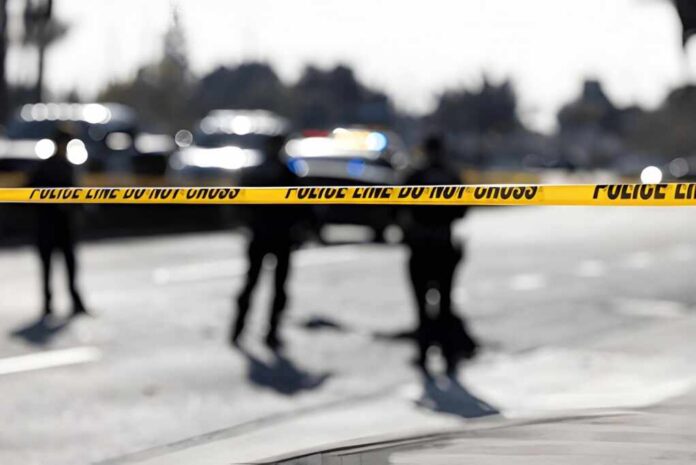
After an Immigration and Customs Enforcement shooting left a man dead in Biddeford, Maine, protests quickly escalated outside Senator Susan Collins’ office, exposing deep anger over federal power and public safety.
Story Snapshot
- State officials confirmed a fatal shooting in Biddeford involving Immigration and Customs Enforcement.
- Protesters gathered at Senator Susan Collins’ office after the shooting, pressing for answers.
- The case echoes a wider pattern of agents firing at drivers during enforcement operations.
- Investigators from state and federal agencies are expected to review what happened.
What Happened in Biddeford
Maine officials said a person was killed Monday morning in a shooting that involved Immigration and Customs Enforcement in Biddeford. The scene was near Pool Street and Hill Street, where roads closed and police responded in force. A state official said the Maine State Police and the Department of Public Safety were gathering details and expected the Federal Bureau of Investigation to review the incident. Authorities had not released the person’s name or full sequence of events by press time.
Local reporting and video from the area showed a heavy emergency response and a large perimeter. A nearby resident reported hearing sirens and gunfire around the time of the incident, matching the police activity window. Officials did not immediately release body camera footage or dashboard camera footage. The absence of official video leaves key questions open, including what led up to the stop, when shots were fired, and what commands were given before the shooting occurred.
Protests and Pressure on Senator Collins
Following the shooting, protesters rallied outside the office of Senator Susan Collins in Maine. Demonstrators demanded transparency and limits on federal immigration raids in the state. The gathering followed weeks of heightened enforcement activity in Maine and mirrored earlier protests after other Immigration and Customs Enforcement shootings in major cities. Senator Collins previously pressed for a pause after backlash to federal operations, signaling the political heat around these tactics.
Protesters from different political backgrounds voiced similar complaints. Some focused on federal overreach and a lack of accountability. Others raised public safety risks when agents fire into moving vehicles. The crowd called for clear evidence, including any video, and for an independent review. The protest highlighted a core point of unity: many believe Washington’s decisions put regular people at risk while leaders dodge blame and avoid straight answers about use of force and oversight.
How This Fits a National Pattern
This case tracks with a national trend in which immigration agents shoot at drivers during arrests. Since last fall, newsrooms have counted multiple shootings tied to vehicle encounters during Immigration and Customs Enforcement operations in different cities. Policing experts warn that shooting at moving cars can endanger bystanders and rarely stops a vehicle. The Department of Homeland Security has often justified these shootings as self-defense, citing drivers who use cars as weapons.
Independent reviews and news investigations have found that agency accounts and video evidence sometimes clash. Reporters have documented cases where cellphone or street cameras raised doubts about the “vehicle as a weapon” narrative. Between 2015 and 2021, at least 59 Immigration and Customs Enforcement shooting inquiries produced no indictments of agents, according to compiled records, fueling claims that internal checks are weak. These patterns intensify calls for clear rules of engagement and independent oversight.
What Investigators Will Look For
State and federal investigators will examine the timing, location, sight lines, and officer positions during the Biddeford shooting. They will seek any body camera, dashboard camera, street camera, and private security video. Forensic teams will map bullet paths and document vehicle damage. Witness statements will be key, including accounts from nearby homes and businesses. A central question will be whether deadly force was reasonable and necessary at the exact moment shots were fired.
🚨 MAINE CHAOS: Anti-ICE Protests Erupt After Shooting Involving Federal Agent While Criminal Migrants Run Wild
Protesters screaming racism as ICE does its job enforcing the law. pic.twitter.com/7rNrc1xBWP
— Gunther Eagleman™ (@GuntherTheEagIe) July 13, 2026
Investigators will also review policy compliance. Many departments warn against shooting at moving vehicles because the tactic often fails to stop a car and can create more danger. If agents said the driver tried to run them over, cameras and measurements must support that claim. If not, pressure will grow for discipline, reforms, or charges. Whatever the findings, the public will expect evidence, not just statements. Trust depends on facts that people can see and test for themselves.
Why This Matters Beyond One City
People on the right and left see a shared problem: leaders in Washington expand force but avoid accountability. Conservatives warn that chaotic street tactics risk bystanders and strain local police. Liberals warn that immigration raids too often spill harm onto families and neighborhoods. Both worry that elites write the rules and face no real checks. The Biddeford shooting will test whether the system can deliver a full and fair accounting, with clear video and clear standards, not another closed loop of blame.
Sources:
twitchy.com, youtube.com, washingtonpost.com, npr.org, thetrace.org, latimes.com, yahoo.com, nbcnews.com