

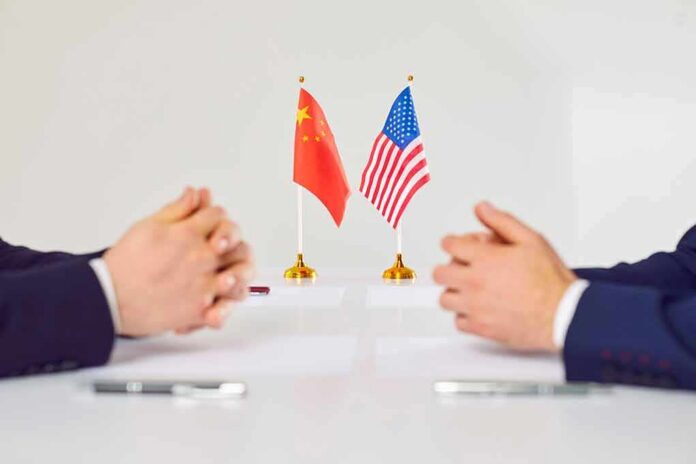
For the first time, the leaders of the United States, China, and Russia are set to sit down together to discuss nuclear issues in China next week, while a possible Trump-Kim contact remains off the official schedule.
Story Highlights
- The White House announced a first-ever three-way meeting among President Trump, Xi Jinping, and Vladimir Putin in China.
- Officials set the session for the Asia-Pacific meetings in Shenzhen, with bilateral talks also planned.
- U.S. officials said the agenda centers on nuclear weapons, with Ukraine not expected on the table.
- Trump has signaled interest in reconnecting with Kim Jong Un, but no meeting is planned on this trip.
White House Confirms Unprecedented Three-Leader Session
White House officials said President Trump will meet China’s Xi Jinping and Russia’s Vladimir Putin in a three-way session in Shenzhen during next week’s Asia-Pacific gatherings. Outlets described it as the first trilateral meeting among the three leaders. The White House timing places the session on the sidelines of the Asia-Pacific Economic Cooperation events, with Trump also expected to meet Xi separately. Officials framed the Shenzhen sit-down as historic for nuclear talks, given the nations’ arsenals.
U.S. officials said the agenda will focus on nuclear weapons, including possible steps on arms control or reduction. Reporting said the scope would likely be general rather than detailed and that Ukraine’s war would not be on the formal agenda. Iran may surface in broader discussion, but the nuclear theme is central. The significance of the meeting lies in putting the three largest nuclear powers in one room, even if the talks do not produce a written agreement on the spot.
Schedule, Setting, and What Is In — and Out
Reports outlined a sequence: Trump travels to Asia, meets Xi, then joins Xi and Putin for the trilateral in Shenzhen around November 19. The Shenzhen venue, tied to Asia-Pacific forums, offers diplomatic cover and a controlled setting. The structure signals a focus on strategic stability rather than a sprawling agenda. Officials suggested Ukraine will not be discussed in depth, which narrows expectations. Nuclear topics remain the anchor, though specifics on verification or treaty formats were not provided.
This approach mirrors a common pattern in leader diplomacy: announcing a meeting and its intent without promising outcomes. Such framing can reset channels and test whether common ground exists. It also lets each capital manage domestic politics. Supporters may see strong leadership and deal-making. Critics may see more show than substance. The real test will be whether the three leaders agree on next steps for talks, technical working groups, or formal statements that move beyond general language.
Trump’s North Korea Track: Open Door, No Trip Stop
President Trump has long kept a line to North Korea’s Kim Jong Un. He met Kim three times in his first term and said in August 2026 that he planned to meet Kim later in the year. Reuters reported that Kim had responded to outreach. Still, U.S. and South Korean officials saw little chance of a meeting in 2026, and there is no confirmed date or venue. For the current Asia trip, officials said there are no plans for a Trump-Kim meeting.
**Trump leaves Washington Monday for Manila then Shenzhen, where the first Trump-Xi-Putin trilateral on nuclear arms control collides with APEC pageantry and fresh midterm bruises.**[[1]](https://t.co/V64L7QylWM)
[Take 11/15 · 𝕏-1]
### 1. The Frame
**What people think this is…— GrumpyNews, emotionally clean news. (@GrumpyNews_) November 16, 2026
That split—clear planning for the trilateral, no scheduled Trump-Kim session—reflects how summit diplomacy works. A stated goal is not the same as a confirmed meeting, and a meeting is not the same as a deal. For readers across the political spectrum, the stakes are plain. Nuclear risks affect everyone. People worry that leaders talk big while problems at home persist. But if this meeting opens a path to safer arsenals or steadier ties, the payoff could be real, even if slow.
Why This Matters for Americans
Americans face real pressures: high living costs, global conflicts, and doubts about whether Washington serves the public. A focused nuclear discussion among the top three nuclear powers speaks to basic safety. Fewer weapons and clearer rules can reduce chances of miscalculation. That does not fix grocery bills or border fights, and it will not end wars tomorrow. Yet preventing a nuclear crisis protects families, savings, and the broader economy from shocks that hit hardest at home.
Sources:
thegatewaypundit.com, seattletimes.com, abcnews.com, reuters.com, rte.ie, en.yna.co.kr, ajupress.com