A sweeping Vatican push to “disarm” artificial intelligence is raising fresh alarms that global elites could use moral language to lock America into dangerous military weakness while our enemies charge ahead.
Story Snapshot
- Pope Leo XIV and the Holy See are urging a global moratorium on lethal autonomous weapons and tighter controls on military artificial intelligence.[1]
- Vatican documents frame artificial intelligence weapons as a grave ethical threat that undermines human responsibility for life-and-death decisions.[1]
- The Holy See links artificial intelligence disarmament with long-standing calls to eliminate even the possession of nuclear weapons.[2][3]
- Conservatives now face the question of how to defend American security and freedom while responding prudently to these high-profile religious appeals.
Pope Leo XIV Moves From Cautious Tech Talk To Direct Artificial Intelligence Disarmament
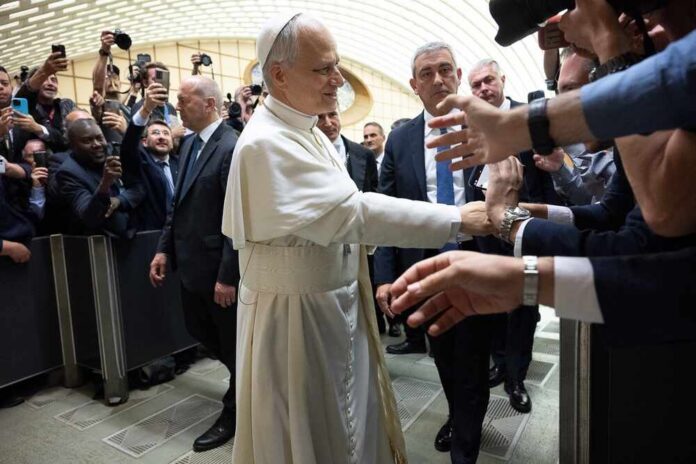
Pope Leo XIV has shifted from general reflections on technology to explicit calls to “disarm” artificial intelligence, especially in warfare, placing the Vatican squarely in the global debate over autonomous weapons.[1] Vatican-aligned reporting describes the Holy See demanding a moratorium on developing and deploying lethal autonomous weapons, arguing such systems lack the uniquely human capacity for moral judgment required in combat decisions.[1] This language builds on earlier papal concerns that rapid artificial intelligence militarization is worsening the tragedy of modern conflicts.[1]
The Dicastery for the Doctrine of the Faith’s note “Antiqua et nova” identifies artificial intelligence used in warfare as a “cause for grave ethical concern,” citing the risk that algorithms, not accountable people, would select and strike targets. Pope Leo’s recent messages on peace warn that military artificial intelligence can erode human responsibility by delegating life-and-death choices to machines.[1] Together these texts are being interpreted as a coordinated Vatican push to halt autonomous weapons development worldwide, not merely to tweak existing rules of engagement.
From Nuclear Disarmament To Artificial Intelligence: A Long Vatican Campaign Against Deterrence
The Holy See’s artificial intelligence stance rests on decades of increasingly categorical opposition to modern weapons, especially nuclear arms. Pope Francis previously declared that not only the use, but even the possession, of nuclear weapons is morally unacceptable, calling them a false source of security and urging total disarmament.[3] Pope Leo XIV continues that line, describing nuclear disarmament as a “moral imperative” and warning that confrontational deterrence logic has come to dominate global politics.
At the United Nations, the Holy See has now explicitly tied artificial intelligence regulation to broader disarmament diplomacy. Archbishop Gabriele Caccia told disarmament forums that nations must recommit to regulating artificial intelligence alongside nuclear disarmament and overcoming the “fallacy” of deterrence.[2] Vatican News summarized the position with the striking headline that outer space and artificial intelligence “must not be weaponized,” underscoring a preference for supranational controls and strengthened international institutions over national military autonomy.[2] For American conservatives, that framing echoes past arms-control pushes that often constrained the United States more than adversarial regimes.
What The Call To ‘Disarm’ Artificial Intelligence Could Mean For U.S. Security
The Vatican’s intervention lands at a moment when authoritarian powers are racing to integrate artificial intelligence into surveillance, cyber operations, and weapons systems, often without meaningful transparency or rule-of-law safeguards. Yet the Holy See’s documents, at least in the public excerpts, offer ethical imperatives rather than concrete mechanisms for verification, enforcement, or reciprocity in any moratorium on lethal autonomous weapons.[1] The evidence provided does not include technical analyses showing that such bans would be operationally feasible or that adversaries would comply.[1]
For a United States led by President Trump and facing hostile regimes, that gap matters. Conservatives who value peace through strength may share the moral intuition that machines must never fully replace human conscience on the battlefield. Still, they must weigh whether sweeping disarmament language, particularly when connected to distrust of nuclear deterrence, could be used in global forums to pressure America into unilateral restraint. The Holy See’s preference for stronger supranational institutions over national sovereignty in security matters will understandably concern those wary of global governance encroaching on constitutional self-government.[2]
Can Ethical Concerns Be Addressed Without Handing Victory To Bad Actors?
Not all Christian voices are calling for blanket restrictions. A Catholic artificial intelligence researcher, Tim Huang of the Institute for a Christian Machine Intelligence, argues that systems should be shaped by moral formation and rigorous technical evaluation rather than broad prohibitions.[1] He describes artificial intelligence models as trainable on human data, including Scripture, and subject to testing, audits, and public data releases that guide their behavior in more ethical directions, though his reported experiments lack fully published methodology.[1]
Pope Leo warns that concentrated AI control lowers conflict thresholds and erodes accountability, calling for international regulation. Geopolitical rivalries remain the obstacle.
— War Intel (@war_intell) May 25, 2026
That more technical approach highlights a potential middle path conservatives may favor: insisting on meaningful, accountable human control over any use of force, demanding transparency from defense contractors, and investing in safeguards that keep decision-making firmly in human hands, while rejecting disarmament schemes that ignore geopolitical realities. The incomplete public record on Pope Leo’s encyclical “Magnifica Humanitas” leaves some ambiguity about how far the Vatican intends to go, and whether its language will be narrowly focused on banning fully autonomous weapons or broadened into a general anti-technology stance.[1]
Sources:
[1] Web – Holy See renews call for moratorium on AI weapons-development
[2] Web – Holy See warns global nuclear disarmament, AI regulation …
[3] Web – Nuclear disarmament now a ‘moral imperative’ as Pope Francis …