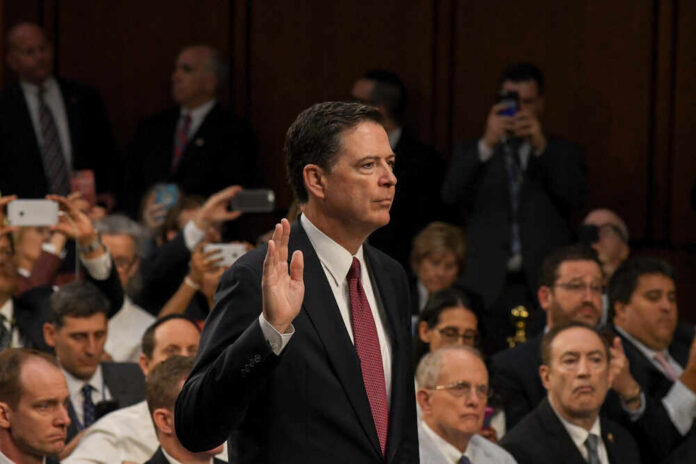
The criminal trial of former FBI Director James Comey over an Instagram “86 47” post about Donald Trump has been pushed deep into the election season, raising fresh questions about how justice works when powerful insiders are in the dock.[1][5]
Story Snapshot
- A federal judge granted Comey a months-long delay, moving trial to October 21 and arraignment to September 30, with no objection from prosecutors.[1][4]
- Comey’s lawyers say they need extra time to file constitutional challenges arguing his “86 47” post was protected political speech, not a true threat.[1][2]
- The Justice Department insists the post constitutes a criminal threat to harm President Trump under two federal threat statutes.[5]
- The drawn-out timing feeds a broader public belief that political elites on all sides play by a different set of rules than ordinary Americans.
What Exactly Just Got Delayed — And Why It Matters
U.S. District Judge Louise Wood Flanagan approved James Comey’s request to postpone his federal trial on charges that he threatened to harm President Donald Trump via a 2025 Instagram post featuring the numbers “86 47” next to a seashell.[1][5] The arraignment was moved from late June to September 30, while the trial was pushed from July to October 21 in New Bern, North Carolina, after prosecutors declined to oppose the delay.[1][4] That timing places a politically explosive case squarely in the late stages of a presidential election year, amplifying concerns that legal calendars are quietly shaped around political interests instead of straightforward justice.[2][6]
According to court filings, Comey’s defense team argued they needed additional time to review discovery and prepare “multiple motions on constitutional grounds,” including challenges to whether the “86 47” image can legally be treated as a criminal threat rather than protected speech.[1][2] Defense lawyers signaled plans to argue that the post was political commentary about making Trump the forty-seventh former president, not an incitement or promise of violence.[1][6] By granting the delay without objection from the government, the court effectively acknowledged the complexity of sorting out where sharp political rhetoric ends and unlawful threats begin in a hyperpolarized era.
How Prosecutors Say a Social Media Post Became a Federal Felony
The Justice Department’s indictment lays out a starkly different narrative, accusing Comey of “knowingly and willfully” making a threat to take the life of, and inflict bodily harm upon, President Trump, in violation of federal law.[5] Prosecutors say that by posting “86 47” on May 15, 2025, in a context they describe as hostile to Trump, Comey sent a message that a reasonable viewer would interpret as a serious expression of intent to harm the sitting president.[5] A second count alleges he transmitted a threatening communication in interstate commerce, arguing he consciously disregarded the substantial risk his post would be seen as threatening violence.[5]
Federal officials emphasize that an indictment is only an accusation and that Comey is presumed innocent unless and until proven guilty, yet they maintain that the evidence supports bringing the case to trial.[5] The Federal Bureau of Investigation is listed as the investigating agency, and a United States Attorney in the Eastern District of North Carolina is leading the prosecution, which carries a potential maximum penalty of ten years in prison if Comey is convicted on the charged counts.[5] For many Americans across the spectrum, the fact that a former FBI director now faces threat charges from the same federal system he once helped run underscores how entangled law enforcement, politics, and personal power have become.[6]
Free Speech, Elite Accountability, and a Justice System Under Suspicion
Legal analysts point out that the heart of the case is not simply whether Comey disliked Trump, but whether his cryptic “86 47” message meets the demanding standard of a “true threat” under the First Amendment.[1][2] Courts must decide if an ordinary viewer, aware of the broader circumstances, would reasonably see his post as a genuine expression of intent to harm, as prosecutors claim, or as symbolic, hyperbolic political speech, as the defense argues.[1][5] That line-drawing exercise is increasingly common in high-profile political prosecutions where a few words or an image trigger sweeping criminal consequences.[6]
🔴 Comey trial on Trump threat charges moved to October
Former FBI Director James Comey's criminal trial was postponed after U.S. District Judge Louise Wood Flanagan granted a delay request on Tuesday. The case centers on a social media post featuring a photo of seashells… pic.twitter.com/X19lZ6ejXq
— NewsTongue (@NewsTongueX) May 26, 2026
For citizens on both the right and the left, the delayed Comey trial feeds a wider anxiety that powerful insiders are treated differently than ordinary people who make ill-advised comments online.[2][6] Conservatives who remember years of aggressive investigations into Trump allies see a former FBI chief now asking for extra time and constitutional protections after posting what prosecutors call a threat against the president he opposed.[1][5] Liberals who distrust Trump’s Justice Department see another politically charged case where speech critical of a president may be stretched into a felony, potentially chilling dissent. Both reactions point to the same underlying worry: a justice system that appears more responsive to politics and status than to equal treatment under the law.
Sources:
[1] Web – The Trial Against James Comey Just Got a Significant Delay
[2] Web – Ex-FBI Director Comey’s trial on Trump threat charge delayed to …
[4] Web – Judge grants James Comey’s request to delay his seashell trial
[5] Web – Prosecution of James Comey – Wikipedia
[6] Web – Comey arraignment set for September, trial in October in New Bern