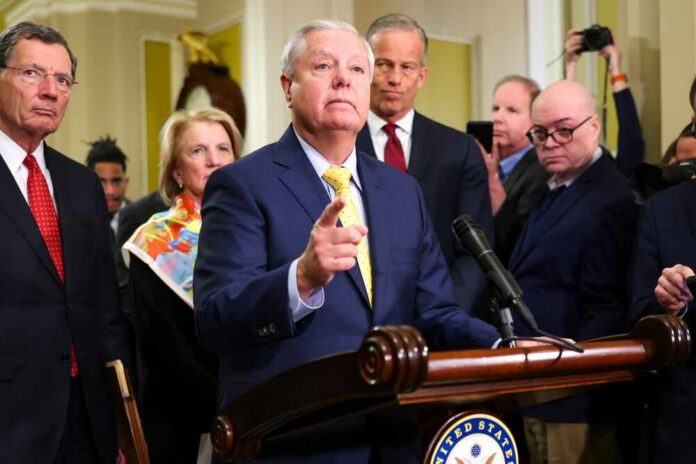
A sudden death has shaken the Senate at the very moment it is supposed to tackle some of the country’s biggest problems, exposing once again how fragile and uncertain Washington’s leadership really is.
Story Snapshot
- Senator Lindsey Graham, a key Republican ally of President Donald Trump, died suddenly at 71 after a reported aortic dissection.
- Preliminary medical findings point to natural heart disease, even as online conspiracy theories claim darker causes without evidence.
- The Senate has returned to Washington with an unsettled agenda and a major hole in Republican leadership.
- Americans on the left and right see Graham’s death as another sign of a government run by elites that feels distant from everyday struggles.
A Sudden Death and an Unfinished Medical Picture
Senator Lindsey Graham, a long-serving Republican from South Carolina and close ally of President Donald Trump, died Saturday night after what his office called a “brief and sudden illness.” His staff said he passed away at his Washington home at age 71, only a day after returning from an official trip to Ukraine. Emergency responders reported treating a man in cardiac arrest at his residence before transporting him to George Washington University Hospital.
The Office of the Chief Medical Examiner for the District of Columbia released preliminary findings that Graham suffered an aortic dissection caused by arteriosclerotic cardiovascular disease, a rupture of the main artery due to long-term hardening of the arteries. His office echoed that language in its public statement. Officials emphasized that the death certificate remains pending while toxicology and microscopic tests continue, meaning the medical review is not yet fully complete.
Tributes, Power Gaps, and a Senate in Flux
President Trump responded quickly, calling Graham “one of the greatest people and Senators I have ever known” and a “true American Patriot.” South Carolina Governor Henry McMaster praised him as “the fiercest of fighters for South Carolina and America,” and said the state “shall not see his likes again.” Leaders from both parties offered condolences, highlighting his long influence on foreign policy and national security debates in Congress.
Under South Carolina law, Governor McMaster will appoint a temporary replacement to hold Graham’s seat until early January, when voters will choose a permanent successor. This gives the governor and state party leaders unusual power at a time when Republicans already control both chambers of Congress and the White House. Many citizens who feel sidelined by party insiders see this kind of appointment as one more example of elites making key decisions without direct voter say, even though the process follows state law.
Conspiracy Theories, Misinformation, and Fading Trust
Despite the medical examiner’s statement pointing to natural causes, social media has filled with claims that Graham was poisoned or targeted because of his recent trip to Ukraine, yet none of these posts offer hard evidence or expert backing. This pattern matches research showing that news tied to death often triggers strong emotions and encourages people to share stories, no matter if those stories are true or false. When emotions run high, rumors can spread much faster than verified information.
Senate convenes after death of Senator Lindsey Graham https://t.co/uacgCt5luG
— Reuters (@Reuters) July 13, 2026
Studies of online behavior have found that people who knowingly share false political information are more likely to support extremist groups, which use shocking claims to gain attention and followers. At the same time, surveys show Americans’ trust in national news has fallen sharply, with many adults now saying they have little or no trust in major outlets. For citizens who already believe the “deep state” protects itself, the mix of confusing medical terms, a pending death certificate, and guarded official statements feels like more proof that the full truth is always kept out of reach.
What Graham’s Death Reveals About Washington’s Disconnect
Graham’s death comes as the Senate returns to Washington facing a full slate of fights over spending, immigration, energy, and foreign policy. Many conservatives blame years of “woke” agendas, globalism, and overspending for high prices and weak borders. Many liberals blame “America First” policies, cuts to social programs, and what they see as discrimination for a growing gap between rich and poor. Both sides increasingly agree that the federal government is failing to solve problems that block the basic American Dream.
The sudden loss of a senior senator underscores how much power is concentrated in a small group of aging lawmakers, party leaders, and donors. When one of them dies, the system scrambles to adjust, but everyday Americans still struggle with rising costs, unstable jobs, and failing public services. Research shows that after a public figure’s death, mentions of that person spike thousands of percent in the news and on social media, then fade quickly. For many citizens, that surge feels like a media circus that rarely leads to deeper change.
Honoring Service While Demanding Accountability
Graham’s allies, including foreign leaders in Ukraine and Israel, praised him as a defender of freedom and a strong supporter of U.S. engagement overseas. His decades in Congress shaped war debates, judicial nominations, and budget talks. Yet his sudden passing has also stirred anger among people who feel both parties have ignored working families while protecting corporate interests and permanent bureaucrats. Some see every Washington tragedy as proof that the system serves itself first.
For citizens who are tired of spin, two things can be true at once. Graham’s long public service and unexpected death deserve respect and careful reporting based on medical facts. At the same time, the way the government handles leadership gaps, medical transparency, and public communication either rebuilds trust or deepens doubt. As the Senate returns to work, many Americans will watch not only how it honors Graham, but whether it finally tackles the hard issues that have pushed faith in the government and the media to historic lows.
Sources:
facebook.com, youtube.com, wjla.com, x.com, instagram.com, abc7ny.com, krcrtv.com, townhall.com, journals.sagepub.com, egap.org, pewresearch.org, misinforeview.hks.harvard.edu