Less than 24 hours after declaring the U.S. the “Guardian of the Hormuz Strait” and demanding a 20% fee on all cargo, President Trump reversed course — and the Gulf states he wanted to charge had a lot to do with it.
Story Snapshot
- Trump announced Monday that the U.S. would charge a 20% fee on all cargo moving through the Strait of Hormuz as payment for American military protection.
- By Tuesday, Trump reversed the plan, saying Gulf nation investments would replace the proposed fee.
- The fast reversal came after Gulf leaders pushed back — and after his own Secretary of State had said such fees violate international law.
- No enforcement plan was ever announced, and prediction markets gave the fee only a 15% chance of actually taking effect.
Trump’s Big Hormuz Announcement
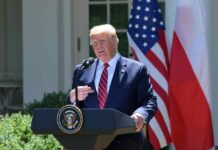
On Monday, July 13, 2026, President Trump posted on Truth Social that the U.S. would become “THE GUARDIAN OF THE HORMUZ STRAIT.” He declared that all cargo shipped through the strait would be charged a 20% fee as payment for American military protection. Trump also said the U.S. was reinstating what he called an “Iranian blockade,” stopping only Iranian ships from using the waterway while leaving it open to all other nations.
Trump was direct about his reasoning. “I want to be reimbursed because we’re protecting a VERY rich portion of the world,” he wrote. He named Saudi Arabia, the United Arab Emirates, Qatar, Bahrain, and Kuwait as countries that benefit from U.S. military protection in the region. The announcement sent oil prices higher as global markets reacted to the uncertainty over one of the world’s most critical shipping lanes.
The Reversal Comes Fast
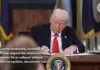
By Tuesday, Trump was already walking it back. Speaking from the Oval Office, he said Gulf nations had come up with a better idea — large investments that would replace the need for a transit fee. He framed the shift as a win, saying the investments would more than cover what the fee would have brought in. The reversal came just one day after the original announcement, making it one of the quickest policy U-turns of his second term.
The fast retreat was not surprising to many observers. Trump himself had acknowledged there was “zero support among the Gulf countries for any sort of toll or fees.” Gulf leaders made clear they were not willing to pay a transit charge. Prediction markets had already placed only a 15% chance on the fee actually being imposed by July 31. No enforcement plan, collection system, or legal framework was ever announced to back up the original proposal.
A Policy Already in Conflict With Itself
The 20% fee idea ran into problems from the start — including from inside Trump’s own administration. Just weeks earlier, Secretary of State Marco Rubio had stated clearly: “No country is allowed to charge tolls or fees on an international waterway. That’s existing international law.” The International Maritime Organization (IMO) also reaffirmed that no legal basis exists for mandatory tolls on ships passing through an international strait.
Trump Says Gulf Investments Will Replace Strait of Hormuz Fees
President Trump on Tuesday backtracked on plans to charge ships for using the Strait of Hormuz, saying Gulf countries would instead invest in the United States.
“Based on highly productive conversations with Middle…
— NTD (@NTD_Live) July 14, 2026
The contradiction went even deeper. In June 2026, Trump had praised Iran for assuring the U.S. there would be “NO TOLLS, NO INSURANCE COSTS, and NO OTHER CHARGES” on the strait. Legal experts point out that only man-made waterways — like the Suez and Panama canals — are permitted under international law to charge transit fees. Natural straits like Hormuz are governed by United Nations Convention on the Law of the Sea (UNCLOS) transit passage rules, which ban mandatory tolls. South Korea’s shipping industry estimated the 20% fee could have cost its economy the equivalent of roughly $12.5 billion.
What This Means for the Bigger Picture
The Strait of Hormuz handles roughly 20% of the world’s oil supply. Control of that waterway has been a flashpoint since U.S. and Israeli military action pushed Iran to shut it down earlier in 2026. Iran and Oman have been negotiating their own “maritime service fee” framework, framed as voluntary administrative charges rather than mandatory tolls — a distinction designed to sidestep international law objections. European nations have signaled they now view some form of fee as unavoidable.
For Americans watching from home, the episode raises familiar questions. A major policy was announced with no legal backing, no enforcement plan, and no allied support — then quietly dropped the next day. Whether the Gulf investment deal Trump cited will actually materialize remains unclear. What is clear is that the world’s most important oil shipping lane is still contested territory, and the rules governing it are being tested in real time.
Sources:
youtube.com, indiatoday.in, energynewsbeat.co, english.elpais.com, theweek.in, facebook.com