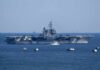
Ship traffic through the Strait of Hormuz has collapsed by more than 94% since conflict began — and now the U.S. military is resuming a port blockade that could push global oil markets into crisis.
Story Snapshot
- The U.S. military is resuming its blockade of Iranian ports, cutting off one of the world’s most critical oil shipping lanes.
- Ship traffic through the Strait of Hormuz has fallen more than 94% since the conflict began, down from roughly 138 vessels per day to just three.
- Iran’s Islamic Revolutionary Guard Corps is warning ships they must get permission before crossing — or face attack.
- Over 800 ships remain stranded in the Gulf, and oil prices have already jumped more than 3% on the renewed threat.
A Waterway the World Depends On
The Strait of Hormuz is a narrow passage between Iran and Oman. About 20% of the world’s oil flows through it. Before the current conflict, roughly 138 ships passed through every day. That number has now fallen to around three per day, according to the UK Maritime Trade Operations Center. Maritime data firm Argus Media puts the overall traffic drop at 94%. For everyday Americans, that means higher gas prices and more expensive goods — the kind of squeeze that hits working families hardest.
The disruption did not happen overnight. Attacks on vessels began in early 2026, and by late February, tanker traffic had already come to a near standstill. Data firm Kpler tracked only 279 ship crossings between February 28 and April 12 — a stretch that would have seen roughly 5,600 crossings at pre-conflict rates. More than 800 ships are now anchored outside the strait, unable to reach their destinations.
Two Sides, One Chokepoint
The U.S. military says the strait remains open for transit. After a ceasefire agreement on April 8, maritime intelligence firm Kpler counted 172 ships crossing, including 42 on a single Saturday. Following a follow-up agreement on June 17, data firm AXSMarine recorded 25 commercial vessels crossing in one day — the highest volume since April. U.S. Central Command confirmed the strait was passable despite Iran’s closure declaration.
Iran tells a different story. The Islamic Revolutionary Guard Corps issued recorded English-language warnings to ships in the Persian Gulf, stating that vessels deviating from its designated route — a narrow corridor along the Iranian coast near Larak Island — “will be targeted.” Iran also forced six of its own oil tankers to turn back when the U.S. blockade blocked their path. The Guard Corps says any ship that does not get prior approval is in danger. Both sides claim to be protecting safe passage. Neither fully controls the outcome.
What the Blockade Means for You
The U.S. blockade order, first issued on April 10, bars vessels from entering Iranian ports. With it back in effect, shipping companies face a difficult choice: seek Iran’s permission and risk U.S. enforcement, or follow U.S. rules and risk Iranian attack. Either way, the cost gets passed on to consumers. Oil futures jumped more than 3% when markets opened on July 13 as news of renewed tensions spread. That kind of spike ripples through fuel, food, and manufacturing costs across the country.
🚢 Strait of Hormuz vessel traffic drops over 50% amid renewed attacks
📍 Commercial crossings fall about 52% between July 10 and 12 near strategic waterway, as ships shift to perceived safer routes, MarineTraffic says
— Markets Today (@marketsday) July 13, 2026
For Americans already frustrated by years of inflation and energy costs driven up by policy decisions made in Washington, this is another reminder of how distant conflicts create real pain at home. The Strait of Hormuz is not just a foreign policy problem — it is a gas pump problem, a grocery bill problem, and a “why does everything cost so much” problem. Both the U.S. and Iran are making decisions that affect millions of ordinary people who have no say in the matter and no easy way out.
Sources:
hormuzstraitmonitor.com, hormuztracking.com, statista.com, bbc.com, reuters.com, nytimes.com, gulfnews.com